

-
ceo.bfi@gmail.com
Send Email
-
2C, C-6/A Block, Janakpuri, Delhi India 110058
Visit Our Office
99902-92279
Confidentiality Guaranteed
99902-92279
Confidentiality Guaranteed
17
Oct

Oct
Graphology: Meaning, Handwriting Analysis, Science & Forensic Uses
Introduction: What Is Graphology?
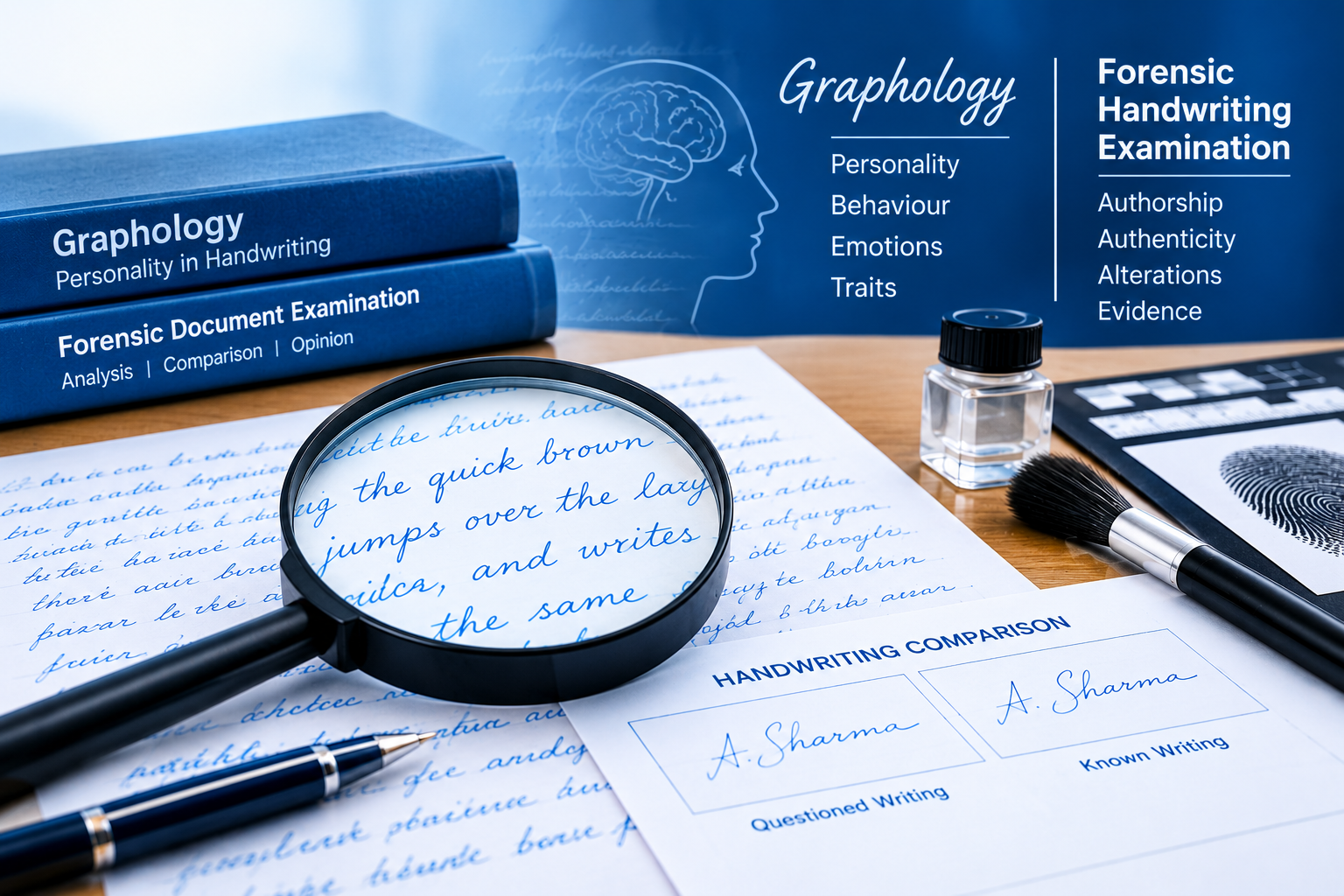
Graphology is the practice of interpreting a person’s personality traits, behavioural tendencies, or emotional characteristics through the analysis of handwriting. Graphologists may examine features such as letter size, slant, spacing, pressure, and the overall arrangement of written text to develop interpretations about the writer. Graphology is often associated with personality assessment and self-understanding. However, it is essential to distinguish it from forensic handwriting examination, which focuses on determining the authorship, authenticity, or possible alteration of handwritten documents. Although both fields examine handwriting, their objectives, methods, and scientific foundations are significantly different. Understanding this distinction is particularly important in modern forensic investigation, where reliable evidence, validated methods, and objective interpretation are essential.
The History and Evolution of Graphology
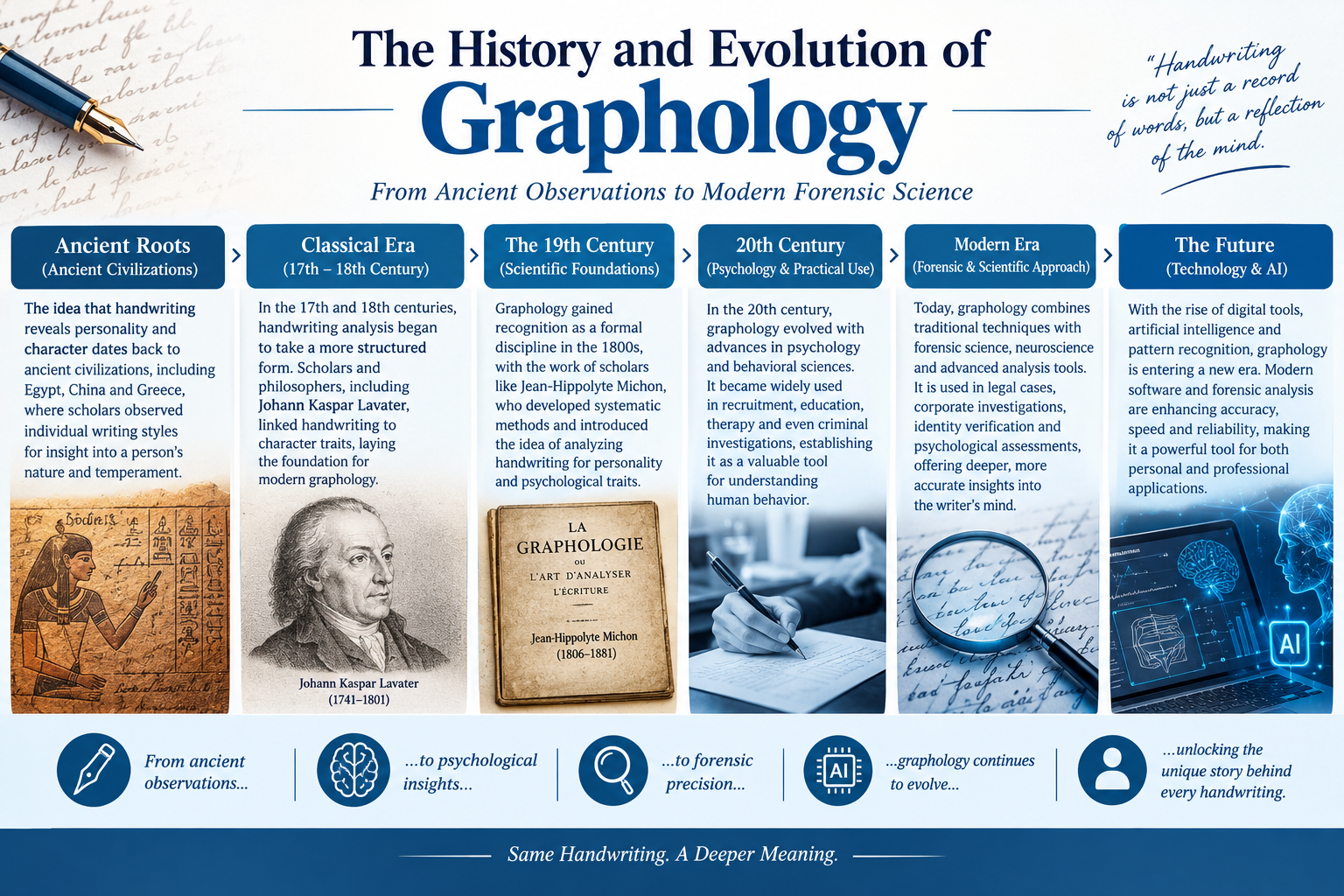
The interest in interpreting personality through handwriting dates back several centuries. Early observers believed that an individual’s writing style might reflect aspects of their temperament, habits, or character.
During the seventeenth century, some European scholars began documenting similarities between handwriting characteristics and perceived personal qualities. In the nineteenth century, graphology developed more systematically, particularly in Europe. French priest Jean-Hippolyte Michon is widely associated with the development and popularisation of modern graphology during this period.
Later, researchers and practitioners developed different systems for interpreting handwriting characteristics. These systems attempted to associate specific writing features with qualities such as confidence, emotional sensitivity, discipline, sociability, and decision-making tendencies.
With the development of psychology and behavioural sciences, handwriting also became a subject of broader scientific investigation. Researchers began examining the relationship between motor activity, cognition, neurological functioning, and written expression.
Graphology vs. Forensic Handwriting Examination: Understanding the Difference
One of the most important aspects of understanding graphology is distinguishing it from forensic document examination.
Graphology attempts to interpret personality through handwriting, whereas forensic handwriting examination evaluates handwriting as potential evidence in an investigation.
Forensic document examiners examine individual writing characteristics, including letter formation, connecting strokes, proportions, spacing, line quality, writing rhythm, pen lifts, and natural variations. They compare questioned writing with suitable known writing samples to assess whether the similarities and differences support common authorship or indicate different writers.
The examination may also consider whether a signature is genuine, whether a document contains suspicious alterations, or whether handwriting characteristics are consistent with a particular writer’s known samples.
Unlike graphology, forensic handwriting examination is not intended to determine whether someone is honest, aggressive, intelligent, trustworthy, or criminal based on the appearance of their handwriting.
Key Handwriting Features Examined in Graphology
Graphologists commonly study several visible characteristics of handwriting. These features form the basis of their interpretations, although the personality meanings assigned to them should not be treated as scientifically established facts.
1. Letter Size
Letter size refers to the relative height and width of handwritten letters. In graphological traditions, larger handwriting is sometimes associated with expressiveness or a desire for attention, while smaller handwriting may be interpreted as a sign of concentration or reserved behaviour.
However, letter size can also be influenced by writing speed, available space, educational background, visual ability, the writing instrument, and the type of paper being used. Consequently, letter size alone cannot reliably establish a person’s personality.
2. Slant of Handwriting
Slant describes the direction in which letters lean. Writing may appear right-slanted, left-slanted, or relatively upright.
Some graphologists associate a rightward slant with emotional expressiveness, a leftward slant with reserve, and upright writing with emotional control or independence.
These interpretations are traditional graphological assumptions rather than dependable psychological conclusions. Handwriting slant can vary with posture, writing conditions, motor habits, and the writer’s natural style.
3. Pen Pressure
Pen pressure refers to the force applied while writing. Heavier pressure may produce darker strokes or indentations on the paper, whereas lighter pressure may create finer marks.
Graphologists sometimes interpret heavy pressure as an indication of determination or intensity and light pressure as a sign of sensitivity or adaptability.
In a scientific examination, however, pressure-related features must be considered in context. The writing instrument, paper surface, physical condition, writing speed, and individual motor habits can all affect the appearance of strokes. Pressure patterns should not be used independently to infer personality or emotional stability.
4. Spacing Between Words and Letters
Spacing refers to the distances between letters, words, and lines. Graphological approaches sometimes associate wider word spacing with independence and narrower spacing with sociability or a preference for closeness.
Nevertheless, spacing is affected by writing habits, page layout, language, writing speed, and the amount of space available. Such features may be described objectively, but their interpretation as indicators of specific personality traits remains unproven.
5. Baseline and Line Direction
The baseline is the imaginary line along which handwriting progresses. Handwriting may remain relatively level, rise gradually, or descend across the page.
Some graphologists interpret an ascending baseline as optimism and a descending baseline as low motivation or sadness.
These conclusions are not reliable psychological diagnoses. Paper positioning, posture, fatigue, writing surface, physical discomfort, and the writer’s habitual movement can influence line direction.
6. Letter Formation and Connections
Graphologists may examine the shapes of individual letters, the connections between letters, loops, curves, and the overall flow of writing.
Different graphological systems assign various meanings to these features. However, there is no established universal rule that allows a specific letter shape or connecting stroke to reveal a particular personality characteristic.
In forensic handwriting examination, by contrast, letter formation and connecting strokes may be important comparison features when assessed alongside other characteristics and appropriate reference samples.
Is Graphology Scientifically Proven?
The scientific validity of graphology is an important question, particularly when its conclusions are used to assess individuals or make consequential decisions.
Although graphologists may offer detailed interpretations of handwriting, research has not established that graphology can consistently and accurately identify personality traits beyond what would be expected from chance or other sources of information in a dependable, generalisable way.
Handwriting is influenced by multiple factors, including learned motor patterns, education, language, physical conditions, writing instruments, and situational circumstances. A visible handwriting characteristic may have several possible explanations, making it difficult to assign one specific psychological meaning to it.
A person who writes with heavy pressure, for example, cannot automatically be classified as aggressive, determined, or emotionally intense. Likewise, irregular handwriting does not necessarily indicate instability, dishonesty, or poor self-control.
For reliable personality assessment, psychologists generally rely on appropriately validated assessment instruments, structured interviews, behavioural observations, and other evidence suitable for the purpose.
Graphology may be explored as a cultural practice or a subject of personal interest, but its interpretations should not be presented as established psychological facts.
Graphology and Psychology: What Is the Connection?
Graphology is frequently associated with psychology because both fields concern human behaviour and individual differences. However, an association between two subjects does not establish that the methods used in one are scientifically valid.
Psychology studies behaviour and mental processes through systematic research, theory development, observation, and validated measurement. Depending on the assessment, psychological professionals may use standardised questionnaires, cognitive tests, clinical interviews, and structured behavioural evaluations.
Graphology, on the other hand, generally relies on interpretive rules linking handwriting characteristics to personality traits. These rules have not demonstrated the level of consistent predictive validity expected of established psychological assessment methods.
Handwriting itself is relevant to psychology and neuroscience because writing involves complex motor control, attention, memory, and learned behaviour. Changes in handwriting may sometimes be associated with neurological or physical conditions, but identifying a medical condition requires appropriate clinical evaluation rather than graphological interpretation.
Applications of Graphology in Modern Society
Graphology is used in certain settings, although its applications must be evaluated in light of its scientific limitations.
Personal Development and Self-Reflection
Some individuals explore graphology to reflect on their habits, communication styles, or perceived personal strengths. When used informally, it may serve as a conversation starter or a framework for self-reflection.
However, interpretations should not be treated as definitive descriptions of personality. Self-understanding is better supported by careful reflection, feedback, observed behaviour, and evidence-based psychological tools.
Recruitment and Human Resource Management
Graphology has historically been used by some organisations in recruitment and personnel assessment. Employers may attempt to infer qualities such as leadership, confidence, reliability, or suitability for a role from handwriting samples.
However, graphology is not a scientifically established method for reliably predicting job performance. Employment decisions should instead be based on job-related qualifications, structured interviews, relevant skills assessments, experience, and validated selection procedures.
Using handwriting-based personality assumptions as a decisive recruitment criterion risks unfair or inaccurate judgements.
Education and Career Guidance
Some practitioners use graphological interpretations to discuss perceived learning preferences or personal tendencies. Nevertheless, handwriting alone cannot reliably determine a student’s intelligence, academic potential, career suitability, or learning ability. Educational and career guidance should be informed by a person’s interests, performance, abilities, goals, and appropriately validated assessments.
Counselling and Personal Consultations
Graphology may appear in informal personal consultations, where handwriting is used as a starting point for discussion. It should not replace professional psychological assessment, mental health care, or evidence-based counselling.
Practitioners should avoid diagnosing mental health conditions or making consequential recommendations solely on the basis of handwriting interpretations.
Graphology, Signature Analysis, and Forgery Detection
Graphology is sometimes confused with signature verification because both may involve the examination of handwritten features. Their objectives, however, are different.
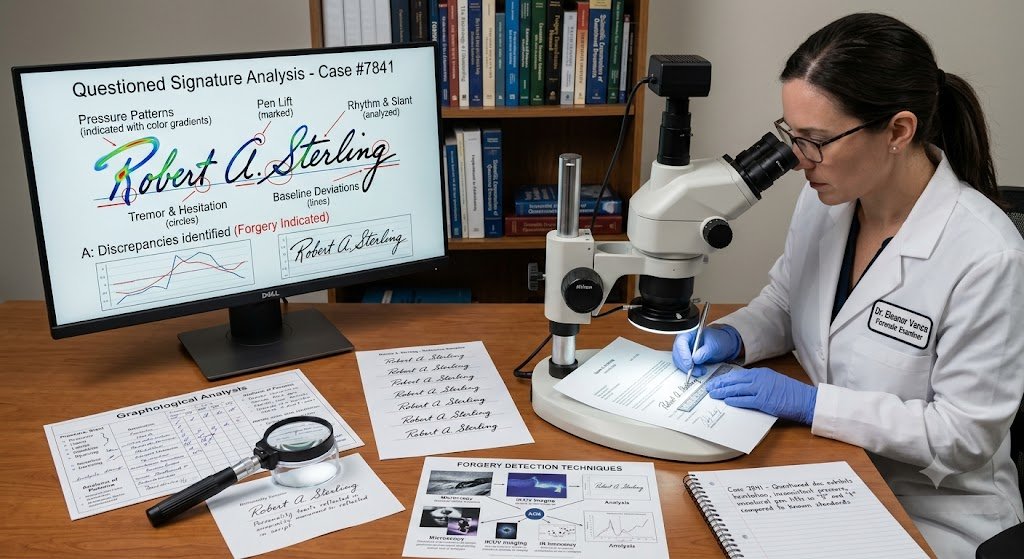
A graphologist may interpret the appearance of a signature as a reflection of personality. A forensic document examiner investigates whether the signature is genuine, potentially simulated, traced, disguised, or otherwise inconsistent with the purported signer’s known writing.
A proper signature examination may consider line quality, movement patterns, stroke sequence where assessable, proportions, spacing, pen lifts, beginning and ending strokes, natural variation, and similarities or differences across comparable samples.
A signature should not be declared genuine or forged merely because it looks attractive, unusual, bold, small, or inconsistent with a graphologist’s expectations. Genuine signatures naturally vary, and skilled simulations may reproduce some visible features while failing to reproduce others.
Where a signature is disputed in a legal or financial matter, the examination should be conducted through a suitable forensic document examination process, with appropriate reference samples and transparent reporting.
Limitations, Ethical Concerns, and Common Misconceptions
The popularity of graphology has contributed to several misconceptions that require clarification.
First, handwriting cannot reliably establish whether a person is honest, dishonest, violent, intelligent, emotionally unstable, or likely to commit a crime. Such conclusions require evidence appropriate to the specific question and cannot be justified by isolated handwriting features.
Second, handwriting is not a fixed expression of personality. Its appearance can change because of writing conditions, physical discomfort, fatigue, the writing surface, the instrument used, or deliberate attempts to alter one’s writing style.
Third, graphology should not be confused with medical or psychological diagnosis. A handwriting sample is not a substitute for clinical assessment, and unusual writing does not automatically indicate a neurological or psychological disorder.
Finally, graphological interpretations can create ethical concerns when used in employment, education, legal disputes, or other situations where inaccurate assumptions may affect a person’s rights or opportunities.
Responsible practitioners should explain the limitations of their methods, avoid unsupported claims, protect the privacy of handwriting samples, and distinguish subjective interpretation from scientifically supported findings.
The Future of Handwriting Analysis: Digital Tools and Forensic Technology
Advances in digital technology are changing how handwriting can be documented, compared, and examined.
High-resolution imaging, digital microscopy, specialised image-processing tools, and computer-assisted comparison systems can help forensic professionals inspect details that may be difficult to assess with the unaided eye. In some settings, electronic signature systems also record dynamic information such as writing speed, pen pressure, stroke timing, and movement trajectories.
These technologies can support the examination process, but their results must be interpreted appropriately. Digital enhancement cannot recover information that was never captured, and automated similarity scores do not independently prove authorship.
It is equally important to distinguish between static handwriting images and dynamic handwriting data. A scanned signature may preserve visible stroke characteristics but ordinarily does not contain the complete movement information recorded by a suitable digital signing device.
Future developments in artificial intelligence and pattern recognition may improve certain aspects of handwriting comparison. However, reliable implementation requires appropriate validation, representative data, transparent limitations, and expert oversight.
Technology can strengthen a forensic examination when used correctly, but it does not remove the need for scientific reasoning, quality assurance, and cautious interpretation.
Conclusion: Understanding Graphology in the Right Context
Graphology remains an interesting subject because handwriting is a distinctive form of human expression that combines learned habits, motor coordination, and individual variation. Its traditional interpretations of letter size, slant, spacing, pressure, and baseline continue to attract curiosity.
Nevertheless, the ability to infer personality accurately from handwriting has not been established to the standard required for dependable scientific assessment. Graphological interpretations should therefore be approached as unvalidated personality claims rather than objective psychological evidence.
Forensic handwriting examination serves a different and more evidence-focused purpose. It evaluates questioned writing, signatures, and documents through systematic comparison, relevant technical methods, and appropriately qualified conclusions.
For anyone interested in handwriting, understanding the distinction between graphology and forensic document examination is essential. It encourages informed interpretation, discourages unsupported assumptions, and promotes the responsible use of handwriting evidence in legal, professional, and investigative settings.
Recent Posts
- Graphology: Meaning, Handwriting Analysis, Science & Forensic Uses
- The Psychology of Criminal Behaviour: Understanding the Mind Behind Crime
- Legal Rights of Protesters at Jantar Mantar, Delhi: What Every Citizen Should Know
- Polygraph Test in India
- What is Forensic Science? Intoduction, History, Branches & Role of forensic science
Archives
Categories
Recent Posts


Popular Tags
Automated fingerprint identification system (2)
Ballistics (2)
Business due diligence (2)
Case Study (2)
Celebrity Freedom of Expression (1)
Computer forensics (2)
Computer vision AI (2)
Court-Admissible Evidence (2)
Crime Scene Documentation (2)
Crime scene investigation (12)
CrimeSceneInvestigation (2)
CriminalInvestigation (2)
cybercrime investigation (2)
deepfake detection (2)
Digital evidence recovery (2)
digital forensics (4)
DNA Evidence (2)
DNA Fingerprinting (2)
DNA Profiling (4)
Expert Witness Services (2)
forensic ballistic (2)
Forensic Biology (2)
Forensic Case Review (2)
Forensic DNA Analysis (7)
Forensic Document Examination (2)
Forensic evidence analysis (10)
Forensic Examination (2)
Forensic fingerprint analysis (2)
forensic handwriting analysis (2)
Forensic investigation (10)
Forensic Photography (3)
forensic science (8)
ForensicScience (6)
Forensic Video Examination (2)
Forgery Detection (2)
handwriting analysis (5)
MicroscopicEvidence (2)
Network forensics (2)
Photo Forensic Analysis (2)
Questioned Document Analysis (2)
Questioned Document Examination (2)
Ranveer Singh Case (1)
Risk assessment services (2)
signature verification (4)
video forensics (2)