

-
ceo.bfi@gmail.com
Send Email
-
2C, C-6/A Block, Janakpuri, Delhi India 110058
Visit Our Office
99902-92279
Confidentiality Guaranteed
99902-92279
Confidentiality Guaranteed
19
Aug

Aug
Jessica lal murder case study
The Jessica Lal Murder Case Study is one of the most prominent criminal cases in India and is widely discussed for its significance in criminal investigation, forensic evidence, eyewitness testimony, prosecution, and judicial review. Jessica Lal was a model who was working as a celebrity barmaid at a crowded social gathering in New Delhi on the night of 29–30 April 1999. During the early hours of 30 April 1999, she was fatally shot following an altercation at the party.
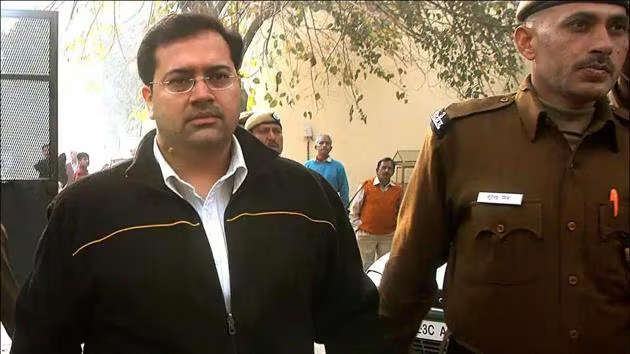
The prosecution identified Siddharth Vashisht, popularly known as Manu Sharma, as the person responsible for the shooting. The case attracted enormous public and media attention because of the large number of people present at the gathering, the eyewitness accounts, the firearm-related evidence, and the subsequent legal proceedings.
The initial trial ended with the acquittal of Manu Sharma, which generated widespread public criticism. The prosecution appealed the decision, and the Delhi High Court subsequently reconsidered the evidence and overturned the acquittal. Manu Sharma was convicted of murder and sentenced to life imprisonment on 20 December 2006.
From a forensic perspective, the Jessica Lal case provides an important opportunity to understand how crime-scene investigation, ballistic evidence, medical and post-mortem findings, witness statements, physical evidence, and other corroborative evidence can contribute to the investigation and reconstruction of a homicide. The case also demonstrates the importance of proper evidence collection, preservation, examination, and presentation during criminal proceedings.
Overall, the Jessica Lal murder case is not only a significant case in India’s legal history but also an important forensic case study for understanding the investigation of firearm-related homicide and the role of scientific evidence in the justice system.
The Night of the Murder
After midnight, Manu Sharma arrived at the party with three associates and asked to be served alcohol. He reportedly offered ₹1,000 for a drink, but Jessica refused because the bar had stopped serving liquor. Manu Sharma then allegedly fired a .22-calibre pistol toward the ceiling, apparently to intimidate her. When Jessica continued to refuse his request, Manu Sharma allegedly fired another shot, striking her in the head and causing her death.
The shooting created confusion and panic at the venue. During the ensuing disturbance, Manu Sharma and his associates—Amardeep Singh Gill, Vikas Yadav and Alok Khanna—left the scene. The incident subsequently became the subject of a major police investigation and criminal prosecution.
Arrests and Early Investigation
Following the shooting, the police began searching for the individuals suspected of involvement in the case. Manu Sharma initially evaded the police, while his associates Alok Khanna and Amardeep Singh Gill were arrested on 4 May 1999. Manu Sharma was subsequently arrested on 6 May 1999.
The alleged murder weapon, a .22-calibre pistol, was not recovered during the initial investigation. Investigators suspected that the weapon had been handed over to another person and may have subsequently been taken outside India.
On 8 May 1999, Amit Jhingan, who was alleged to be associated with Manu Sharma, was arrested and faced allegations relating to the removal or concealment of evidence, including the firearm.
Another individual associated with the case, Vikas Yadav, remained outside police custody for a period and later appeared before the Delhi Police on 19 May 1999 after obtaining anticipatory bail. He acknowledged that Manu Sharma had stayed with him on the night of the incident but denied being present at the venue when Jessica Lal was shot.
The arrests and investigation attracted considerable attention because several individuals connected with the case came from politically or socially prominent backgrounds. The police investigation subsequently focused on establishing the roles of the accused and associates, locating the missing firearm, and determining whether any evidence had been concealed or destroyed.
Trial Proceedings and Initial Acquittal
Several other individuals were also named in the proceedings, including Shyam Sunder Sharma, Amit Jhingan, Yograj Singh, Harvinder Chopra, Vikas Gill and Raja Chopra. Some accused persons were either subsequently discharged or had not been apprehended at that stage.
Acquittal of the Accused
After nearly seven years of proceedings, the trial court delivered its judgment on 21 February 2006. Of the twelve accused originally facing proceedings, nine were acquitted, including Manu Sharma. Amit Jhingan had already been discharged, while Ravinder Kishan Sudan and Dhanraj remained at large.
A major difficulty for the prosecution was that 32 prosecution witnesses were declared hostile during the trial. Several important witnesses, including Shayan Munshi, Andleeb Sehgal, Karan Rajput and Shiv Lal Yadav, did not support the prosecution’s case in the manner expected. Two ballistic experts, Roop Singh and Prem Sagar, also provided evidence that did not support the prosecution’s earlier position regarding the firearm evidence.
The issue of hostile witnesses later became significant in its own right. In February 2011, proceedings were announced against the 32 witnesses on allegations of perjury, relating to inconsistencies between their earlier statements and testimony given during the trial.
High Court Appeal, Reassessment of Evidence and Conviction
After the trial court acquitted Manu Sharma and several other accused in February 2006, the Delhi Police appealed the decision before the Delhi High Court. On 22 March 2006, the High Court issued warrants against the accused who had faced the original trial. Most of them were subsequently granted bail, subject to conditions including restrictions on international travel.
Allegations Concerning Witnesses
The case took another significant turn in September 2006, when a sting operation conducted by Tehelka was broadcast on television. The operation contained allegations that some witnesses had been offered money, pressured or otherwise influenced to change their earlier statements.
The allegations attracted considerable public and political attention. Venod Sharma, the father of Manu Sharma and a prominent political figure in Haryana, was named in the investigation as being allegedly involved in payments made to certain witnesses. Following the controversy, he resigned from the Haryana government.
These developments increased scrutiny of the circumstances surrounding the witnesses who had changed their testimony during the trial.
Re-examination of the Evidence
The Delhi High Court conducted a detailed review of the evidence that had been considered by the trial court. The appellate bench examined eyewitness accounts, documentary evidence and other material connected with the prosecution’s case.The court gave particular attention to the evidence of witnesses such as Bina Ramani and Deepak Bhojwani, whose testimony the High Court considered relevant to reconstructing the events at the party.The testimony of Shayan Munshi was also examined closely. The High Court identified inconsistencies between his earlier account and the evidence he subsequently gave during the trial, affecting its assessment of his credibility.
High Court Decision
On 15 December 2006, the Delhi High Court overturned the trial court’s acquittal and convicted Manu Sharma for the murder of Jessica Lal.The High Court held that the evidence needed to be evaluated as a whole rather than by isolating individual inconsistencies. It concluded that the prosecution evidence, when considered collectively, established Sharma’s involvement in the shooting.The decision represented a major turning point in the case and reversed the controversial outcome of the original trial.
Sentence for the Convicted Accused
On 20 December 2006, Manu Sharma was sentenced to life imprisonment and fined.The High Court also convicted Vikas Yadav and Amardeep Singh Gill for offences connected with the case and imposed four years of rigorous imprisonment and fines.The prosecution had requested the death penalty for Manu Sharma. The court rejected this request, holding that although the killing was intentional, the circumstances did not establish the level of premeditation or other factors necessary to impose the maximum punishment.
Further Legal Challenge
After the High Court conviction, Manu Sharma’s defence announced that the judgment would be challenged before the Supreme Court of India. The defence questioned the High Court’s interpretation and reliance on certain evidence and witnesses.
Temporary Release on Parole
During his imprisonment at Tihar Jail, Manu Sharma was granted temporary parole on several occasions.In September 2009, he received an initial 30-day parole to deal with matters concerning his seriously ill mother and family business. The period was subsequently extended, and he returned to Tihar Jail on 10 November 2009.He was later granted another limited period of parole from 28 December 2013 to 5 January 2014 so that he could appear for his master’s degree examinations in Delhi.The High Court proceedings were a decisive stage in the Jessica Lal case, as the appellate court’s reassessment of the evidence resulted in the reversal of the trial court’s acquittal and the conviction of Manu Sharma.
Supreme Court Verdict and Later Perjury Proceedings
Supreme Court Upholds the Conviction
On 19 April 2010, the Supreme Court of India upheld the conviction and sentence awarded to Manu Sharma by the Delhi High Court. The Court examined the evidence relating to the shooting, statements of witnesses, evidence connecting the accused with relevant vehicles and cartridges, and his conduct following the incident.After considering the evidence collectively, the Supreme Court concluded that the prosecution had established Manu Sharma’s guilt beyond reasonable doubt. The Court therefore confirmed the High Court’s judgment and the life imprisonment sentence.During the appeal, the prosecution argued that the evidence formed a consistent chain pointing towards Sharma’s involvement. The defence, represented by senior advocate Ram Jethmalani, challenged the High Court’s findings and argued that extensive media coverage had created a public perception of guilt before the final judicial determination.The Supreme Court recognised that the case had received considerable media attention and referred to an element of “trial by media.” However, it found that such coverage had not affected the High Court’s independent assessment of the evidence or its final decision.The Supreme Court’s ruling marked the conclusion of the principal judicial proceedings concerning Manu Sharma’s conviction.
Proceedings Concerning Hostile Witnesses
The issue of witnesses changing their statements continued to receive judicial attention after the main trial had concluded.In May 2013, the Delhi High Court directed proceedings against Shayan Munshi and ballistic expert P. S. Manocha over allegations relating to their testimony during the trial.The court also examined the cases of other witnesses whose later statements allegedly differed from their earlier accounts. Some individuals were cleared, while others had already been discharged from the proceedings. Several witnesses were no longer available because they had died after the original trial.These proceedings highlighted the importance of consistent and truthful testimony in criminal cases. They also demonstrated how changes in witness statements can create significant challenges for investigators and prosecutors and may influence the judicial assessment of evidence.
Final Outcome
The Supreme Court’s decision confirmed the conviction and life sentence imposed on Manu Sharma, bringing the principal appellate proceedings to an end.The Jessica Lal case subsequently became an important case study concerning criminal investigation, forensic and ballistic evidence, witness credibility, evidence evaluation, judicial review and the role of media coverage in high-profile criminal cases.
Recent Posts
- Graphology: Meaning, Handwriting Analysis, Science & Forensic Uses
- The Psychology of Criminal Behaviour: Understanding the Mind Behind Crime
- Legal Rights of Protesters at Jantar Mantar, Delhi: What Every Citizen Should Know
- Polygraph Test in India
- What is Forensic Science? Intoduction, History, Branches & Role of forensic science
Archives
Categories
Recent Posts


Popular Tags
Automated fingerprint identification system (2)
Ballistics (2)
Business due diligence (2)
Case Study (2)
Celebrity Freedom of Expression (1)
Computer forensics (2)
Computer vision AI (2)
Court-Admissible Evidence (2)
Crime Scene Documentation (2)
Crime scene investigation (12)
CrimeSceneInvestigation (2)
CriminalInvestigation (2)
cybercrime investigation (2)
deepfake detection (2)
Digital evidence recovery (2)
digital forensics (4)
DNA Evidence (2)
DNA Fingerprinting (2)
DNA Profiling (4)
Expert Witness Services (2)
forensic ballistic (2)
Forensic Biology (2)
Forensic Case Review (2)
Forensic DNA Analysis (7)
Forensic Document Examination (2)
Forensic evidence analysis (10)
Forensic Examination (2)
Forensic fingerprint analysis (2)
forensic handwriting analysis (2)
Forensic investigation (10)
Forensic Photography (3)
forensic science (8)
ForensicScience (6)
Forensic Video Examination (2)
Forgery Detection (2)
handwriting analysis (5)
MicroscopicEvidence (2)
Network forensics (2)
Photo Forensic Analysis (2)
Questioned Document Analysis (2)
Questioned Document Examination (2)
Ranveer Singh Case (1)
Risk assessment services (2)
signature verification (4)
video forensics (2)