

-
ceo.bfi@gmail.com
Send Email
-
2C, C-6/A Block, Janakpuri, Delhi India 110058
Visit Our Office
99902-92279
Confidentiality Guaranteed
99902-92279
Confidentiality Guaranteed

21
Oct
Oct
Forensic Accounting: Uncovering Financial Fraud Through the Science of Numbers
Introduction: When Numbers Tell a Different Story
In the modern business world, financial records are more than entries in ledgers, figures in spreadsheets, or transactions in bank statements. They can reveal the hidden truth behind corporate fraud, financial manipulation, embezzlement, and economic crimes. While conventional accounting focuses on recording and reporting financial activities, forensic accounting goes a step further by investigating financial information to identify irregularities, uncover deception, and establish evidence that may be used in legal proceedings.
From suspicious corporate transactions and employee fraud to insurance disputes, money laundering investigations, and financial misconduct, forensic accounting plays a vital role in identifying what went wrong, how it happened, and who may be responsible.
As businesses increasingly rely on digital payments, online banking, complex financial systems, and international transactions, financial crimes are also becoming more sophisticated. Forensic accounting combines accounting expertise, investigative techniques, analytical reasoning, and an understanding of legal requirements to examine financial activities systematically.
But what exactly is forensic accounting? How does it work, and how can it help uncover financial fraud? Understanding these questions provides valuable insight into one of the most important fields at the intersection of finance, investigation, and law.
What Is Forensic Accounting?
Forensic accounting is a specialized field of accounting that involves examining financial records, transactions, documents, and related information to investigate suspected fraud, financial disputes, economic misconduct, and other financial irregularities.
The term forensic refers to the application of scientific or specialized knowledge in matters involving legal proceedings. Accordingly, forensic accounting applies accounting principles and investigative methods to financial questions that may arise during civil disputes, criminal investigations, corporate inquiries, insurance claims, and regulatory proceedings.
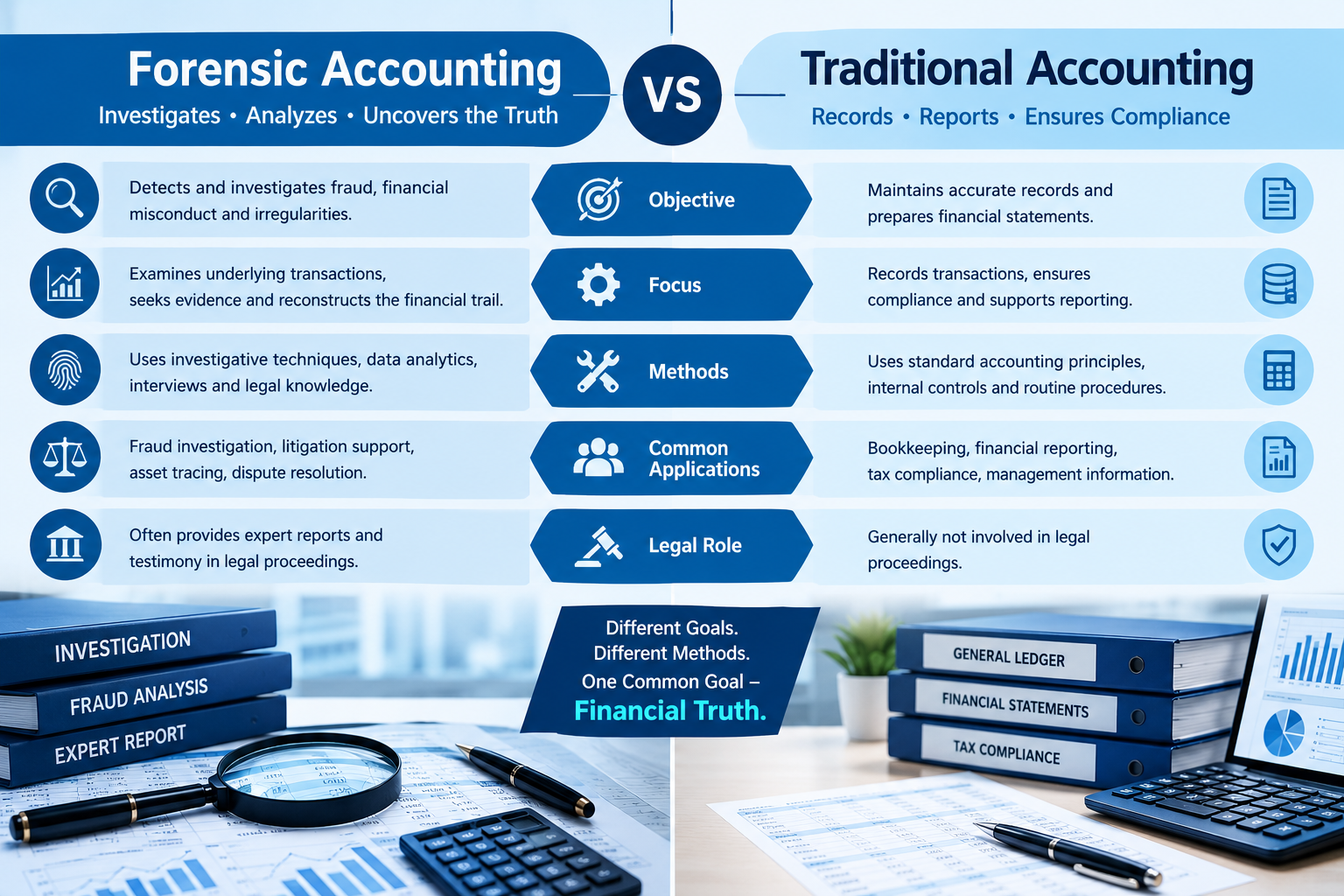
Unlike routine accounting, which generally focuses on maintaining accurate financial records and preparing financial statements, forensic accounting examines the underlying facts to determine whether financial information is consistent, complete, and supported by reliable evidence.
Forensic Accounting vs. Traditional Accounting
Although forensic accounting and traditional accounting rely on many of the same fundamental principles, their objectives and methods differ significantly. Traditional accounting primarily focuses on recording financial transactions, maintaining books of accounts, preparing financial statements, managing tax-related information, and supporting financial reporting. Its emphasis is generally on accuracy, compliance, and the presentation of an organization’s financial position. Forensic accounting, on the other hand, focuses on investigating specific financial questions, particularly when fraud, disputes, manipulation, or unexplained discrepancies are suspected.
For example a traditional accountant may record a payment made to a supplier and include it in the company’s financial statements. A forensic accountant may investigate whether the supplier actually exists, whether the goods were delivered, whether the invoice was manipulated, and whether the payment was authorized.
Why Is Forensic Accounting Important?
Financial misconduct can cause substantial losses to businesses, individuals, investors, financial institutions, and public organizations. In many cases, the damage extends beyond the amount of money involved and includes reputational harm, legal disputes, regulatory consequences, and a loss of stakeholder confidence.
Forensic accounting helps organizations and investigators understand complex financial events by converting large volumes of financial information into meaningful findings.
Its importance can be understood through several key applications.
1. Detecting Financial Fraud
Fraud may involve falsified invoices, fictitious suppliers, unauthorized payments, manipulated financial statements, concealed liabilities, or the diversion of company funds.
Forensic accountants examine financial records to identify inconsistencies, unusual transactions, unsupported expenses, suspicious payment patterns, and other indicators that require further investigation.
For instance, repeated payments to a vendor with incomplete documentation may justify an examination of the vendor’s identity, bank details, approval history, and relationship with employees responsible for procurement.
However, an unusual transaction is not automatically proof of fraud. Investigators must examine supporting evidence and consider legitimate explanations before reaching conclusions.
2. Investigating Embezzlement and Employee Misconduct
Embezzlement occurs when a person unlawfully misappropriates money or property entrusted to them. It can involve employees, managers, financial officers, business partners, or others with access to organizational funds.
A forensic accounting investigation may examine cash withdrawals, expense reimbursements, payroll entries, vendor payments, company credit card transactions, and accounting adjustments.
The investigation may also compare transaction records with authorization documents, employment records, delivery confirmations, and other relevant evidence to determine whether funds were diverted and to estimate the financial impact.
3. Supporting Litigation and Financial Disputes
Financial disagreements frequently arise in commercial contracts, partnership disputes, shareholder conflicts, divorce proceedings, insurance claims, and business dissolution matters.
Forensic accounting can help establish the financial facts relevant to such disputes. This may include calculating losses, tracing funds, examining disputed transactions, evaluating business valuations, and analyzing claims for damages.
A forensic accountant may prepare a detailed report explaining the methodology, supporting records, assumptions, calculations, and limitations of the analysis. Depending on the case and applicable legal requirements, the expert may also provide testimony.
4. Examining Corporate Financial Misconduct
Corporate fraud can involve deliberate misrepresentation of revenue, concealment of liabilities, manipulation of expenses, fictitious sales, or improper recognition of income.
Forensic accountants may compare financial statements with underlying ledgers, contracts, invoices, bank records, inventory documents, and operational data.
The objective is to identify whether reported financial results are supported by actual business activities and whether discrepancies indicate errors, non-compliance, or possible intentional manipulation.
5. Tracing Funds and Identifying Suspicious Transactions
Financial investigations often require the reconstruction of money movements across multiple accounts, entities, or transactions.
Forensic accountants may prepare transaction timelines, trace transfers between related parties, examine unexplained deposits, and identify patterns that warrant further inquiry.
In suspected money laundering or other financial crime cases, this work may support a broader investigation. However, tracing funds alone does not necessarily establish the source, purpose, or legality of every transaction. Conclusions must be supported by appropriate documentary and contextual evidence.
Major Types of Forensic Accounting Investigations
Forensic accounting covers a wide range of investigations, depending on the nature of the suspected misconduct and the questions that need to be answered.
Fraud Investigation
Fraud investigations focus on suspected deception intended to obtain an unlawful financial or other benefit. They may involve procurement fraud, payroll manipulation, fictitious billing, false expense claims, financial statement fraud, or unauthorized transfers.
The investigator reviews transaction-level evidence, identifies suspicious patterns, and assesses whether the available records support the allegation.
Corporate and Employee Fraud Examination
Organizations may commission forensic accounting examinations when they suspect internal theft, conflicts of interest, manipulation of company expenses, undisclosed related-party transactions, or misuse of corporate resources.
These investigations may involve comparing purchase orders, invoices, vendor master data, payment approvals, and bank records to identify inconsistencies or relationships that require explanation.
Insurance Claim Investigation
Insurance claims may involve disputes over the amount of a loss, business interruption, damaged assets, inventory, or claimed expenses.
Forensic accountants can examine financial records before and after an incident, assess revenue and expense patterns, evaluate supporting documents, and calculate financial losses in accordance with the relevant policy terms and accepted methodology.
Their work may help distinguish documented losses from unsupported amounts, while recognizing that the final interpretation of coverage depends on the policy and applicable law.
Partnership and Shareholder Disputes
Disputes between business partners or shareholders may involve allegations of concealed profits, unauthorized withdrawals, improper distributions, understated revenue, or the misuse of company assets.
A forensic accountant may reconstruct the financial history, examine related-party transactions, reconcile accounts, and assess the financial consequences of disputed conduct.
Asset Tracing and Financial Misrepresentation
Asset tracing involves following financial movements to understand where money or property originated, how it was transferred, and where it may have been held or used.
This can be particularly relevant in complex commercial disputes, suspected diversion of funds, insolvency matters, and investigations involving multiple entities.
The reliability of the conclusions depends on the completeness of available records, the traceability of transactions, and the ability to corroborate financial movements with independent evidence.
How Does a Forensic Accounting Investigation Work?
A reliable forensic accounting investigation follows a structured process. The exact procedure depends on the allegations, the type of records available, the scope of the engagement, and the applicable legal framework.
<figure>
</figure>
Step 1: Understanding the Allegation and Defining the Scope
The investigation begins by identifying the financial concern that needs to be examined.
This may involve suspected embezzlement, unexplained business losses, questionable payments, manipulated accounts, disputed invoices, or inconsistencies between reported income and actual receipts.
The investigator defines the relevant period, individuals or entities involved, records to be examined, and questions the investigation is expected to answer.
A clearly defined scope helps ensure that the investigation remains focused, proportionate, and relevant.
Step 2: Collecting Financial and Supporting Records
The next stage involves collecting relevant documents and data. Depending on the case, these may include:
- 1. Bank statements and transaction histories.
- 2. General ledgers, journals, and trial balances.
- 3. Invoices, receipts, purchase orders, and contracts.
- 4. Payroll records and employee expense claims.
- 5. Tax filings and financial statements.
- 6. Vendor information and payment authorization records.
- 7. Emails, accounting-system logs, and other relevant electronic records.
The authenticity, completeness, and reliability of these records must be assessed. Where records may be required for legal proceedings, appropriate documentation of their source, handling, and integrity is important.
Step 3: Examining and Reconciling Financial Data
After collection, the investigator examines the records to identify discrepancies and establish how transactions were recorded and processed.
Bank statements may be reconciled against accounting entries. Invoice amounts may be compared with purchase orders and delivery records. Expense claims may be checked against receipts, company policies, and authorization requirements.
Investigators may also use spreadsheet analysis, database queries, financial analytics, and other suitable tools to process large datasets and identify unusual patterns.
Examples of indicators requiring further examination include duplicate invoices, round-number payments, unusual transactions near reporting deadlines, unexplained journal entries, and payments to vendors with incomplete documentation.
These indicators are investigative leads rather than automatic proof of wrongdoing.
Step 4: Reconstructing the Financial Trail
A central part of forensic accounting is reconstructing the sequence of financial events.
The investigator may establish when a transaction occurred, who authorized it, which account was involved, how it was recorded, and where the funds were subsequently transferred.
A transaction timeline can help connect individual entries that might otherwise appear unrelated. For example, a questionable vendor payment may be examined alongside a related journal entry, a bank transfer, and a communication concerning the underlying purchase.
The goal is to establish a coherent, evidence-supported account of the financial activity.
Step 5: Evaluating Findings and Alternative Explanations
Once discrepancies have been identified, the investigator evaluates whether they are attributable to accounting errors, inadequate controls, incomplete documentation, policy violations, or possible fraud.
Alternative explanations must be considered carefully. A duplicate entry could result from a software error, while an unusual payment could relate to a legitimate emergency purchase.
A sound investigation distinguishes verified facts from assumptions and clearly identifies unresolved questions. It should not presume guilt merely because a transaction appears unusual.
Step 6: Preparing the Forensic Accounting Report
The final stage involves presenting the findings in a clear and structured report.
A comprehensive report typically describes the scope of the examination, records reviewed, methodology, significant transactions, calculations, supporting evidence, limitations, and conclusions.
Where financial loss is calculated, the report should explain the basis of the calculation and identify any assumptions or uncertainties.
The report should enable the intended reader—such as management, legal counsel, an insurer, a regulator, or a court—to understand what was examined, what the evidence establishes, and what remains unverified.
Common Red Flags in Financial Fraud Investigations
Financial fraud is not always obvious. In some cases, individual transactions may appear legitimate when viewed separately, while a broader pattern reveals inconsistencies.
Certain warning signs can justify closer examination.
Unexplained transactions: Payments, deposits, or withdrawals that lack a clear business purpose or adequate supporting documents.
Duplicate invoices and payments: Repeated billing for the same goods or services, potentially caused by error or deliberate manipulation.
Unusual journal entries: Manual adjustments that are poorly documented, lack appropriate authorization, or occur at unusual times.
Fictitious or suspicious vendors: Suppliers with incomplete business information, unusual bank-account arrangements, or possible connections to employees involved in approving payments.
Inconsistent financial statements: Significant differences between recorded revenue, bank receipts, inventory movements, contracts, and operational records.
Unusual employee reimbursements: Repeated claims with missing receipts, inconsistent descriptions, altered documentation, or questionable approval histories.
Unexplained changes in financial performance: Sudden changes in revenue, expenses, margins, or cash flow that cannot be adequately explained by normal business activity.
The Role of Technology in Modern Forensic Accounting
The growing volume of digital financial information has transformed the way financial investigations are conducted.
Modern organizations may generate millions of transactions through accounting software, enterprise resource planning systems, digital payment platforms, online banking, and cloud-based business applications. Manually reviewing every record may be impractical.
Technology helps forensic accountants examine larger datasets, identify patterns, and connect information from different sources.
Data Analytics and Transaction Analysis
Digital Records and Electronic Evidence
Artificial Intelligence and Automated Detection
Forensic Accounting in India: Legal and Regulatory Considerations
In India, forensic accounting can support investigations involving corporate fraud, commercial disputes, financial misrepresentation, insurance claims, employee misconduct, and other matters with a financial dimension.
The applicable legal and regulatory framework depends on the facts of the case, the nature of the organization, and the type of suspected misconduct.
Relevant frameworks may include the Companies Act, 2013, particularly provisions addressing fraud and corporate governance; the Prevention of Money Laundering Act, 2002, where applicable; the Bharatiya Nyaya Sanhita, 2023, for relevant criminal offences; and the Bharatiya Sakshya Adhiniyam, 2023, concerning evidence.
Tax legislation, insurance regulations, banking requirements, insolvency laws, and other sector-specific provisions may also be relevant.
The precise legal provisions must be identified according to the circumstances rather than applied indiscriminately to every financial irregularity.
Forensic accounting findings may assist legal counsel, investigators, auditors, regulators, and courts by explaining financial transactions and quantifying losses. However, a forensic accounting report does not automatically establish criminal liability or guarantee admissibility in court. Its evidentiary value depends on the methodology, supporting records, applicable law, expert competence, and the circumstances in which the evidence was obtained.
Where electronic records are involved, the requirements applicable to their production and evidentiary use should be considered separately.
Challenges and Limitations of Forensic Accounting
Although forensic accounting can reveal important financial information, its conclusions are limited by the quality and availability of evidence.
Incomplete bank statements, missing invoices, altered records, inaccessible accounting systems, and transactions involving multiple intermediaries can make reconstruction difficult.
Complex investigations may also involve numerous entities, international transfers, inconsistent recordkeeping practices, or different accounting systems.
Another challenge is distinguishing fraud from mistakes or poor internal controls. A financial discrepancy may be caused by negligence, a system failure, an incorrect accounting treatment, or deliberate deception. Establishing which explanation is best supported requires careful analysis.
Investigators must also maintain objectivity and confidentiality, document their methodology, and avoid conclusions that exceed the evidence.
How to Choose a Forensic Accounting Expert
Selecting an appropriate professional is essential when the findings may influence a financial dispute, corporate investigation, insurance claim, or legal proceeding.
Consider the expert’s qualifications, practical experience, knowledge of the relevant accounting systems, and familiarity with the type of suspected misconduct. Experience in fraud examination, transaction tracing, loss quantification, or litigation support may be particularly relevant, depending on the assignment.
The professional should be able to explain the proposed methodology, identify the records required, establish the scope of work, and communicate the findings in language that non-accountants can understand.
The Future of Forensic Accounting
The future of forensic accounting will increasingly involve the integration of traditional accounting expertise with data analytics, digital investigation, artificial intelligence, and cross-disciplinary financial analysis.
As businesses adopt automated payment systems, digital assets, cloud accounting, and interconnected financial platforms, investigators will need to understand both conventional accounting records and the digital systems that generate them.
Automated monitoring may help organizations identify unusual activity earlier, while advanced analytical techniques may reveal relationships that are difficult to detect through manual examination alone.
At the same time, the fundamental principles of forensic accounting will remain unchanged: reliable evidence, sound methodology, professional skepticism, independence, and clear reporting.
Technology can accelerate an investigation, but the strength of its conclusions will continue to depend on how carefully the evidence is interpreted and verified.
Conclusion: Turning Financial Data into Evidence
Forensic accounting is far more than the examination of numbers. It is a structured investigative discipline that connects financial records with the underlying events, decisions, and transactions they represent.
By examining documentary evidence, reconciling accounts, tracing financial movements, identifying suspicious patterns, and calculating losses, forensic accountants help organizations and legal professionals understand complex financial matters.
Whether the issue involves suspected embezzlement, corporate fraud, disputed insurance claims, unexplained business losses, or a commercial disagreement, a properly conducted forensic accounting investigation can provide clarity where financial records raise more questions than answers.
As financial transactions become increasingly digital and interconnected, the importance of reliable financial investigation will continue to grow.
Ultimately, forensic accounting transforms financial information into evidence-based insight, helping uncover irregularities, support informed decisions, and strengthen accountability.
For organizations facing unexplained financial discrepancies or suspected fraud, early identification of the problem, appropriate preservation of records, and a carefully scoped independent examination can make a meaningful difference to the quality of the investigation.
Recent Posts
- Forensic Accounting: Uncovering Financial Fraud Through the Science of Numbers
- Graphology: Meaning, Handwriting Analysis, Science & Forensic Uses
- The Psychology of Criminal Behaviour: Understanding the Mind Behind Crime
- Legal Rights of Protesters at Jantar Mantar, Delhi: What Every Citizen Should Know
- Polygraph Test in India
Archives
Categories
Recent Posts


Popular Tags
Automated fingerprint identification system (2)
Ballistics (2)
Business due diligence (2)
Case Study (2)
Celebrity Freedom of Expression (1)
Computer forensics (2)
Computer vision AI (2)
Court-Admissible Evidence (2)
Crime Scene Documentation (2)
Crime scene investigation (12)
CrimeSceneInvestigation (2)
CriminalInvestigation (2)
cybercrime investigation (2)
deepfake detection (2)
Digital evidence recovery (2)
digital forensics (4)
DNA Evidence (2)
DNA Fingerprinting (2)
DNA Profiling (4)
Expert Witness Services (2)
forensic ballistic (2)
Forensic Biology (2)
Forensic Case Review (2)
Forensic DNA Analysis (7)
Forensic Document Examination (2)
Forensic evidence analysis (10)
Forensic Examination (2)
Forensic fingerprint analysis (2)
forensic handwriting analysis (2)
Forensic investigation (10)
Forensic Photography (3)
forensic science (8)
ForensicScience (6)
Forensic Video Examination (2)
Forgery Detection (2)
handwriting analysis (5)
MicroscopicEvidence (2)
Network forensics (2)
Photo Forensic Analysis (2)
Questioned Document Analysis (2)
Questioned Document Examination (2)
Ranveer Singh Case (1)
Risk assessment services (2)
signature verification (4)
video forensics (2)