
-
ceo.bfi@gmail.com
Send Email
-
2C, C-6/A Block, Janakpuri, Delhi India 110058
Visit Our Office
99902-92279
Confidentiality Guaranteed
99902-92279
Confidentiality Guaranteed
Crime scene investigation expert Services in India
-
BRILLIANT FORENSIC INVESTIGATION | Best Forensic Expert Delhi India | Handwriting Signature Verification Expert| Training Internship in forensic lab > Crime scene investigation expert Services in India

Brilliant Forensic Investigation (BFI) provides professional Crime Scene Investigation Expert Services in India for the scientific examination, documentation, preservation, collection and interpretation of evidence associated with a crime or suspicious incident. Crime scene investigation is much more than simply visiting a location and collecting objects. It is a systematic forensic process in which the condition of the scene, position of objects, biological material, fingerprints, impressions, trace evidence, weapons, digital devices and other potentially significant evidence are examined in their original context.
A properly examined crime scene can provide information that may not be apparent from statements, photographs or documents alone. The location of an object, pattern of damage, distribution of biological material, presence of fingerprints, footwear impressions, digital devices or trace material may help establish relationships between people, objects and locations. For this reason, scene examination must be conducted carefully, because once an item is moved, a surface is contaminated or fragile evidence is destroyed, the original condition of the scene may not be recoverable.
BFI’s crime scene investigation approach combines scene documentation, forensic photography, evidence identification, evidence collection, preservation, packaging, chain-of-custody documentation, specialist forensic examination and reconstruction. Depending upon the circumstances, the investigation may involve multiple disciplines including fingerprint forensics, DNA analysis, trace evidence, forensic biology, toxicology, firearms examination, digital forensics, video forensics and forensic photography.
What Is Crime Scene Investigation?
Crime Scene Investigation, commonly referred to as CSI, is the scientific examination of a location associated with an alleged crime, suspicious incident, accident or disputed event. The objective is to identify potentially relevant evidence, document its original condition and location, preserve it appropriately and facilitate subsequent forensic examination.
The crime scene may be a house, apartment, office, commercial establishment, road, vehicle, outdoor location, industrial facility, hotel, agricultural property or another environment. In modern investigations, the concept of a crime scene may also extend to digital and electronic environments because smartphones, computers, CCTV systems, cloud-connected devices and other electronic equipment can contain information relevant to an incident.
A professional crime scene investigator therefore does not look at an isolated object only. The investigator considers the relationship between evidence and its surrounding environment. A fingerprint on a particular surface, for example, has greater investigative context when its exact location, orientation, condition and relationship to other evidence have been documented.
Crime scene investigation can therefore be understood as a bridge between the incident location and subsequent forensic analysis. The National Institute of Criminology and Forensic Science forensic guide emphasizes preservation, early documentation, recognition and proper handling of physical evidence, while government forensic laboratories similarly describe crime-scene examination as an important part of the forensic process.
Why Crime Scene Investigation Is Important
The importance of crime scene investigation arises from the fact that a crime scene can contain information that cannot be recreated later. The physical environment may preserve traces of contact, movement, impact, biological transfer, entry or exit, object displacement and other events. Environmental conditions and human activity, however, can rapidly alter this information.
A scene may contain both obvious evidence and evidence that is difficult to see without forensic examination. A weapon lying in an open area may be immediately visible, whereas a latent fingerprint, microscopic fibre, minute biological deposit, footwear impression or small fragment of glass may require specialized methods to identify and preserve.
The value of crime scene investigation therefore depends not only on discovering evidence but also on maintaining its context, integrity and traceability.
The Government of Uttar Pradesh’s forensic guidance notes that important clue material may be lost once a scene has been disturbed, while the National Institute of Criminology and Forensic Science emphasizes the importance of preserving scene integrity and maintaining traceability and continuity through the chain of custody.
For BFI, the objective is to approach each scene methodically rather than making assumptions about what happened before the evidence has been examined.
Crime Scene Examination Services
Initial Crime Scene Assessment
The initial assessment establishes the basic forensic scope of the scene. Before evidence is collected, the investigator considers the physical environment, potential entry and exit points, areas of disturbance, visible evidence, environmental conditions and any circumstances that could affect preservation.
This stage is particularly important because premature movement of objects or unnecessary access to the location can alter evidence. The investigator therefore considers which areas require immediate protection and which evidence may be vulnerable to contamination, degradation or loss.
The initial assessment also helps determine whether specialist disciplines may be required. For example, a scene involving suspected blood evidence may require biological examination, while a scene involving a damaged lock may require toolmark examination. If electronic devices or CCTV systems are present, digital forensic considerations may also become relevant.
Crime Scene Documentation
Crime scene documentation creates a permanent record of the scene as it existed when the forensic examination began. It may involve written observations, photographs, video documentation, measurements, sketches, diagrams and evidence inventories.
Detailed documentation is important because the scene may change after investigators leave. Furniture may be moved, damaged property may be repaired, biological material may deteriorate and electronic systems may overwrite recordings. A properly documented scene allows later reviewers and forensic experts to understand the original environment.
Documentation should distinguish between what was actually observed and what may later be interpreted from the evidence. This distinction is essential in professional forensic reporting.
Crime Scene Photography and Videography
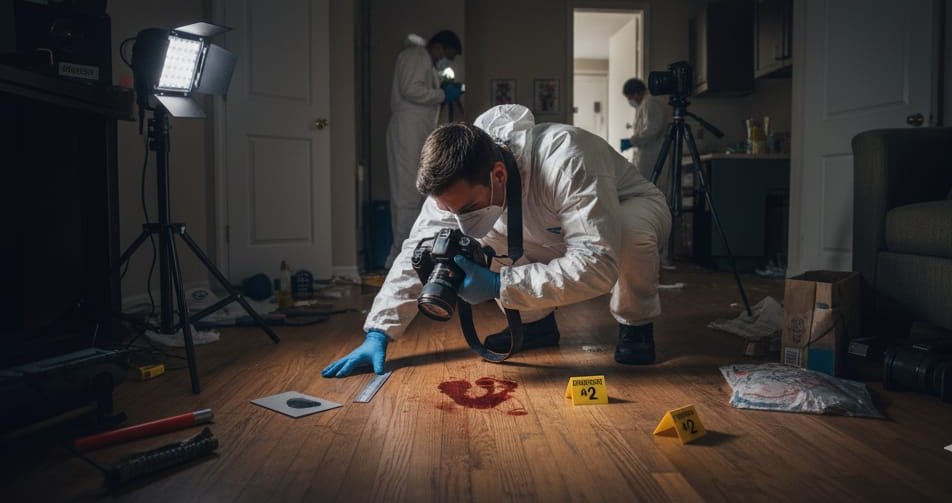
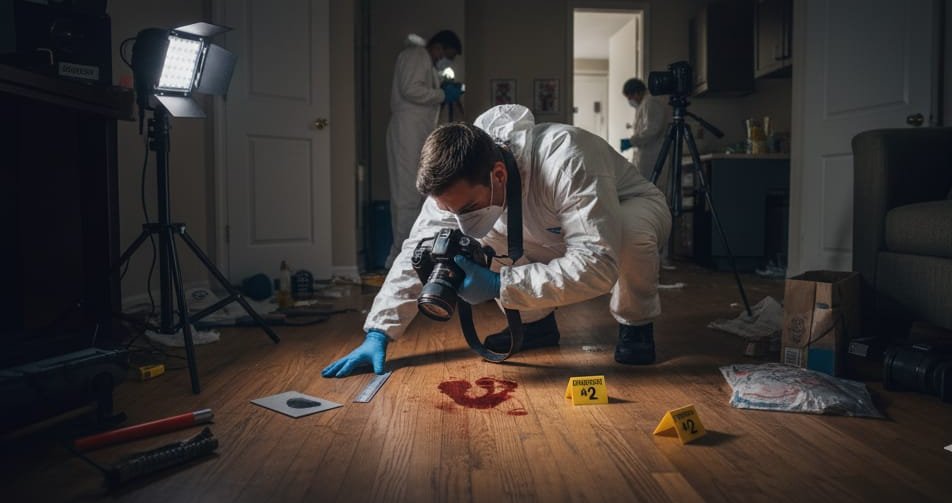
Crime scene photography is one of the fundamental components of forensic scene documentation. The purpose is not simply to take attractive or clear photographs; the photographs should preserve relevant information about the scene, evidence and spatial relationships.
A systematic photographic sequence commonly moves from broader views of the location toward increasingly detailed photographs of individual evidence items. The investigator may photograph the exterior, entrance, rooms, relevant objects, evidence positions, damage patterns and individual exhibits.
Close-up photographs may be taken with appropriate scales when measurements or dimensions are relevant. Different lighting techniques may also be considered for particular evidence.
For example, photography may be used to document:
Bloodstains and biological deposits
Fingerprint impressions
Footwear impressions
Toolmarks
Bullet holes and firearm-related evidence
Damaged locks and doors
Broken glass
Trace evidence
Vehicle damage
Digital devices
Documents and other physical exhibits
The photographs form part of the overall forensic record and should be preserved with appropriate case documentation.
Fingerprint Evidence Collection and Examination
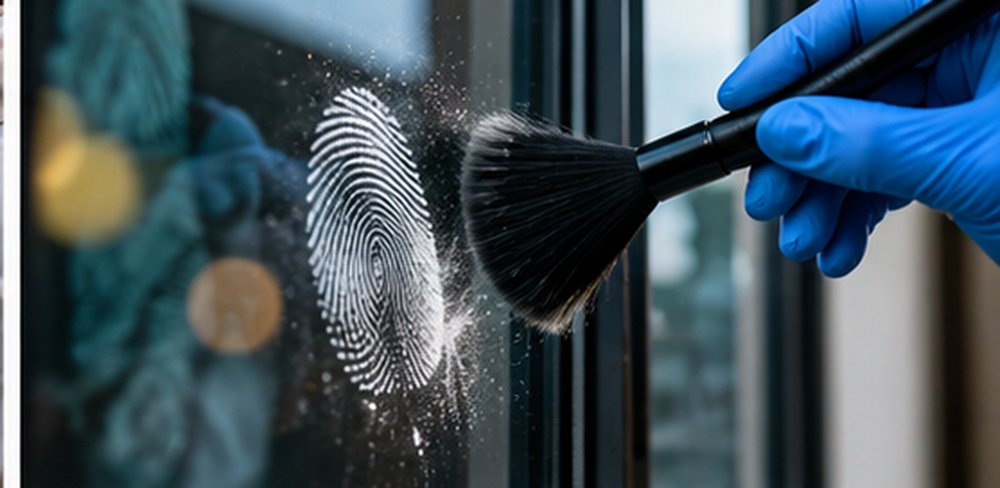
Fingerprints are among the most important forms of impression evidence encountered during crime scene investigation. A person’s friction-ridge patterns are highly individual, but the forensic value of a recovered impression depends on its quality, preservation and the circumstances in which it was obtained.
BFI can assist with identifying surfaces that may retain latent fingerprints and documenting potentially relevant impressions before appropriate development or lifting procedures are undertaken.
Potential fingerprint-bearing surfaces may include doors, windows, glass, metal, plastic, furniture, containers, vehicles and electronic equipment.
Fingerprint examination can involve several stages, beginning with locating and documenting an impression and continuing through development, preservation and comparison where suitable reference material is available.
A fingerprint should not be considered in isolation. Its location and relationship to the scene can be important in understanding its evidentiary significance.
Biological Evidence and DNA Collection
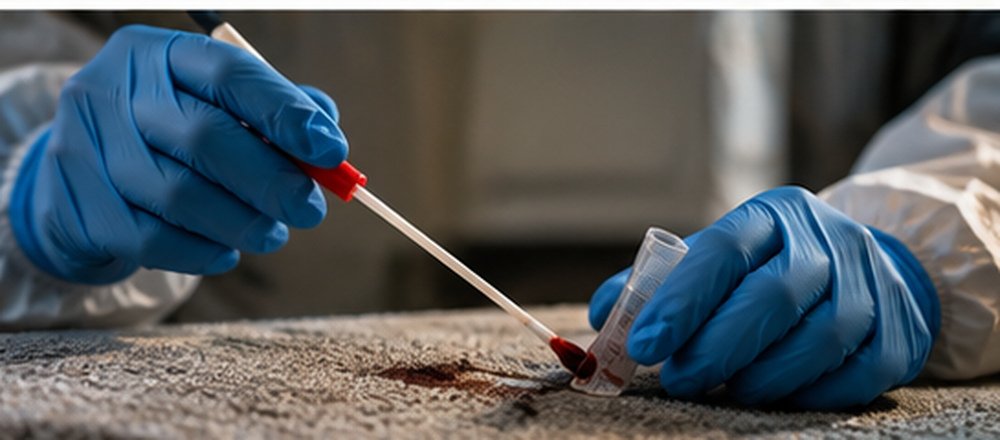
Biological evidence can be extremely valuable in investigations involving violence, sexual offences, suspicious deaths, physical contact or other circumstances in which biological material may have been transferred.
Potential biological evidence can include blood, saliva, tissue, hair, cellular material and biological stains on clothing or other objects. The presence of biological material does not automatically establish how or when it was deposited. Proper collection and subsequent scientific interpretation are therefore essential.
BFI can assist in identifying potential biological evidence, documenting its location and coordinating appropriate collection and examination procedures.
Particular attention is required when handling biological material because environmental exposure, moisture, contamination and improper packaging can affect subsequent analysis.
Depending upon the evidence and examination requirements, biological material may subsequently undergo laboratory testing and, where suitable, DNA analysis.
Bloodstain Evidence Examination
Bloodstain evidence can provide information concerning the location and distribution of blood within a scene. However, interpretation requires careful examination of the observed characteristics rather than relying on assumptions.
A forensic assessment may consider the size, shape, distribution, location, directionality and relationship of bloodstains to surrounding objects and surfaces.
The investigator may also examine whether the pattern is consistent with particular possible mechanisms of deposition. Such interpretation must account for the characteristics of the surface, environmental conditions and other available evidence.
For this reason, bloodstain documentation begins at the scene. Photographs, measurements and contextual observations can be important before surfaces are disturbed.
Footwear Impression Examination
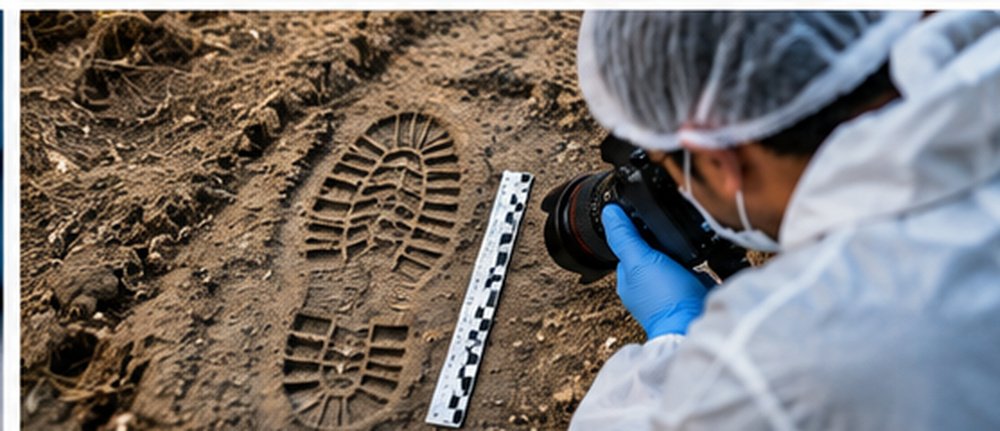
Footwear impressions can provide information about movement through a scene and may sometimes allow comparison with a particular shoe or footwear pattern.
An impression can contain both general tread characteristics and, where sufficiently preserved, additional characteristics caused by wear, damage or other features.
BFI can document footwear impressions using appropriate photographic techniques and measurements. Depending upon the surface and condition of the impression, additional preservation techniques may be considered.
The location and sequence of footwear impressions can also be relevant to scene reconstruction because impressions may indicate movement between different areas.
Tire Impression and Vehicle Evidence Examination
Vehicle-related crime scenes can contain significant physical evidence. Tire impressions, vehicle damage, broken components, paint transfer, glass, biological material and other trace evidence may provide information for investigation.
A forensic examination may document the position of the vehicle, damage patterns, tire impressions, fragments and surrounding environmental evidence.
Where appropriate, photographs and measurements can preserve the relationship between the vehicle and the surrounding scene. Vehicle evidence can be particularly important in hit-and-run investigations, suspicious accidents, property damage investigations and other incidents involving motor vehicles.
Trace Evidence Examination
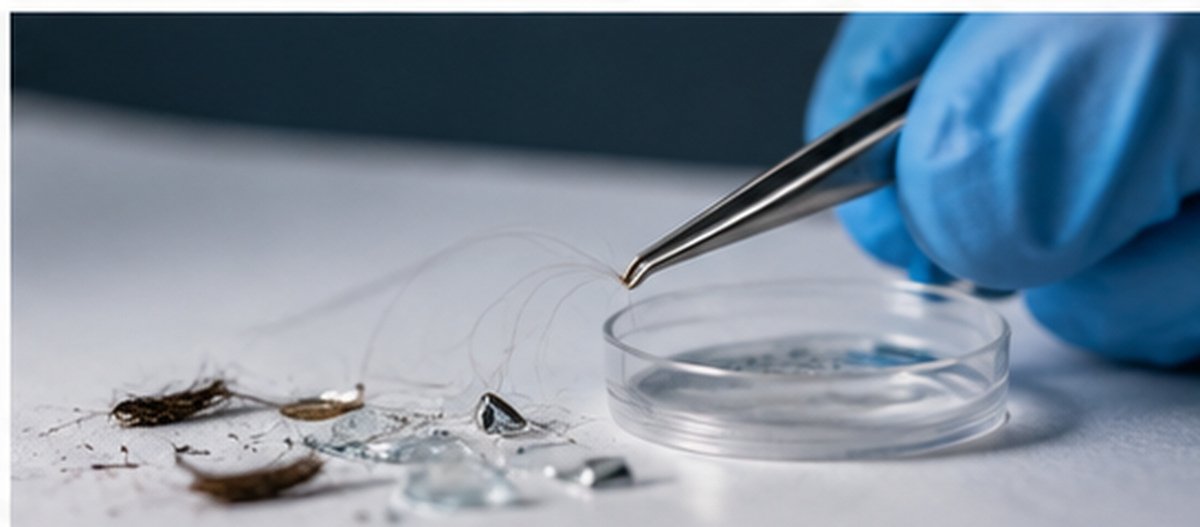
Trace evidence refers to small materials that may be transferred between people, objects and environments. Such evidence may be microscopic or visually inconspicuous, making systematic collection particularly important.
Potential trace evidence includes hair, fibres, soil, glass, paint, metal particles, building materials and other small fragments.
A single trace item may not necessarily identify a person or object by itself. Its evidentiary significance depends on its characteristics, location, condition, comparison material and the overall circumstances of the case.
BFI’s crime scene methodology therefore emphasizes documenting where trace evidence was found and preserving it appropriately before laboratory examination.
Toolmark Examination
Toolmarks may be created when a tool contacts another surface. Examples can include marks produced on locks, doors, windows, safes, metal structures, wooden surfaces or other objects during forced entry.
Crime scene investigators document the mark before it is disturbed. Photographs, measurements and appropriate preservation methods may be used to record the characteristics of the questioned mark.
Where a suspected tool is available, forensic examination may involve comparison of the questioned mark with test impressions produced under appropriate conditions.
Toolmark evidence can be relevant in burglary, theft, vandalism, forced-entry and property-damage investigations.
Firearms and Ballistic Crime Scene Investigation
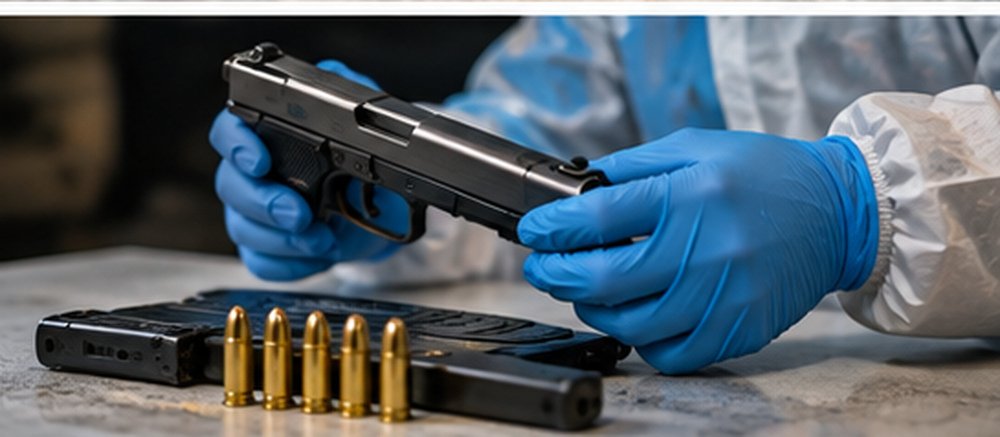
Firearms-related crime scenes require specialized knowledge and strict safety procedures. A scene may contain a firearm, cartridge cases, bullets or projectiles, bullet holes, damaged objects, clothing or other firearm-related evidence.
The forensic investigator documents the firearm’s location and condition without unnecessarily disturbing it. Cartridge cases and projectiles are also documented in relation to their surrounding environment.
Where relevant, investigators may document bullet holes, damage patterns and potential trajectory information. Laboratory examination can subsequently address questions concerning firearms, ammunition and other ballistic evidence.
Firearm handling should always prioritize safety and be undertaken only by appropriately trained personnel.
Digital Evidence at a Crime Scene
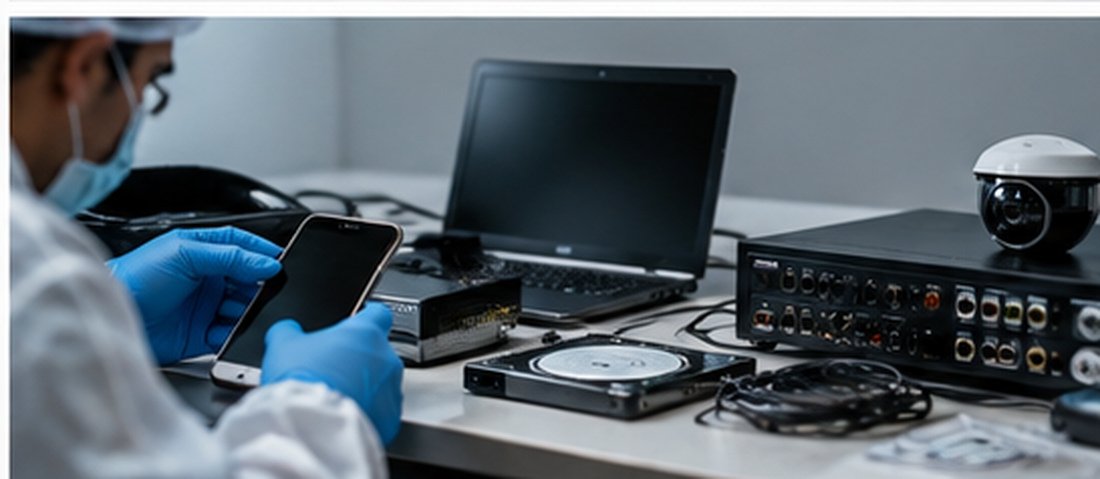
Modern crime scenes frequently contain electronic devices that may hold information relevant to an investigation. A smartphone, computer, CCTV recorder, storage device, router or other electronic system may contain communications, photographs, videos, files, timestamps or other information.
Digital evidence requires specialized handling because ordinary interaction with a device can alter data. Turning a device on, opening an application, connecting it to a network or modifying its configuration may potentially affect available information.
BFI can provide forensic support for identifying and preserving relevant digital devices and coordinating appropriate digital forensic examination.
Digital forensic work may involve:
Mobile phones
Computers and laptops
Hard drives
USB storage
Memory cards
CCTV/DVR/NVR systems
Digital cameras
Network devices
Other electronic storage systems
The forensic objective is to preserve the integrity of the information and document the acquisition and examination process.
CCTV and Video Evidence Investigation
CCTV recordings can become important evidence in investigations involving theft, assault, robbery, unauthorized entry, road incidents, workplace events and suspicious activity.
A CCTV investigation should begin with preservation of the original recording system or relevant source material. Depending on the system, footage may exist on a DVR, NVR, server, memory card or other storage architecture.
BFI can assist with video forensic examination involving:
Timeline analysis
Multiple-camera correlation
Frame-by-frame examination
Image clarification where technically appropriate
Video format analysis
Metadata-related examination
Identification of relevant sequences
Export and preservation of evidentiary material
Video enhancement has technical limitations. An enhancement process can improve visibility of recorded information, but it should not be represented as creating information that was never captured by the original recording system.
Crime Scene Reconstruction
Crime scene reconstruction is a specialized forensic process that attempts to understand relationships between physical evidence and possible sequences of events.
Reconstruction may consider the positions of people or objects, damage patterns, bloodstain distribution, footwear impressions, projectile paths, digital timestamps, CCTV footage and other evidence.
A reconstruction should be based on documented evidence rather than assumptions. Multiple possible explanations may need to be considered when the available evidence does not uniquely establish one sequence.
BFI can integrate information from different forensic disciplines to develop a structured reconstruction where the evidence is sufficient for such analysis.
3D Crime Scene Mapping and Digital Documentation
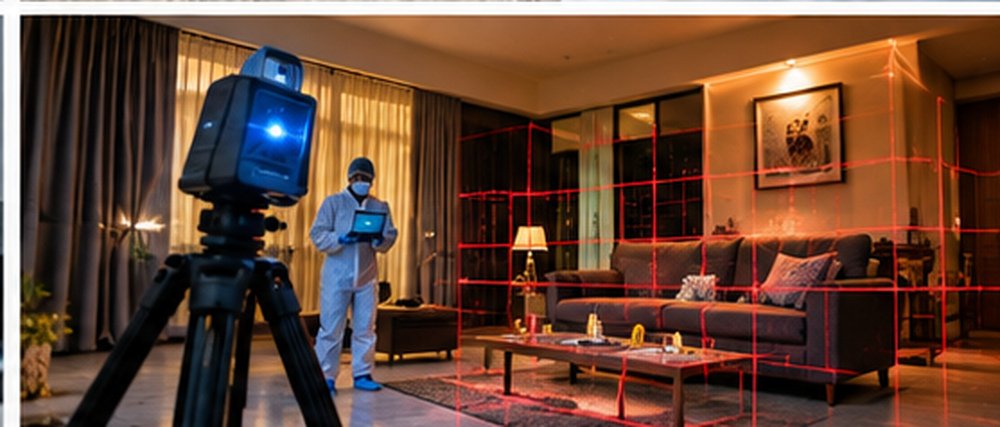
Complex crime scenes may benefit from advanced spatial documentation. Digital mapping and three-dimensional documentation can help preserve the geometry and spatial relationships of a location.
Such documentation may assist with:
Measuring distances
Understanding object positions
Reconstructing room layouts
Reviewing evidence locations
Explaining spatial relationships
Preparing technical presentations
Three-dimensional documentation can be particularly useful for large buildings, industrial locations, accident scenes and complicated indoor or outdoor environments.
Evidence Packaging and Preservation
Evidence preservation begins at the scene. The selected packaging method should be appropriate for the type of evidence being collected.
The West Bengal State Forensic Science Laboratory’s guidance, for example, emphasizes documenting the scene before collection, careful labeling and appropriate packaging of different categories of exhibits.
BFI’s evidence-handling approach focuses on maintaining the identity and condition of the exhibit from collection through subsequent examination.
Each exhibit should be properly identified with relevant case information and handled in a manner appropriate to its characteristics.
Improper packaging can result in degradation or contamination. For this reason, forensic evidence should not simply be placed into whatever container happens to be available.
Types of Crime Scenes We Examine
BFI can provide forensic consultation and examination for a broad range of crime and incident locations.
Residential Crime Scenes
Residential locations may involve murder, suspicious death, burglary, theft, assault, domestic incidents, property damage or other offences. Examination can include the building’s entry points, rooms, furniture, biological evidence, fingerprints, trace evidence and digital devices.
Commercial and Corporate Crime Scenes
Corporate environments can contain evidence associated with theft, sabotage, unauthorized access, workplace misconduct, fraud-related incidents or property damage. In such cases, physical evidence may need to be considered alongside CCTV and digital evidence.
Vehicle Crime Scenes
Vehicles may contain fingerprints, biological material, fibres, glass, paint, digital devices, damage patterns and other evidence. Examination can include both the vehicle and surrounding location.
Outdoor Crime Scenes
Outdoor scenes require additional consideration of environmental conditions. Rain, sunlight, wind, soil movement, animals and public access can rapidly affect evidence.
Industrial Crime Scenes
Factories, warehouses and industrial facilities can involve complex layouts, machinery, hazardous materials, fire incidents, workplace accidents and multiple evidence locations. A structured scene examination is particularly important in such environments.
Crime Scene Investigation for Suspicious Death Cases
Suspicious death investigations can require multidisciplinary forensic examination. The scene may contain information concerning body position, surrounding objects, biological material, weapons, damage, fingerprints, footwear impressions, digital devices and other evidence.
The forensic examination should document the scene before unnecessary movement of objects. Where relevant, the relationship between the body, surrounding evidence and environmental conditions can be recorded.
BFI can provide forensic consultation and examination support for appropriate suspicious-death investigations, subject to the legal and investigative framework governing the case.
Crime Scene Investigation for Murder Cases
Murder investigations frequently require multiple forensic disciplines. A single scene may contain biological evidence, fingerprints, footwear impressions, weapons, trace evidence, bloodstains, digital devices and CCTV recordings.
The significance of individual evidence items often increases when their locations and relationships are documented systematically.
BFI can support multidisciplinary examination by coordinating relevant forensic areas and preparing technical documentation based on the evidence available.
Crime Scene Investigation for Sexual Offence Cases
Sexual-offence-related scenes require particularly careful handling because biological evidence can be fragile and contamination-sensitive.
Potential evidence may include biological material, clothing, bedding, personal objects, digital communications and scene-related trace evidence.
Collection and examination must follow appropriate legal, medical and forensic procedures, with particular attention to privacy, dignity, contamination prevention and chain of custody.
Crime Scene Investigation for Burglary and Theft
Burglary scenes may contain evidence relating to forced entry, movement through the property and interaction with objects.
Investigators may examine doors, locks, windows, safes, drawers, containers and other potential contact surfaces.
Potential evidence can include fingerprints, footwear impressions, toolmarks, fibres, CCTV footage and damaged materials.
The position of evidence may also help reconstruct the sequence in which different areas were accessed.
Crime Scene Investigation for Fire and Arson
Fire scenes require specialized examination because fire, heat and firefighting activity can substantially alter the original environment.
A forensic fire investigation may consider burn patterns, points of origin, electrical components, fuel or accelerant-related evidence, damaged structures and available CCTV or digital records.
Chemical examination may be required for appropriate samples.
BFI can provide forensic fire and arson investigation support where the case requires specialist scene examination.
Crime Scene Investigation for Road and Vehicle Incidents
Road incidents can leave physical evidence such as vehicle debris, tire marks, paint transfer, glass fragments, damage patterns and biological material.
Scene documentation may include measurements, photographs, vehicle positions, roadway conditions and relevant surrounding evidence.
Where CCTV or dashcam footage is available, digital and video forensic analysis may supplement the physical examination.
Why Choose Brilliant Forensic Investigation?
Brilliant Forensic Investigation can provide a multidisciplinary forensic approach for cases requiring more than a single type of examination.
The advantage of a multidisciplinary approach is that different categories of evidence can be considered together. For example, physical scene evidence may be examined alongside fingerprints, biological evidence, CCTV footage and digital evidence where the case requires it.
BFI’s broader forensic service portfolio includes crime scene investigation, digital forensics, fingerprint examination, document examination, DNA-related services, video forensics, fire investigation and other specialist forensic disciplines.
The focus is on systematic documentation, evidence preservation, scientific examination and technically structured reporting.
Pan-India Crime Scene Investigation Services
BFI provides forensic consultation and crime-scene assistance for cases across India, subject to location, case requirements, availability, applicable permissions and the nature of the engagement.
Services may be required in metropolitan areas such as Delhi, Mumbai, Bengaluru, Hyderabad, Chennai, Kolkata and Pune as well as in other cities and regions including Madhya Pradesh, Uttar Pradesh, Rajasthan, Haryana and surrounding areas.
For cases where physical deployment is not immediately required, BFI may also provide forensic consultation concerning evidence already collected, photographs, documents, CCTV recordings, digital material or other available information.
Call To Action

BFI can structure the investigation around the evidence sources and questions relevant to your case.
📞 Contact Us: 9990292279
🌐 Visit Our Website: https://forensicexpertinvestigation.com/
✉️ Email: ceo.bfi@gmail.com
Frequently Asked Questions About Crime Scene Investigation Services
-
What is the purpose of crime scene investigation?
The purpose is to systematically identify, document, preserve and collect potentially relevant evidence and provide a scientific basis for subsequent forensic examination and investigation.
-
How soon should a crime scene be examined?
As early as reasonably possible. Environmental exposure, human movement and other changes can affect evidence and the condition of the scene.
-
What types of evidence can be collected?
Depending upon the incident, evidence can include fingerprints, DNA, blood, hair, fibres, glass, paint, soil, footwear impressions, tire marks, weapons, toolmarks, documents, CCTV recordings and electronic devices.
-
Can fingerprints be recovered from a crime scene?
Potentially yes. Recovery depends on the surface, condition of the impression, environmental exposure and other factors.
-
Can DNA evidence be collected from a crime scene?
Potential biological material can be collected for appropriate laboratory examination. The suitability of the material depends on its condition and the circumstances of collection.
Crime scene investigation Expert Services In India
union territory Crime Secene Investigation Expert in Andaman and Nicobar Islands (union territory)-Port Blair | Crime Secene Investigation Expert in Andhra Pradesh – Adoni, Amaravati, Anantapur, Chandragiri, Chittoor, Dowlaiswaram, Eluru, Guntur, Kadapa, Kakinada, Kurnool, Machilipatnam, Nagarjunakoṇḍa, Rajahmundry, Srikakulam, Tirupati, Vijayawada, Visakhapatnam, Vizianagaram, Yemmiganur | Crime Secene Investigation Expert in Arunachal Pradesh – Itanagar | Crime Secene Investigation Expert in Assam – Dhuburi, Dibrugarh, Dispur, Guwahati, Jorhat, Nagaon, Sivasagar, Silchar, Tezpur, Tinsukia | Crime Secene Investigation Expert in Bihar – Ara, Barauni, Begusarai, Bettiah, Bhagalpur, Bihar Sharif, Bodh Gaya, Buxar, Chapra, Darbhanga, Dehri, Dinapur Nizamat, Gaya, Hajipur, Jamalpur, Katihar, Madhubani, Motihari, Munger, Muzaffarpur, Patna, Purnia, Pusa, Saharsa, Samastipur, Sasaram, Sitamarhi, Siwan | Crime Secene Investigation Expert in Chandigarh (union territory) – Chandigarh | Crime Secene Investigation Expert in Chhattisgarh – Ambikapur, Bhilai, Bilaspur, Dhamtari, Durg, Jagdalpur, Raipur, Rajnandgaon | Crime Secene Investigation Expert in Dadra and Nagar Haveli and Daman and Diu (union territory) – Daman, Diu, Silvassa | Crime Secene Investigation Expert in Delhi (national capital territory) – Delhi, New Delhi | Crime Secene Investigation Expert in Goa – Madgaon, Panaji | Crime Secene Investigation Expert in Gujarat – Ahmadabad, Amreli, Bharuch, Bhavnagar, Bhuj, Dwarka, Gandhinagar, Godhra, Jamnagar, Junagadh, Kandla, Khambhat, Kheda, Mahesana, Morbi, Nadiad, Navsari, Okha, Palanpur, Patan, Porbandar, Rajkot, Surat, Surendranagar, Valsad, Veraval | Crime Secene Investigation Expert in Haryana – Ambala, Bhiwani, Chandigarh, Faridabad, Firozpur Jhirka, Gurugram, Hansi, Hisar, Jind, Kaithal, Karnal, Kurukshetra, Panipat, Pehowa, Rewari, Rohtak, Sirsa, Sonipat | Crime Secene Investigation Expert in Himachal Pradesh – Bilaspur, Chamba, Dalhousie, Dharmshala, Hamirpur, Kangra, Kullu, Mandi, Nahan, Shimla, Una | Crime Secene Investigation Expert in Jammu and Kashmir (union territory) – Anantnag, Baramula, Doda, Gulmarg, Jammu, Kathua, Punch, Rajouri, Srinagar, Udhampur | Crime Secene Investigation Expert in Jharkhand – Bokaro, Chaibasa, Deoghar, Dhanbad, Dumka, Giridih, Hazaribag, Jamshedpur, Jharia, Rajmahal, Ranchi, Saraikela | Crime Secene Investigation Expert in Karnataka – Badami, Ballari, Bengaluru, Belagavi, Bhadravati, Bidar, Chikkamagaluru, Chitradurga, Davangere, Halebid, Hassan, Hubballi-Dharwad, Kalaburagi, Kolar, Madikeri, Mandya, Mangaluru, Mysuru, Raichur, Shivamogga, Shravanabelagola, Shrirangapattana, Tumakuru, Vijayapura | Crime Secene Investigation Expert in Kerala – Alappuzha, Vatakara, Idukki, Kannur, Kochi, Kollam, Kottayam, Kozhikode, Mattancheri, Palakkad, Thalassery, Thiruvananthapuram, Thrissur | Crime Secene Investigation Expert in Ladakh (union territory) – Kargil, Leh | Crime Secene Investigation Expert in Madhya Pradesh – Balaghat, Barwani, Betul, Bharhut, Bhind, Bhojpur, Bhopal, Burhanpur, Chhatarpur, Chhindwara, Damoh, Datia, Dewas, Dhar, Dr. Ambedkar Nagar (Mhow), Guna, Gwalior, Hoshangabad, Indore, Itarsi, Jabalpur, Jhabua, Khajuraho, Khandwa, Khargone, Maheshwar, Mandla, Mandsaur, Morena, Murwara, Narsimhapur, Narsinghgarh, Narwar, Neemuch, Nowgong, Orchha, Panna, Raisen, Rajgarh, Ratlam, Rewa, Sagar, Sarangpur, Satna, Sehore, Seoni, Shahdol, Shajapur, Sheopur, Shivpuri, Ujjain, Vidisha | Crime Secene Investigation Expert in Maharashtra – Ahmadnagar, Akola, Amravati, Aurangabad, Bhandara, Bhusawal, Bid, Buldhana, Chandrapur, Daulatabad, Dhule, Jalgaon, Kalyan, Karli, Kolhapur, Mahabaleshwar, Malegaon, Matheran, Mumbai, Nagpur, Nanded, Nashik, Osmanabad, Pandharpur, Parbhani, Pune, Ratnagiri, Sangli, Satara, Sevagram, Solapur, Thane, Ulhasnagar, Vasai-Virar, Wardha, Yavatmal | Crime Secene Investigation Expert in Manipur – Imphal | Crime Secene Investigation Expert in Meghalaya – Cherrapunji, Shillong | Crime Secene Investigation Expert in Mizoram – Aizawl, Lunglei | Crime Secene Investigation Expert in Nagaland – Kohima, Mon, Phek, Wokha, Zunheboto | Crime Secene Investigation Expert in Odisha – Balangir, Baleshwar, Baripada, Bhubaneshwar, Brahmapur, Cuttack, Dhenkanal, Kendujhar, Konark, Koraput, Paradip, Phulabani, Puri, Sambalpur, Udayagiri | Crime Secene Investigation Expert in Puducherry (union territory) – Karaikal, Mahe, Puducherry, Yanam | Crime Secene Investigation Expert in Punjab – Amritsar, Batala, Chandigarh, Faridkot, Firozpur, Gurdaspur, Hoshiarpur, Jalandhar, Kapurthala, Ludhiana, Nabha, Patiala, Rupnagar, Sangrur | Crime Secene Investigation Expert in Rajasthan – Abu, Ajmer, Alwar, Amer, Barmer, Beawar, Bharatpur, Bhilwara, Bikaner, Bundi, Chittaurgarh, Churu, Dhaulpur, Dungarpur, Ganganagar, Hanumangarh, Jaipur, Jaisalmer, Jalor, Jhalawar, Jhunjhunu, Jodhpur, Kishangarh, Kota, Merta, Nagaur, Nathdwara, Pali, Phalodi, Pushkar, Sawai Madhopur, Shahpura, Sikar, Sirohi, Tonk, Udaipur | Crime Secene Investigation Expert in Sikkim – Gangtok, Gyalshing, Lachung, Mangan | Crime Secene Investigation Expert in Tamil Nadu – Arcot, Chengalpattu, Chennai, Chidambaram, Coimbatore, Cuddalore, Dharmapuri, Dindigul, Erode, Kanchipuram, Kanniyakumari, Kodaikanal, Kumbakonam, Madurai, Mamallapuram, Nagappattinam, Nagercoil, Palayamkottai, Pudukkottai, Rajapalayam, Ramanathapuram, Salem, Thanjavur, Tiruchchirappalli, Tirunelveli, Tiruppur, Thoothukudi, Udhagamandalam, Vellore | Crime Secene Investigation Expert in Telangana – Hyderabad, Karimnagar, Khammam, Mahbubnagar, Nizamabad, Sangareddi, Warangal | Crime Secene Investigation Expert in Tripura – Agartala | Crime Secene Investigation Expert in Uttar Pradesh – Agra, Aligarh, Amroha, Ayodhya, Azamgarh, Bahraich, Ballia, Banda, Bara Banki, Bareilly, Basti, Bijnor, Bithur, Budaun, Bulandshahr, Deoria, Etah, Etawah, Faizabad, Farrukhabad-cum-Fatehgarh, Fatehpur, Fatehpur Sikri, Ghaziabad, Ghazipur, Gonda, Gorakhpur, Hamirpur, Hardoi, Hathras, Jalaun, Jaunpur, Jhansi, Kannauj, Kanpur, Lakhimpur, Lalitpur, Lucknow, Mainpuri, Mathura, Meerut, Mirzapur-Vindhyachal, Moradabad, Muzaffarnagar, Partapgarh, Pilibhit, Prayagraj, Rae Bareli, Rampur, Saharanpur, Sambhal, Shahjahanpur, Sitapur, Sultanpur, Tehri, Varanasi | Crime Secene Investigation Expert in Uttarakhand – Almora, Dehra Dun, Haridwar, Mussoorie, Nainital, Pithoragarh | Crime Secene Investigation Expert in West Bengal – Alipore, Alipur Duar, Asansol, Baharampur, Bally, Balurghat, Bankura, Baranagar, Barasat, Barrackpore, Basirhat, Bhatpara, Bishnupur, Budge Budge, Burdwan, Chandernagore, Darjeeling, Diamond Harbour, Dum Dum, Durgapur, Halisahar, Haora, Hugli, Ingraj Bazar, Jalpaiguri, Kalimpong, Kamarhati, Kanchrapara, Kharagpur, Cooch Behar, Kolkata, Krishnanagar, Malda, Midnapore, Murshidabad, Nabadwip, Palashi, Panihati, Purulia, Raiganj, Santipur, Shantiniketan, Shrirampur, Siliguri, Siuri, Tamluk, Titagarh.
Crime scene investigation Expert Services in Various Major Cities of India
Brilliant Forensic Investigation (BFI) provides Crime Scene Investigation Expert Services across major cities and regions in India, including Mumbai, New Delhi, Bangalore, Hyderabad, Ahmedabad, Chennai, Kolkata, Surat, Pune, Jaipur, Lucknow, Kanpur, Nagpur, Indore, Thane, Bhopal, Visakhapatnam, Pimpri-Chinchwad, Patna, Vadodara, Ghaziabad, Ludhiana, Agra, Nashik, Meerut, Kalyan-Dombivali, Vasai-Virar, Varanasi, Srinagar, Aurangabad, Dhanbad, Amritsar, Navi Mumbai, Allahabad, Howrah, Ranchi, Gwalior, Coimbatore, Vijayawada, Jodhpur, Madurai, Raipur, Kota, Chandigarh, Guwahati, Solapur, Hubballi-Dharwad, Nellore, Bhavnagar, Dehradun, Durgapur, Asansol, Rourkela, Nanded, Kolhapur, Ajmer, Akola, Gulbarga, Mangalore, Erode, Belgaum, Ambattur, Tirunelveli, Malegaon, Gaya, Jalgaon, Udaipur, Maheshtala, Davanagere, Kozhikode, Kurnool, Rajpur-Sonarpur, Bhatpara, Rajahmundry, Bokaro, South Dumdum, Bellary, Patiala, Gopalpur, Agartala, Bhagalpur, Muzaffarnagar, Ahmednagar, Mathura, Kollam, Avadi, Kadapa, Kamarhati, Sambalpur, Bilaspur, Shahjahanpur, Satara, Bijapur, Rampur, Shivamogga, Chandrapur, Junagadh, Thrissur, Alwar, Bardhaman, Kulti, Kakinada, Nizamabad, Parbhani, Tumkur, Khammam, Ozhukarai, Bihar Sharif, Panipat, Darbhanga, Bally, Aizawl, Dewas, Ichalkaranji, Karnal, Bathinda, Jalna, Eluru, Kirari Suleman Nagar, Mehsana, Durg, Barasat, Purnia, Satna, Mau, Sonipat, Farrukhabad, Sagar, Imphal, Ratlam, Hapur, Begusarai, Gandhidham, Baranagar, Tiruvottiyur, Puducherry, Sikar, Thoothukudi, Rewa, Mirzapur, Raichur, Pali, Ramagundam, Haridwar, Thanjavur, Bulandshahr, Uluberia, Murwara, Sambhal, Singrauli, Nadiad, Secunderabad, Naihati, Bidhannagar, Pallavaram, Bidar, Munger, Panchkula, Burhanpur, Raurkela Industrial Township, Chittoor, Jehanabad, Kharagpur, Dindigul, Gandhinagar, Hospet, Nangloi Jat, Malda, Ongole, Deoghar, Chapra, Haldia, Khandwa, Nandyal, Morena, Amroha, Anand, Bhind, Bhalswa Jahangir Pur, Rae Bareli, Madhyamgram, Bhiwani, Panvel, Baharampur, Ambala, Morbi, Fatehpur, Mahabubnagar, Bhusawal, Orai, Bahraich, Vellore, Raiganj, Sirsa, Danapur, Serampore, Sultan Pur Majra, Guna, Jaunpur, Shivpuri, Surendranagar-Dudhrej, Kumbakonam, Dehri, Madanapalle, Phagwara, Narasaraopet, Tadipatri, Kishanganj, Karaikudi, Faridabad, Rajkot, Jabalpur, Tiruchirappalli, Bareilly, Mysore, Tiruppur, Gurgaon, Aligarh, Jalandhar, Bhubaneswar, Salem, Mira-Bhayandar, Warangal, Guntur, Bhiwandi, Saharanpur, Gorakhpur, Bikaner, Amravati, Noida, Jamshedpur, Bhilai, Cuttack, Firozabad, Kochi, Jamnagar, Ujjain, Loni, Siliguri, Jhansi, Ulhasnagar, Jammu, Sangli-Miraj-Kupwad, Thiruvananthapuram, Panihati, Latur, Dhule, Tirupati, Rohtak, Korba, Bhilwara, Berhampur, Arrah, Anantapur, Karimnagar, Etawah, Ambarnath, North Dumdum, Bharatpur, Vijayanagaram, Katihar, Nagercoil, Sri Ganganagar, Karawal Nagar, Mango, Katni, Yamunanagar, Unnao, Chinsurah, Alappuzha, Kottayam, Machilipatnam, Shimla, Adoni, Udupi, Tenali, Proddatur, Saharsa, Hindupur, Sasaram, Hajipur, Bhimavaram, Siwan, Bettiah, Guntakal, Srikakulam, Motihari, Dharmavaram, Gudivada, Suryapet, Kavali, Tadepalligudem, Amaravati, Buxar, and Gangtok, as well as Kolkata and other locations throughout West Bengal. BFI aims to support individuals, advocates, law firms, corporate organizations, insurance companies, and institutions with professional forensic investigation, scientific evidence examination, and expert consultation services, subject to service availability and case requirements.