
-
ceo.bfi@gmail.com
Send Email
-
2C, C-6/A Block, Janakpuri, Delhi India 110058
Visit Our Office
99902-92279
Confidentiality Guaranteed
99902-92279
Confidentiality Guaranteed
Handwriting Expert Services-India
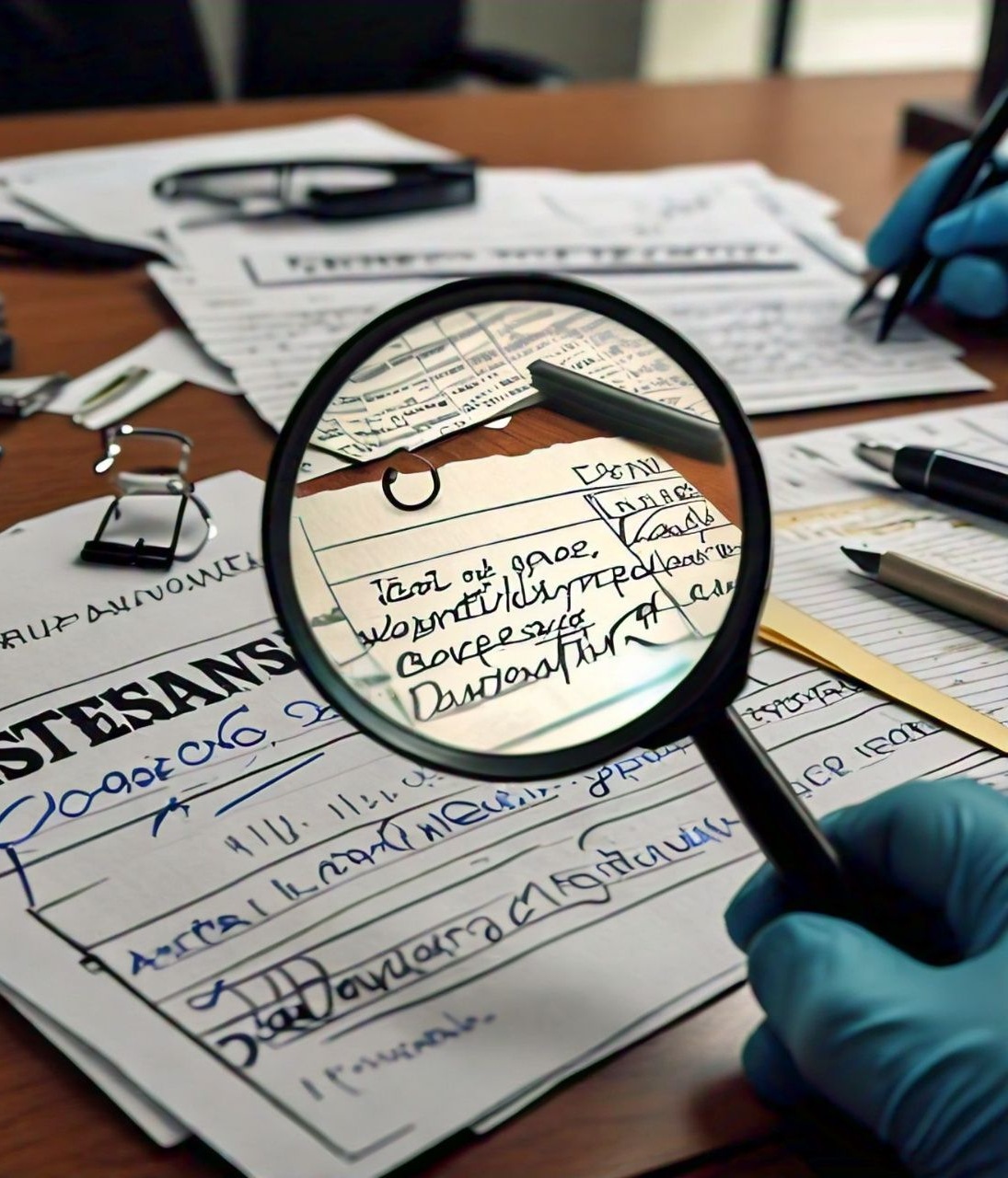
Forensic Handwriting Expert Services India
Brilliant Forensic Investigation (BFI) provides professional Handwriting Expert Services in India for the forensic examination, comparison and assessment of questioned handwriting appearing on personal, legal, financial, commercial, corporate and official documents. When the authorship of handwriting is disputed, the issue may extend far beyond whether two samples appear visually similar. A questioned entry may be relevant to a will, agreement, cheque, affidavit, anonymous letter, financial record, statement, property document, employment record or another document having legal or investigative significance. In such matters, a scientific handwriting examination can help determine whether the characteristics observed in questioned writing are consistent with suitable known material.
Forensic handwriting examination is a specialized field of questioned-document examination. It involves systematic observation and comparison of writing characteristics rather than a casual visual assessment. A forensic examiner considers the way letters, numerals and connecting strokes are formed, the relationship between characters, spacing, alignment, movement, rhythm, line quality, pen lifts, proportions and other recurring features. At the same time, the examiner must account for the fact that genuine handwriting naturally varies from one writing occasion to another. A person’s writing can be influenced by age, writing position, writing instrument, speed, physical condition, fatigue, stress, surface and many other circumstances.
BFI approaches handwriting examination as an evidence-based forensic service. The purpose is not to begin with an assumption that a document is genuine or forged, but to examine the available material objectively and determine what the evidence reasonably supports. Where appropriate, BFI can examine questioned handwriting together with signatures, altered entries, anonymous writings, document characteristics, ink, paper and other relevant evidence so that the forensic question is considered in its proper context.
What Is Forensic Handwriting Examination?
Forensic handwriting examination is the scientific examination of questioned handwriting to determine whether it shows characteristics consistent or inconsistent with handwriting attributed to a particular known source. The questioned writing may be a complete document, a short entry, a handwritten note, a signature, a group of initials, a numerical entry or another form of manually produced writing.
The examination generally requires two broad categories of material. The first is the questioned material whose authorship or authenticity is disputed. The second is known or admitted writing that can reasonably be attributed to the proposed writer. The examiner then evaluates the suitability of the material and compares relevant characteristics between the questioned and known writings.
The scientific significance of handwriting does not depend upon a single feature. A particular letter formation, slant, spacing or size may occur in the writing of many people. What becomes important is the combination of characteristics and the consistency with which they occur across suitable comparison material.
Why Handwriting Examination Matters
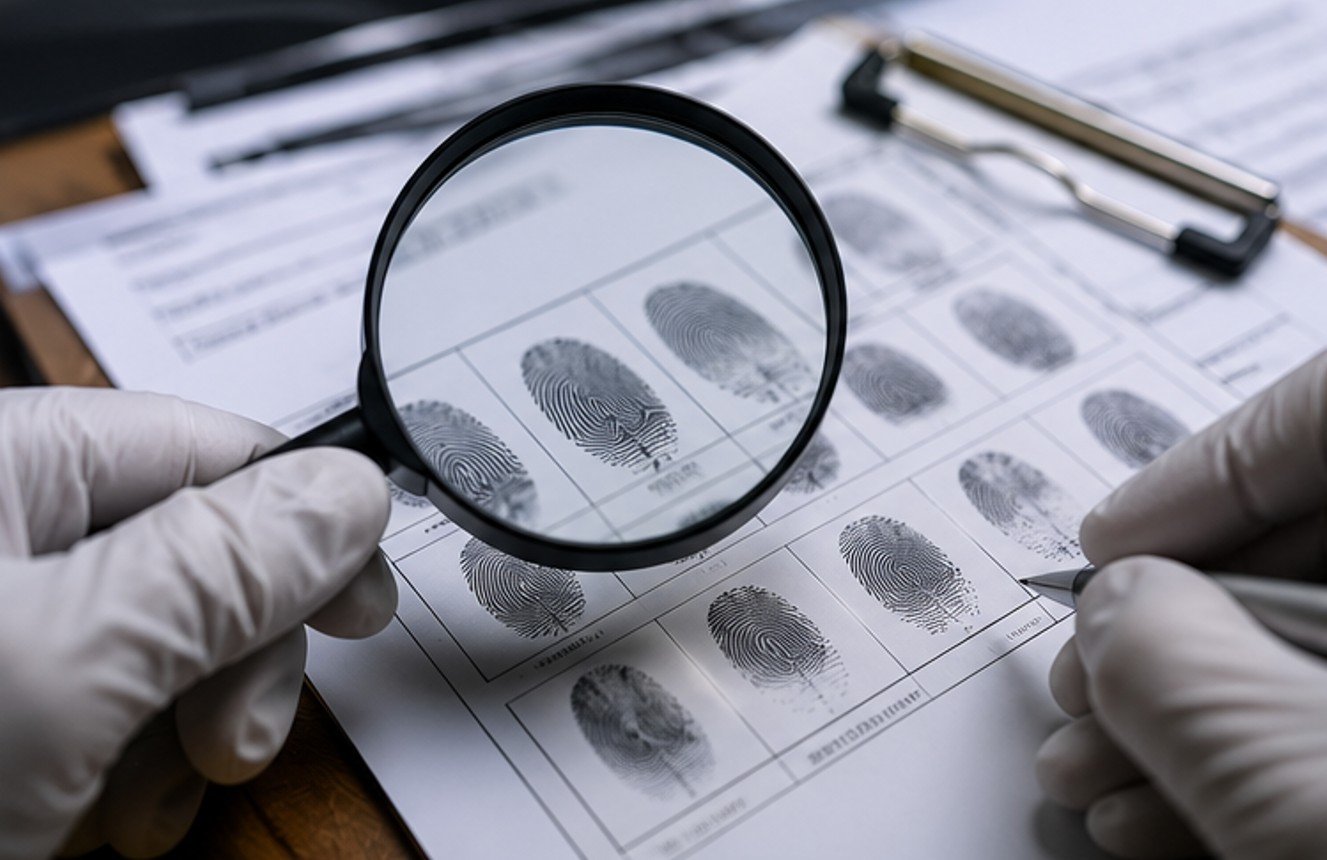
Handwriting can become significant whenever a person’s authorship of written material is disputed. A handwritten clause in an agreement, a signature on a cheque, an entry in a will, a note left at an incident location or a disputed handwritten declaration can become an important part of a legal or investigative matter.
In civil cases, handwriting disputes may arise in property transactions, succession matters, contractual disagreements, loan documentation, affidavits and other records. In criminal investigations, questioned handwriting may be associated with anonymous letters, threatening communications, suicide notes, alleged confessional material or other disputed writings. In business investigations, handwriting may appear on internal authorizations, financial records, employee documents or corporate records.
The significance of a handwriting examination comes from its ability to address a specific forensic question. It can provide technical information about the writing itself while leaving broader questions of legal validity, ownership, liability or guilt to the appropriate legal or investigative authority.
Understanding Natural Variation in Handwriting
One of the most important concepts in forensic handwriting examination is natural variation.
A genuine writer does not produce perfectly identical writing every time. Even a familiar signature or frequently used handwriting style can change slightly depending on circumstances. Writing with the dominant hand while seated at a desk can look different from writing while standing. A fast note may differ from carefully prepared handwriting. Age, illness, fatigue, medication, stress and writing conditions can also influence the appearance of writing.
For this reason, a forensic examiner should not compare one questioned sample against a single idealized version of a person’s handwriting and assume that every deviation represents forgery.
Instead, suitable known material should be used to understand the writer’s natural range of variation. This allows the examiner to consider whether differences fall within an expected range or whether the overall characteristics present a different forensic pattern.
Handwriting Characteristics Examined by BFI
A forensic handwriting examination may involve many characteristics simultaneously. These can include letter construction, numeral formation, proportions, spacing, alignment, baseline behavior, connecting strokes, initial and terminal strokes, relative size, writing movement, line quality, pen lifts, rhythm and recurring habits.
The examiner may also assess the way strokes are formed and connected rather than focusing solely on their final visual shape. The manner in which writing begins, changes direction and terminates can contain information about how the writing was physically produced.
Pressure-related appearance, tremor, hesitation and pen movement may also be considered where the available material permits meaningful assessment. These characteristics are not normally treated as isolated identity markers. Their significance arises from their relationship with the rest of the writing system.
The objective is to determine whether the combination of observed characteristics is consistent with the comparison material and the forensic question presented.
Comparative Handwriting Examination
Comparative handwriting examination involves systematic comparison of questioned writing with known writing.
The quality of this comparison depends on the quality of both evidence sets. The known writing must be sufficiently reliable and genuinely attributable to the proposed writer, while the questioned writing must contain enough usable characteristics for examination.
Comparability is also important. Handwriting in the same language and script may be more informative than a comparison between fundamentally different forms of writing. A hurried note, a carefully prepared legal document and a signature on a small form can each present different writing circumstances.
BFI therefore assesses the nature of the questioned and known material before treating a comparison as a meaningful basis for a forensic opinion.
Disputed and Admitted Handwriting
In a handwriting dispute, the questioned material is the writing whose authorship is uncertain or contested. Known or admitted material is writing that can reasonably be attributed to a particular individual.
The relationship between these two categories is central to the examination.
A known sample should not automatically be considered suitable merely because the document is accepted by a client. Its origin, authenticity, writing conditions, date and comparability can all affect its value.
Where possible, multiple known samples can provide a better representation of natural variation than a single isolated specimen.
BFI can assess both questioned and known material as part of a structured forensic comparison.
Handwriting Authorship Examination
Authorship examination addresses the question of whether questioned writing is consistent with writing attributable to a particular writer.
This type of examination may become relevant when the writer of a note, letter, handwritten entry or other document is unknown or disputed.
The process involves comparison of relevant characteristics between the questioned writing and appropriate known material. The examiner considers meaningful similarities as well as meaningful differences and evaluates whether the observed characteristics support a particular source proposition.
A forensic authorship opinion should be limited to what the available evidence can support. Where the evidence does not permit a sufficiently reliable conclusion, an appropriately limited or inconclusive result may be scientifically preferable to an overstated finding.
Handwriting Identification and Verification
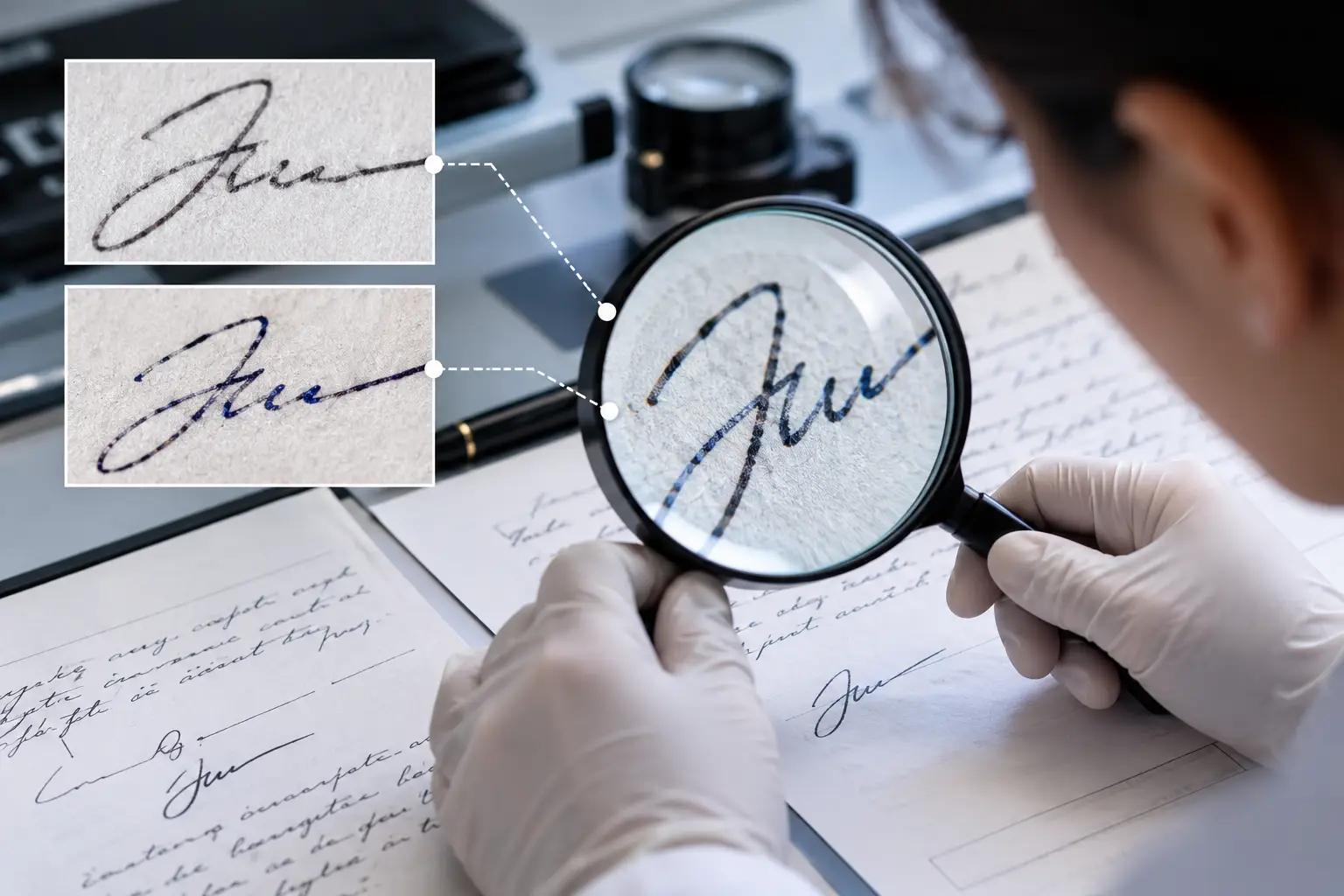
Handwriting identification and verification are commonly requested when a client wants to know whether two writings appear to originate from the same writer.
BFI approaches this question through forensic comparison rather than ordinary visual matching. The examiner considers multiple writing characteristics and evaluates them in relation to natural variation and the quality of the comparison material.
This distinction is important because two samples can look superficially similar while demonstrating meaningful differences in execution, while genuine samples from the same writer can exhibit visible differences caused by natural variation.
Disguised Handwriting Examination
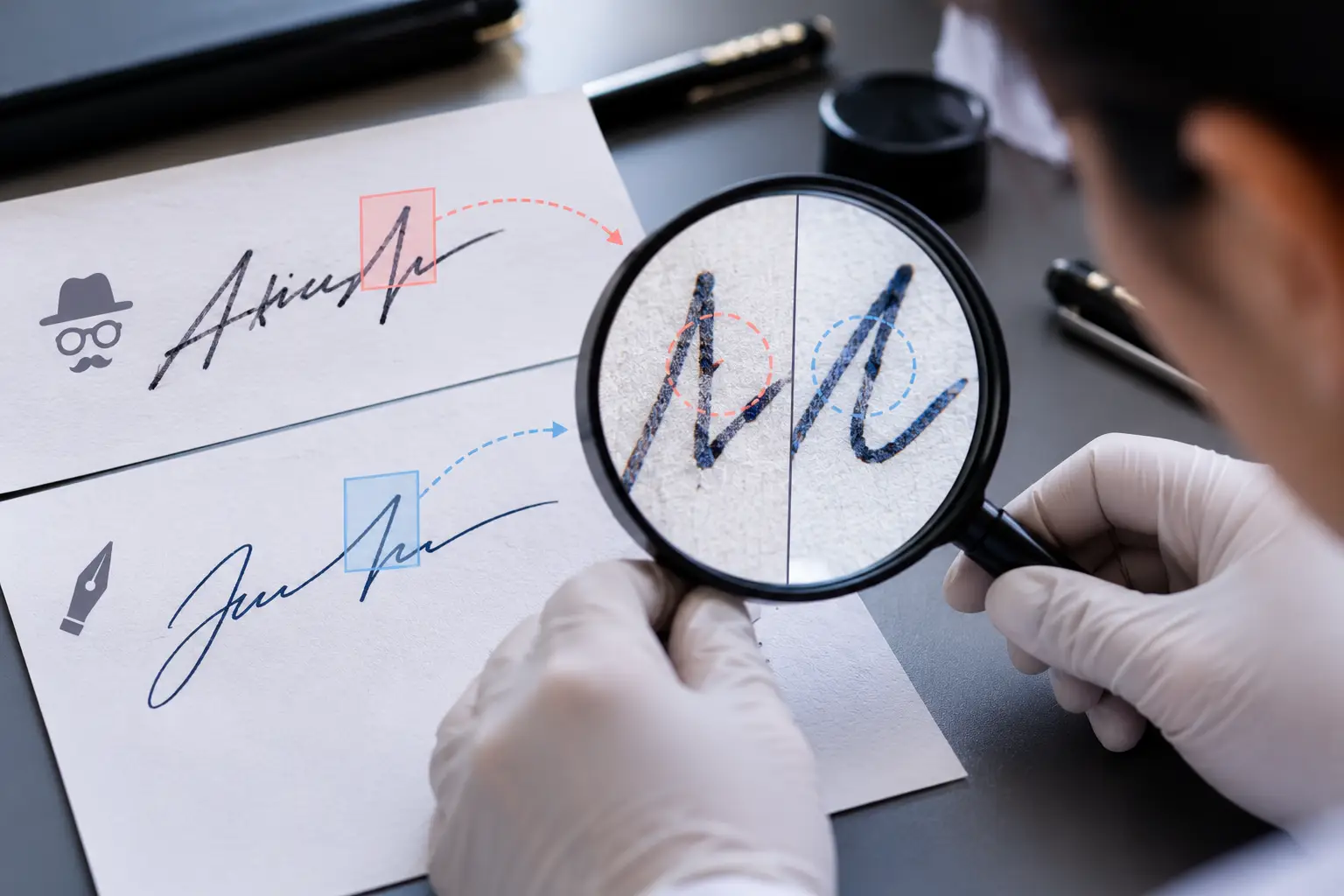
Disguised handwriting occurs when a writer deliberately changes aspects of their normal writing in an attempt to conceal authorship.
A person may modify letter forms, alter the size or slant of writing, change spacing, write unusually slowly or deliberately adopt a different style. Such changes can make a questioned sample appear substantially different from a writer’s ordinary handwriting.
The forensic challenge is to distinguish deliberate disguise from genuine variation and other factors that may affect writing.
BFI can examine questioned material together with suitable known samples to determine whether recurring features remain despite apparent stylistic changes.
Traced Handwriting and Signature Examination
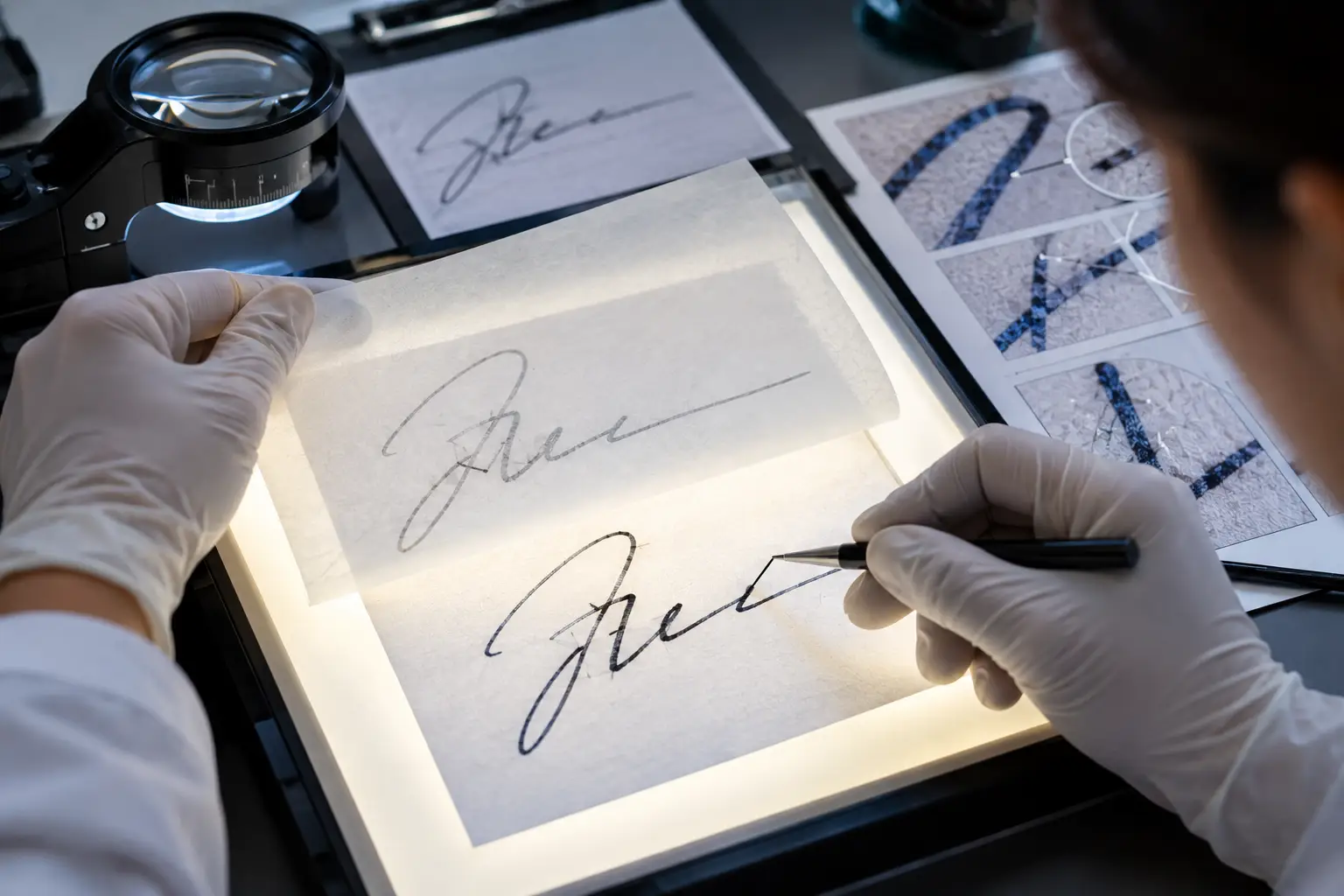
Tracing is another form of questioned writing in which the writer attempts to reproduce an existing model.
Because traced writing involves following a pre-existing outline rather than generating natural writing movement, the resulting strokes may exhibit characteristics different from ordinary freehand writing.
Depending on the quality of the evidence, forensic examination may consider hesitation, restricted movement, unnatural line quality, unusual pen lifts, stroke continuity and other relevant features.
A tracing opinion must be based on the actual evidence available and should not be reached simply because a signature appears slow or unusually controlled.
Simulated Handwriting Examination
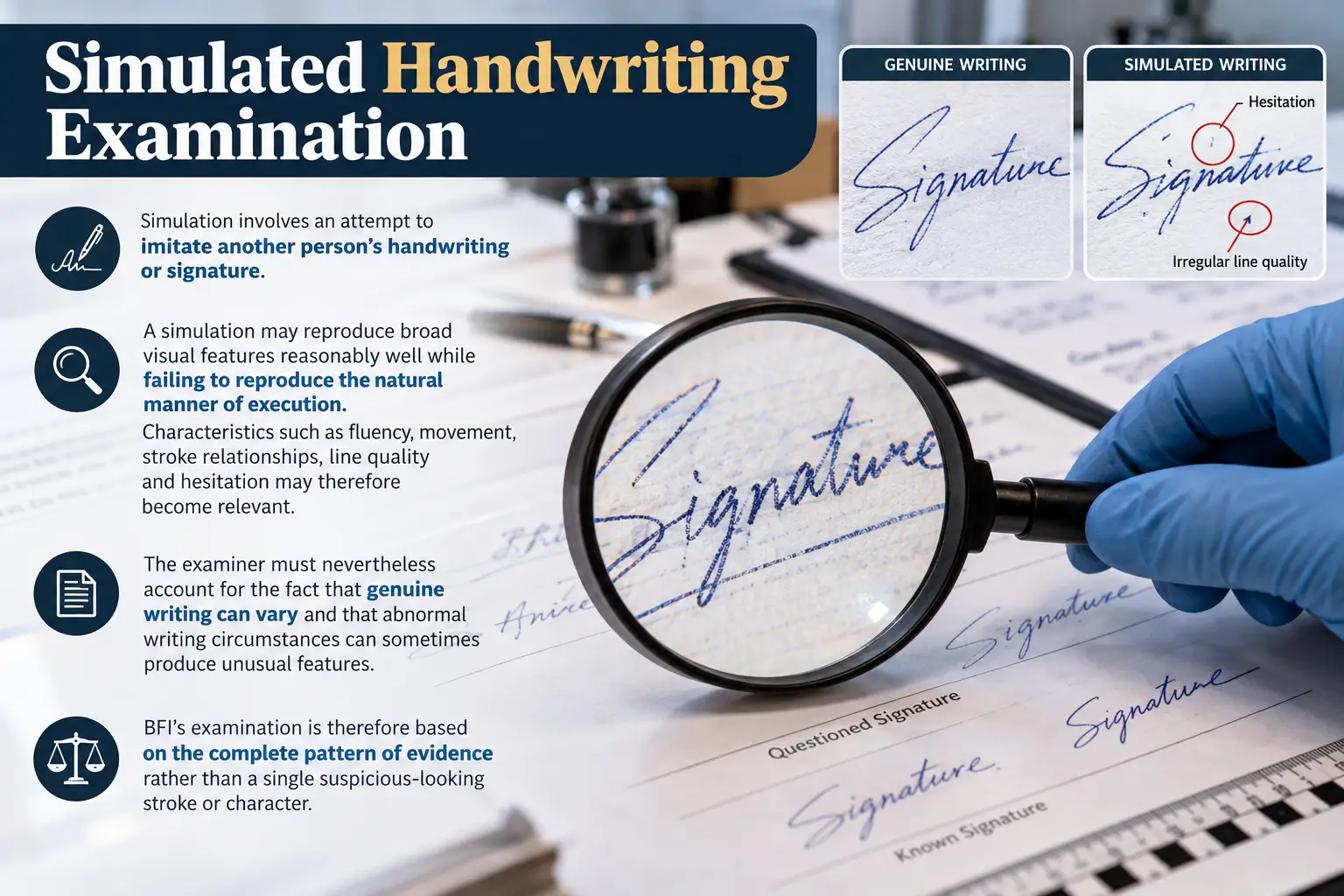
Simulation involves an attempt to imitate another person’s handwriting or signature.
A simulation may reproduce broad visual features reasonably well while failing to reproduce the natural manner of execution. Characteristics such as fluency, movement, stroke relationships, line quality and hesitation may therefore become relevant.
The examiner must nevertheless account for the fact that genuine writing can vary and that abnormal writing circumstances can sometimes produce unusual features.
BFI’s examination is therefore based on the complete pattern of evidence rather than a single suspicious-looking stroke or character.
Forged Handwriting Detection
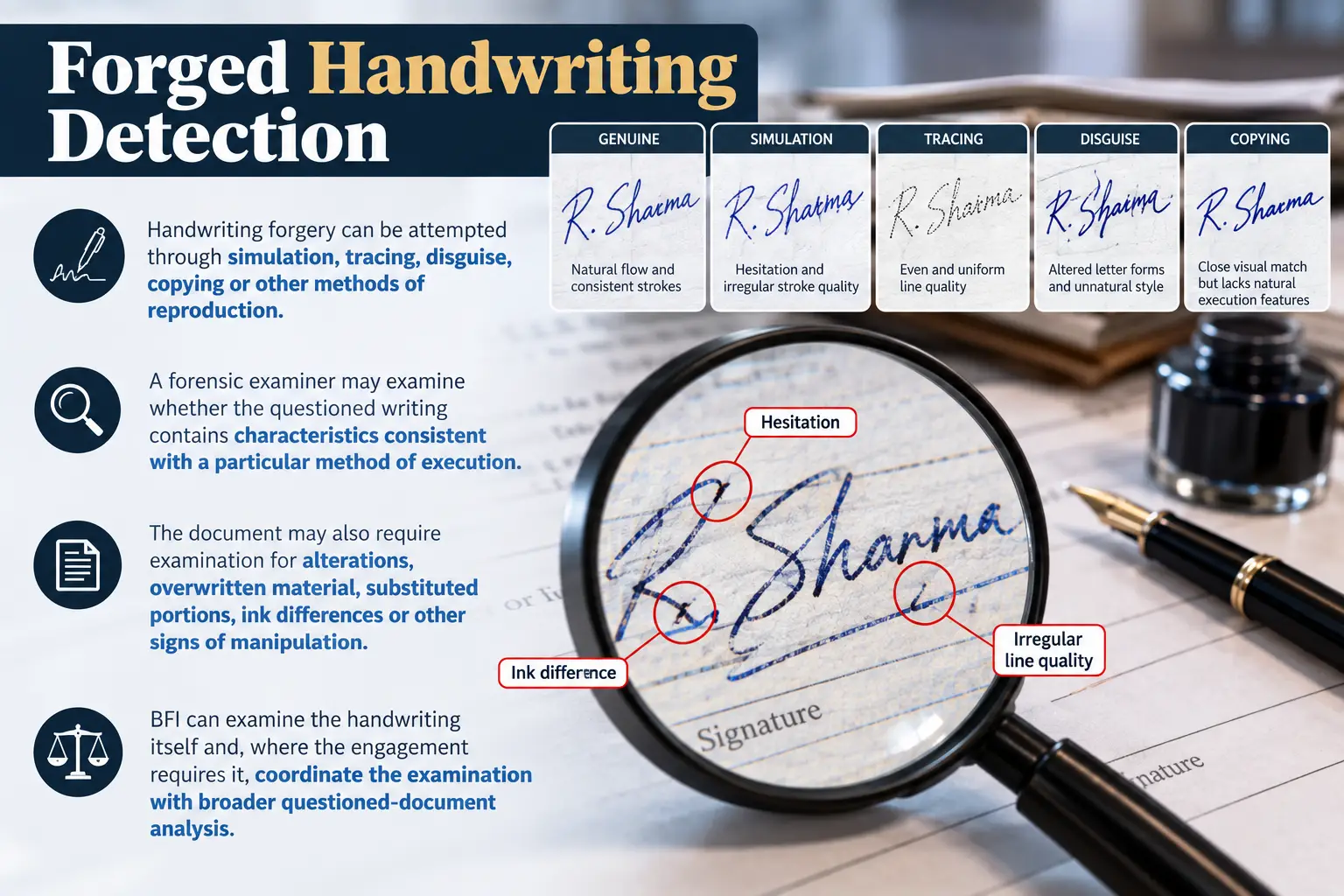
Handwriting forgery can be attempted through simulation, tracing, disguise, copying or other methods of reproduction.
A forensic examiner may examine whether the questioned writing contains characteristics consistent with a particular method of execution. The document may also require examination for alterations, overwritten material, substituted portions, ink differences or other signs of manipulation.
BFI can examine the handwriting itself and, where the engagement requires it, coordinate the examination with broader questioned-document analysis.
Anonymous Handwriting Examination
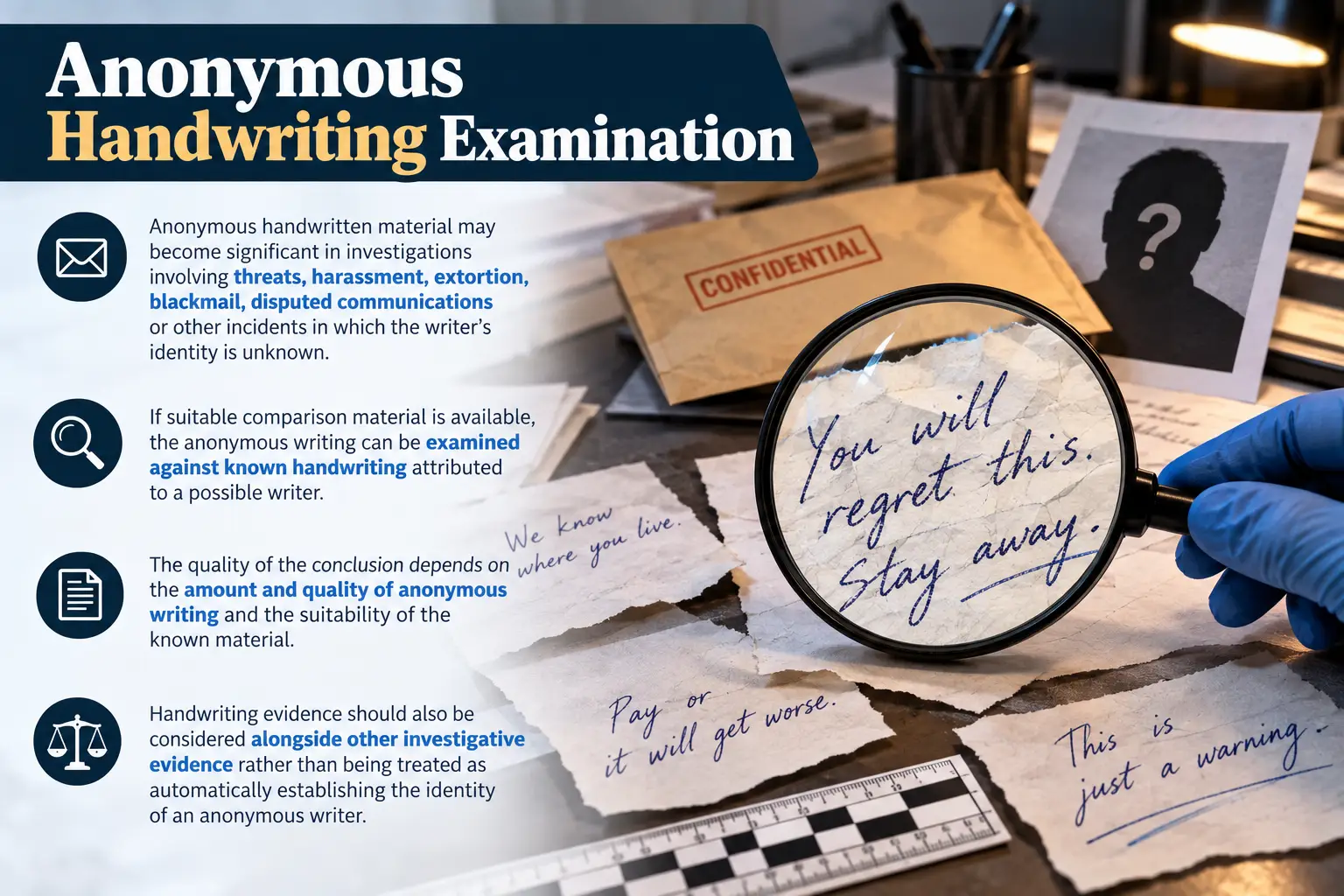
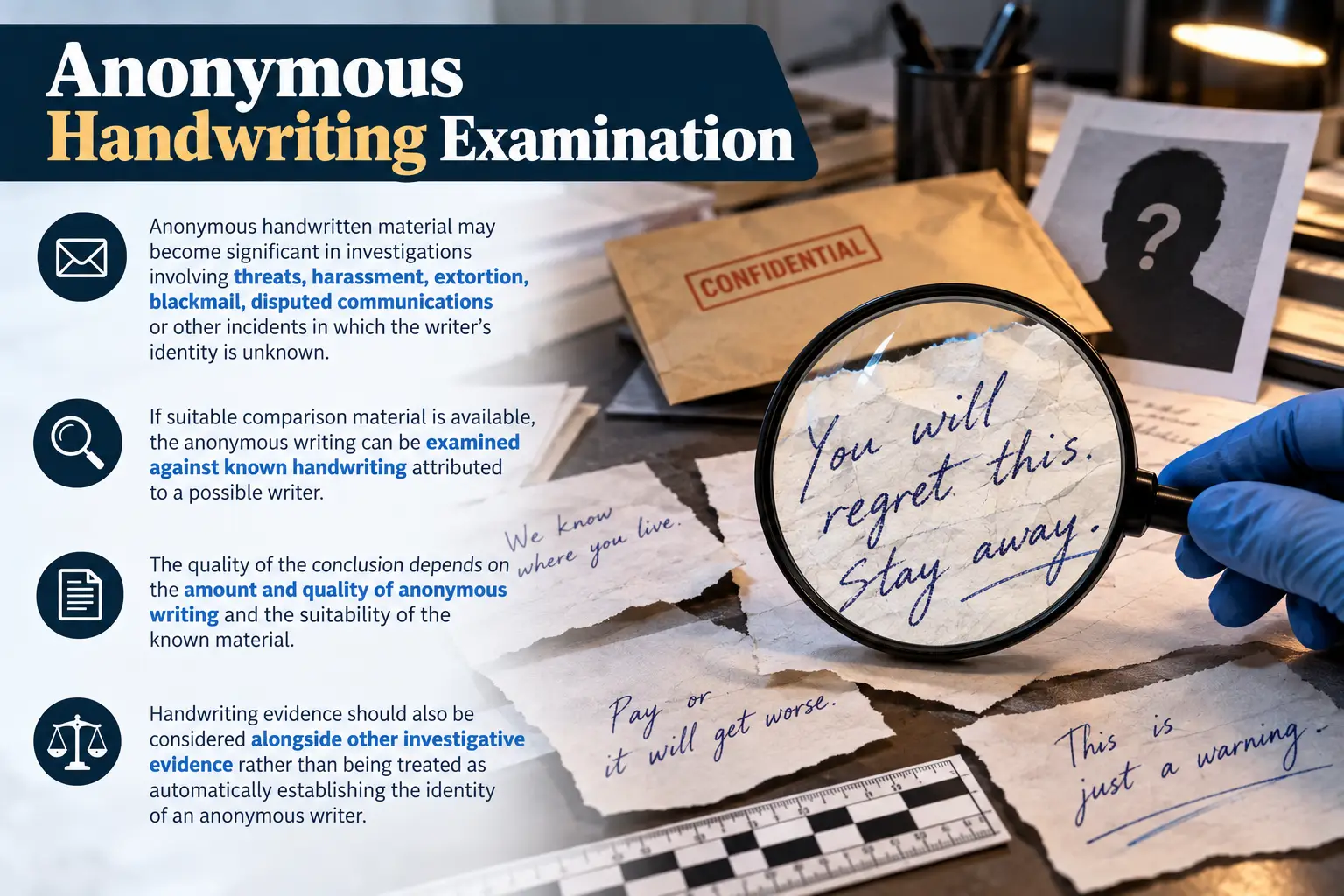
Anonymous handwritten material may become significant in investigations involving threats, harassment, extortion, blackmail, disputed communications or other incidents in which the writer’s identity is unknown.
If suitable comparison material is available, the anonymous writing can be examined against known handwriting attributed to a possible writer.
The quality of the conclusion depends on the amount and quality of anonymous writing and the suitability of the known material.
Handwriting evidence should also be considered alongside other investigative evidence rather than being treated as automatically establishing the identity of an anonymous writer.
Handwriting Examination of Wills and Testamentary Documents
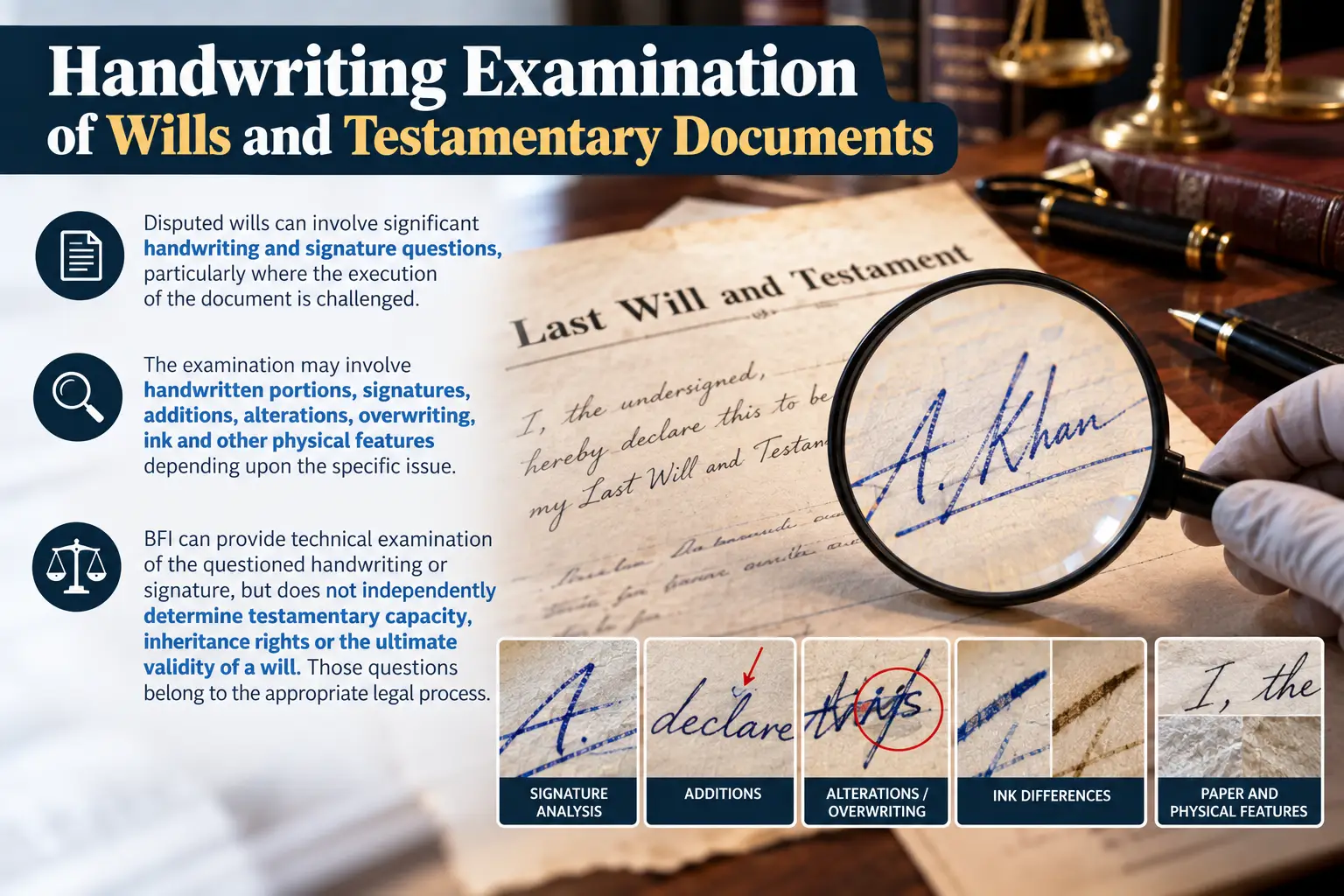
Disputed wills can involve significant handwriting and signature questions, particularly where the execution of the document is challenged.
The examination may involve handwritten portions, signatures, additions, alterations, overwriting, ink and other physical features depending upon the specific issue.
BFI can provide technical examination of the questioned handwriting or signature, but does not independently determine testamentary capacity, inheritance rights or the ultimate validity of a will. Those questions belong to the appropriate legal process.
Anonymous Letter and Threatening-Note Investigation
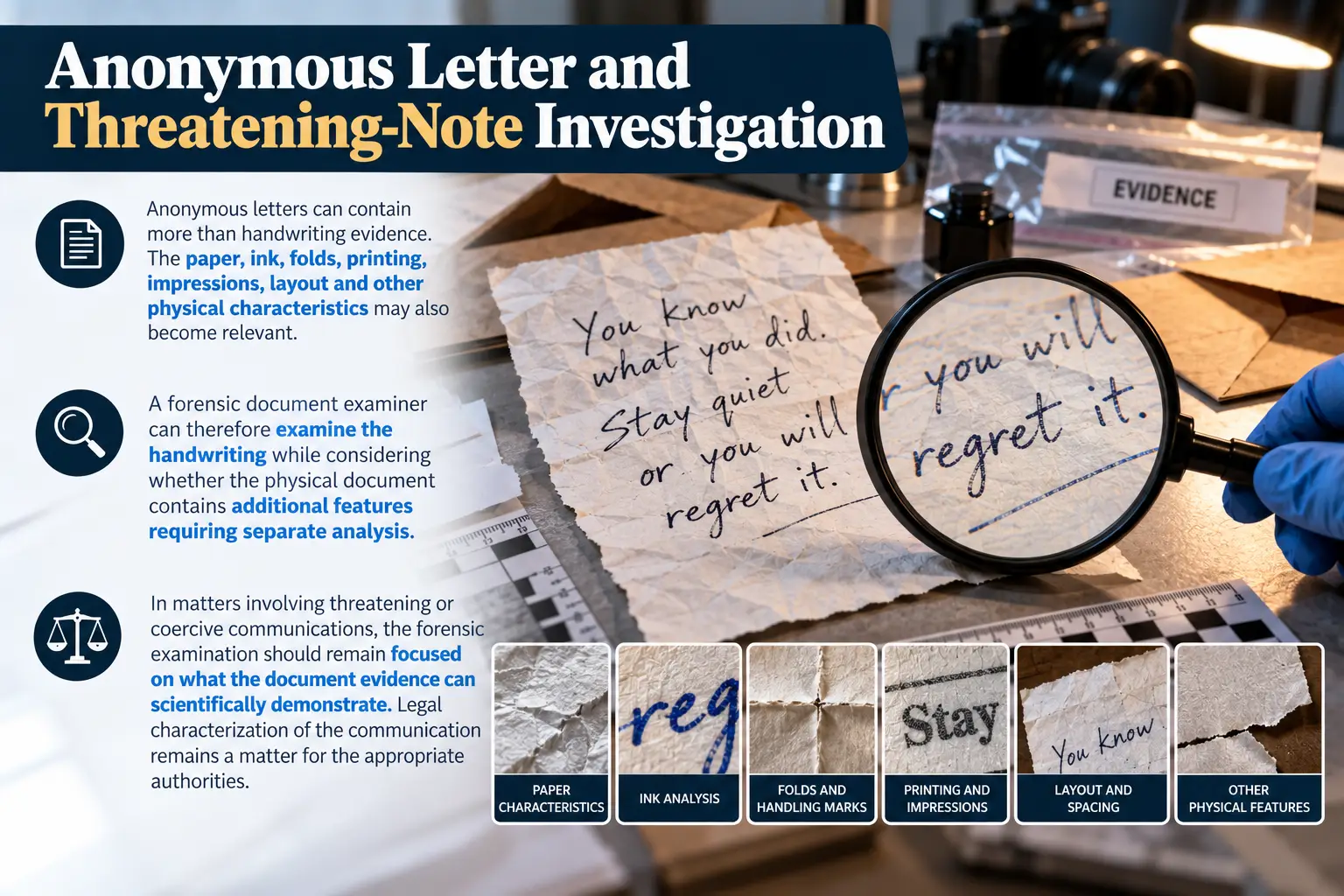
Anonymous letters can contain more than handwriting evidence. The paper, ink, folds, printing, impressions, layout and other physical characteristics may also become relevant.
A forensic document examiner can therefore examine the handwriting while considering whether the physical document contains additional features requiring separate analysis.
In matters involving threatening or coercive communications, the forensic examination should remain focused on what the document evidence can scientifically demonstrate. Legal characterization of the communication remains a matter for the appropriate authorities.
Handwriting Examination in Property Disputes
Property-related disputes can involve agreements, sale deeds, affidavits, powers of attorney, declarations and other documents containing handwriting or signatures.
A party may dispute whether a particular person wrote an entry, signed a document or made an amendment.
BFI can examine the relevant handwriting and document evidence to address the forensic question presented. Where required, handwriting examination can be considered together with document alteration, ink, paper or signature analysis.
Questions concerning title, possession, ownership or enforceability are legal questions and should not be confused with the forensic examination itself.
Handwriting Examination in Banking and Cheque Disputes
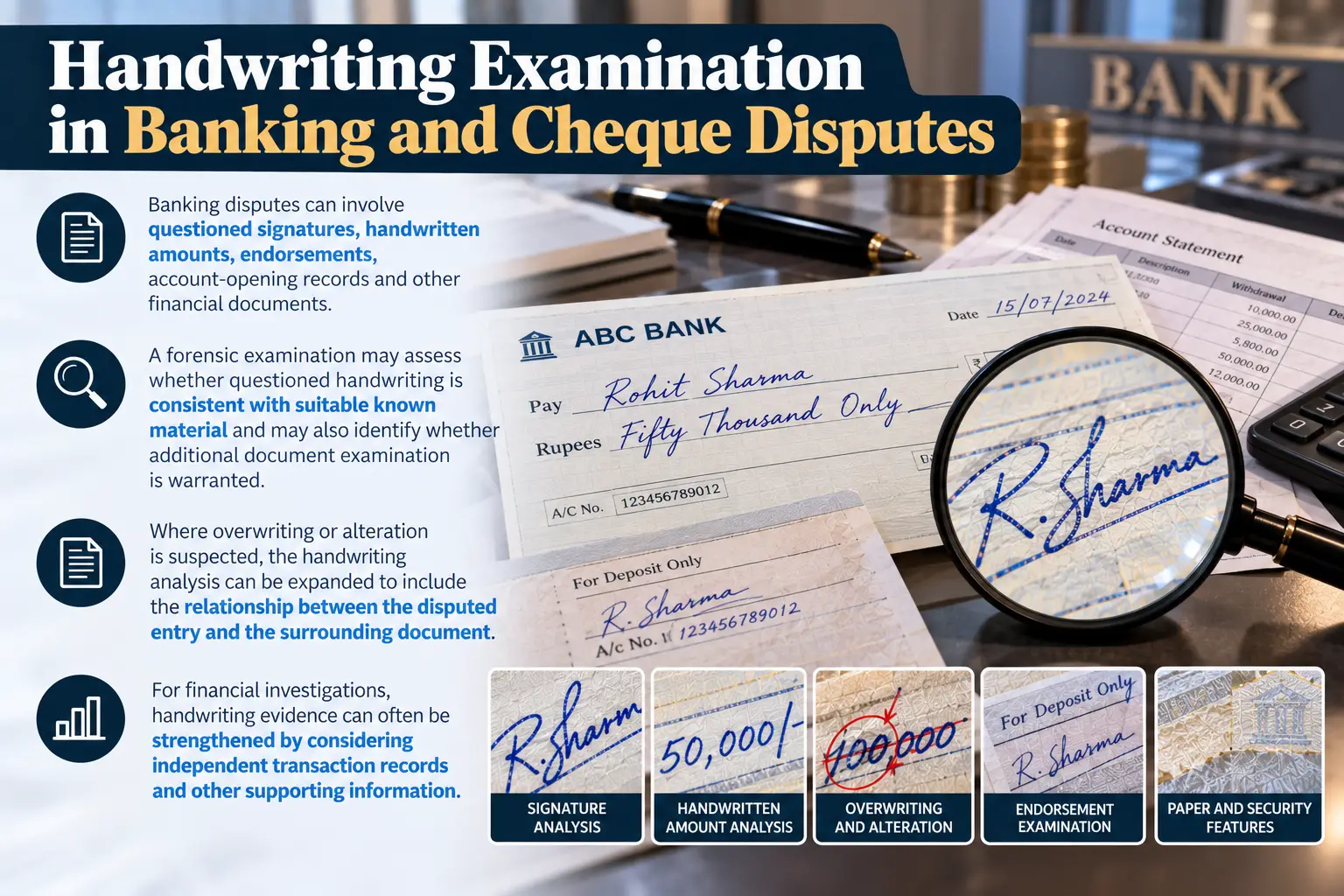
Banking disputes can involve questioned signatures, handwritten amounts, endorsements, account-opening records and other financial documents.
A forensic examination may assess whether questioned handwriting is consistent with suitable known material and may also identify whether additional document examination is warranted.
Where overwriting or alteration is suspected, the handwriting analysis can be expanded to include the relationship between the disputed entry and the surrounding document.
For financial investigations, handwriting evidence can often be strengthened by considering independent transaction records and other supporting information.
Handwriting Examination in Corporate Investigations
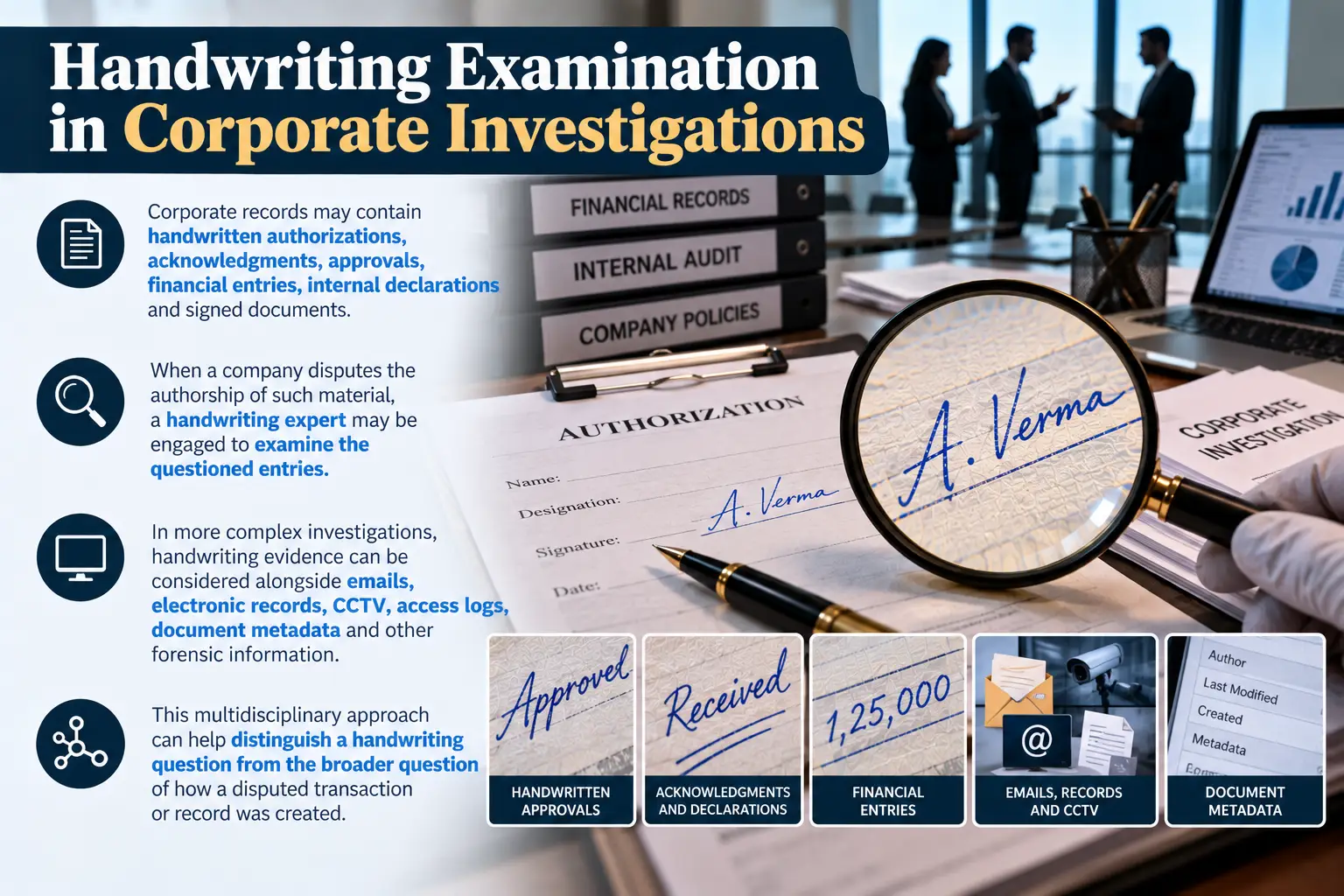
Corporate records may contain handwritten authorizations, acknowledgments, approvals, financial entries, internal declarations and signed documents.
When a company disputes the authorship of such material, a handwriting expert may be engaged to examine the questioned entries.
In more complex investigations, handwriting evidence can be considered alongside emails, electronic records, CCTV, access logs, document metadata and other forensic information.
This multidisciplinary approach can help distinguish a handwriting question from the broader question of how a disputed transaction or record was created.
Handwriting Examination in Employment and HR Disputes
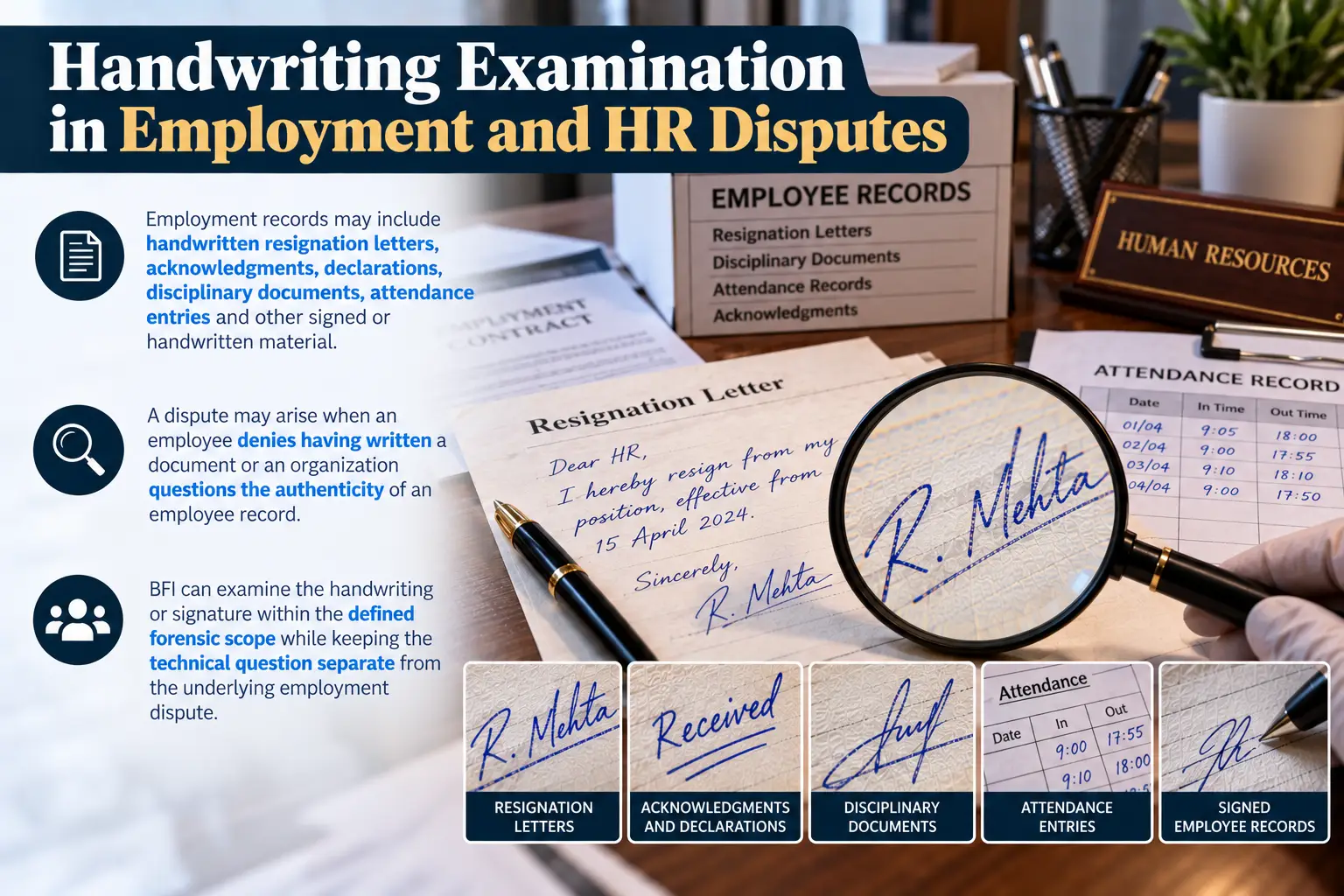
Employment records may include handwritten resignation letters, acknowledgments, declarations, disciplinary documents, attendance entries and other signed or handwritten material.
A dispute may arise when an employee denies having written a document or an organization questions the authenticity of an employee record.
BFI can examine the handwriting or signature within the defined forensic scope while keeping the technical question separate from the underlying employment dispute.
Handwriting Examination in Criminal Investigations
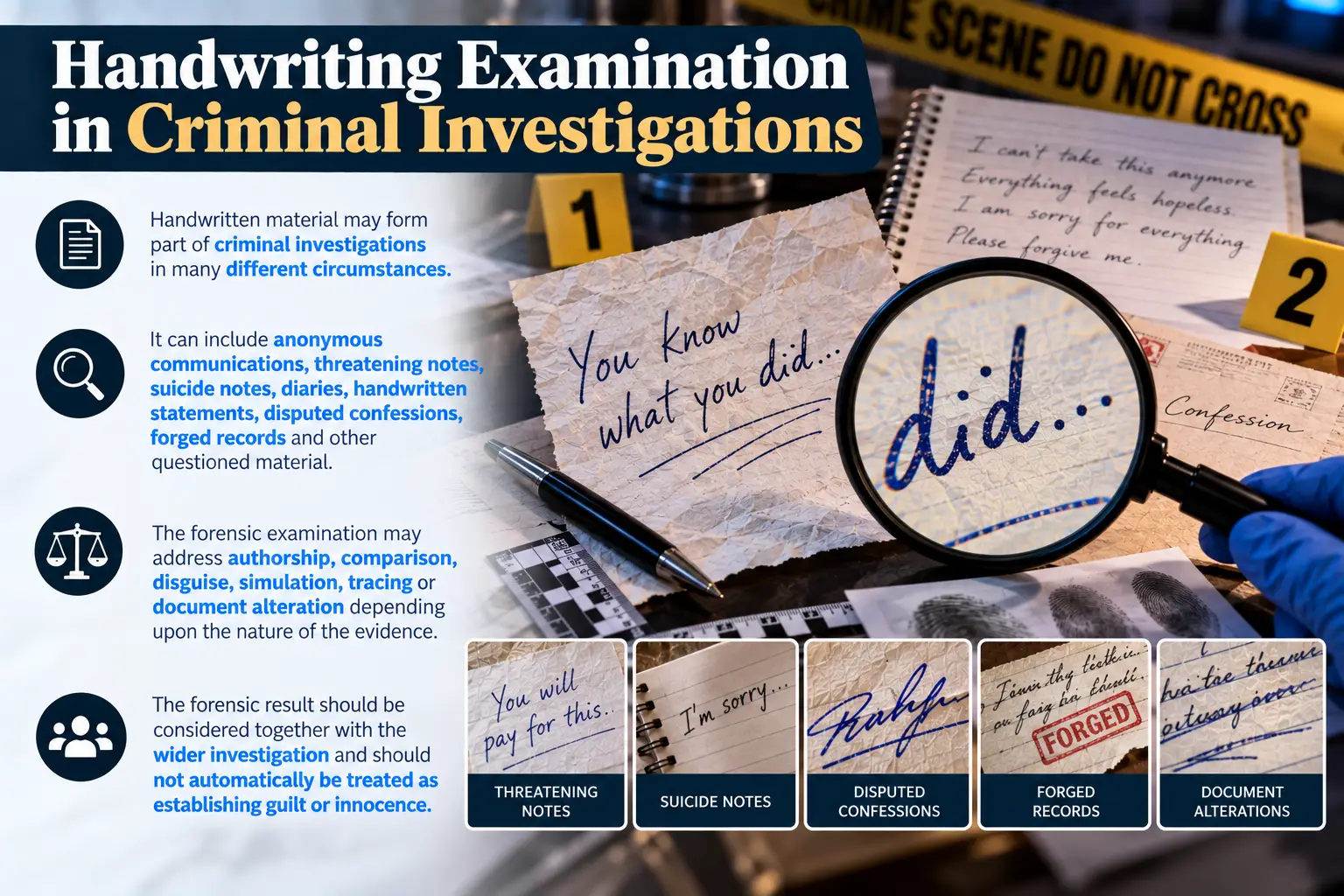
Handwritten material may form part of criminal investigations in many different circumstances.
It can include anonymous communications, threatening notes, suicide notes, diaries, handwritten statements, disputed confessions, forged records and other questioned material.
The forensic examination may address authorship, comparison, disguise, simulation, tracing or document alteration depending upon the nature of the evidence.
The forensic result should be considered together with the wider investigation and should not automatically be treated as establishing guilt or innocence.
Handwriting Examination of Official and Medical Records
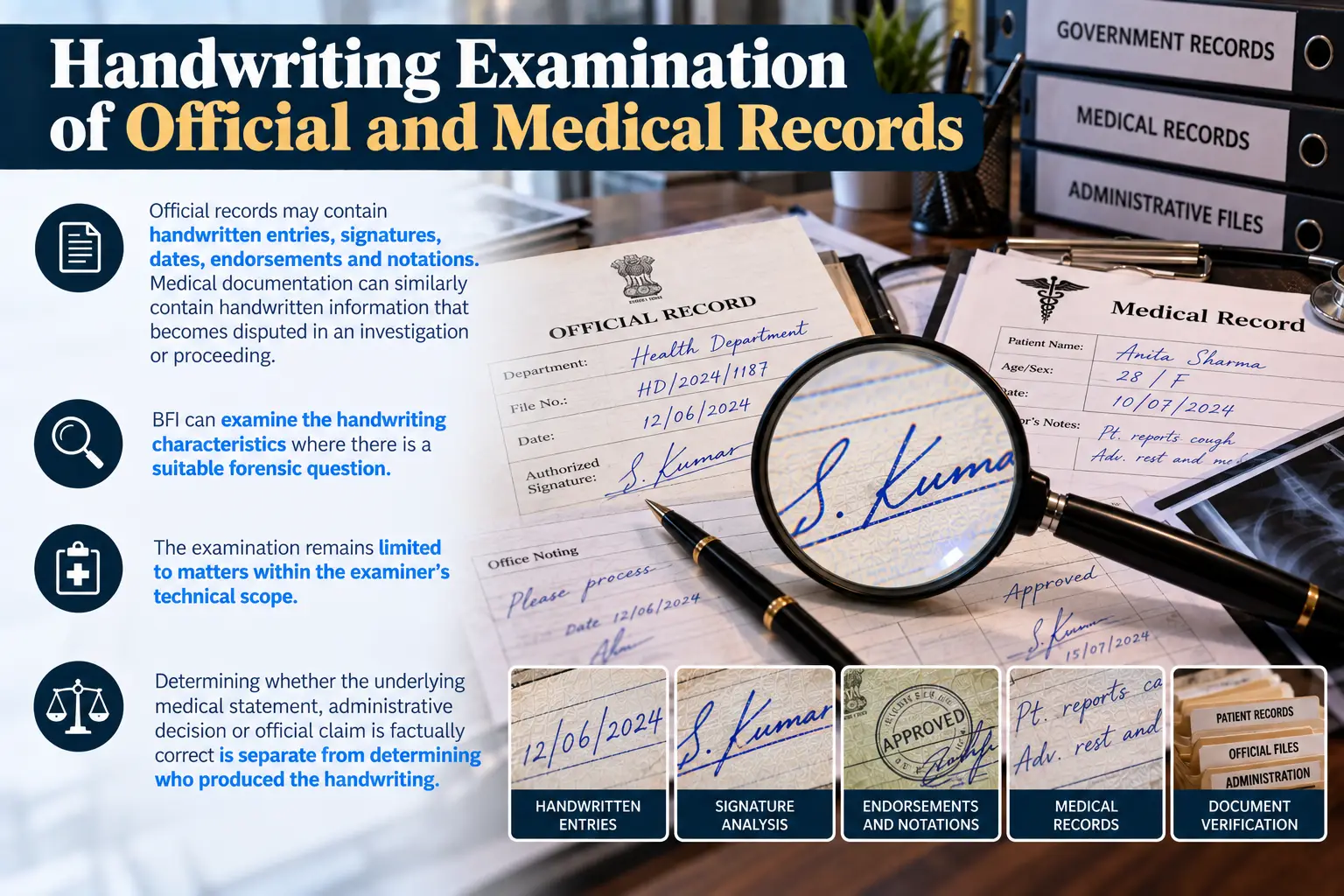
Official records may contain handwritten entries, signatures, dates, endorsements and notations. Medical documentation can similarly contain handwritten information that becomes disputed in an investigation or proceeding.
BFI can examine the handwriting characteristics where there is a suitable forensic question.
The examination remains limited to matters within the examiner’s technical scope. Determining whether the underlying medical statement, administrative decision or official claim is factually correct is separate from determining who produced the handwriting.
Examination of Altered Handwritten Documents
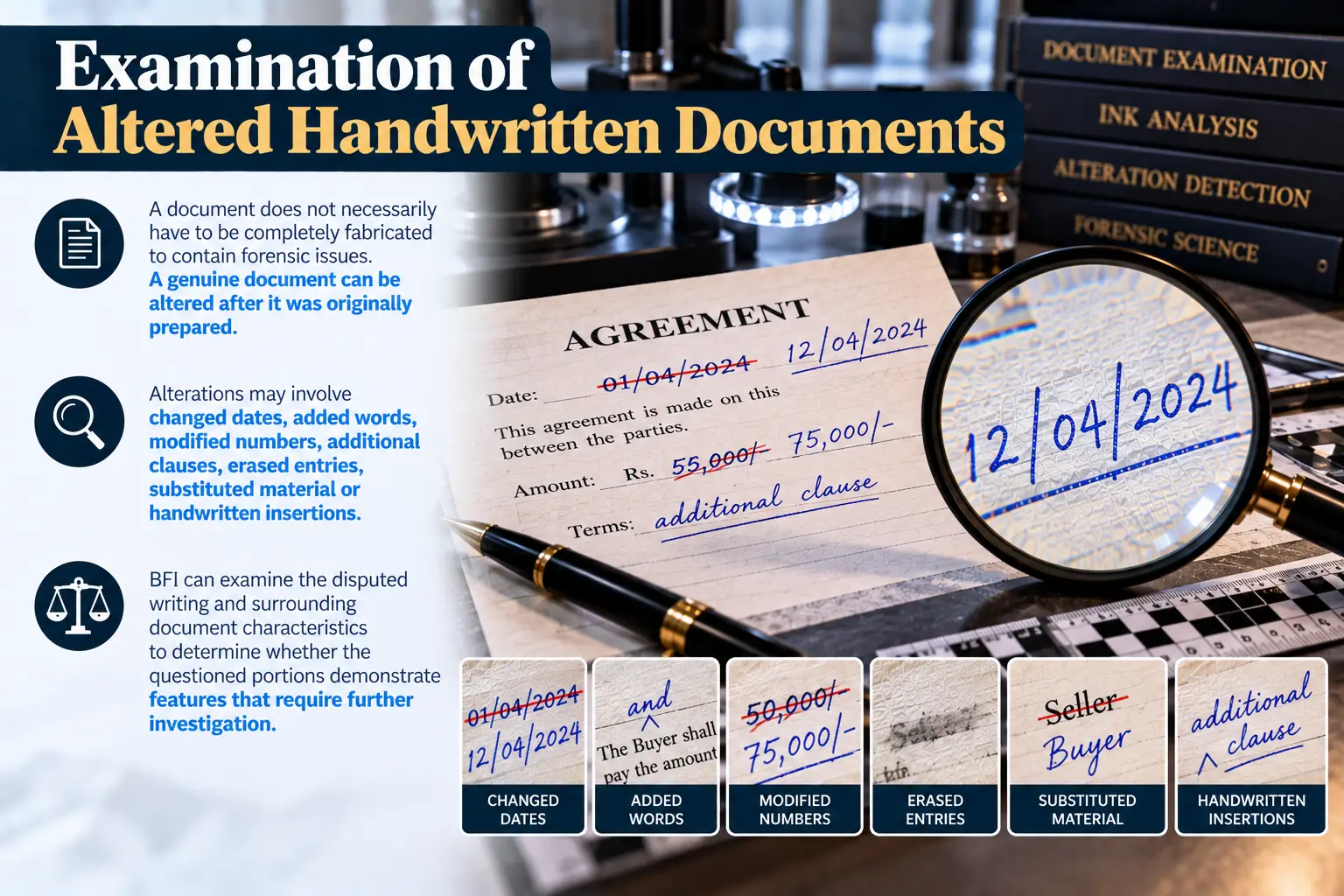
A document does not necessarily have to be completely fabricated to contain forensic issues. A genuine document can be altered after it was originally prepared.
Alterations may involve changed dates, added words, modified numbers, additional clauses, erased entries, substituted material or handwritten insertions.
BFI can examine the disputed writing and surrounding document characteristics to determine whether the questioned portions demonstrate features that require further investigation.
Erasure and Obliteration Examination
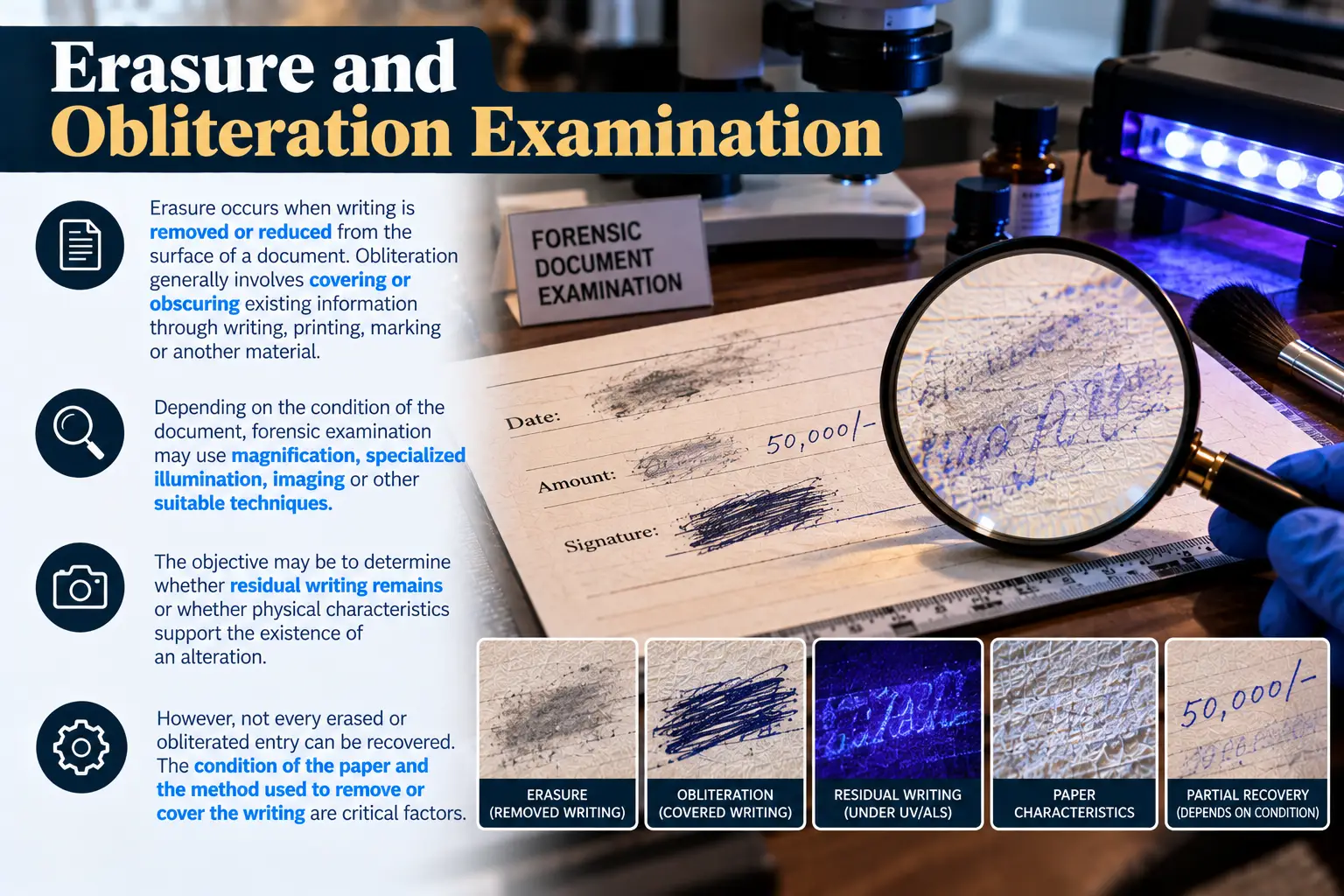
Erasure occurs when writing is removed or reduced from the surface of a document. Obliteration generally involves covering or obscuring existing information through writing, printing, marking or another material.
Depending on the condition of the document, forensic examination may use magnification, specialized illumination, imaging or other suitable techniques.
The objective may be to determine whether residual writing remains or whether physical characteristics support the existence of an alteration.
However, not every erased or obliterated entry can be recovered. The condition of the paper and the method used to remove or cover the writing are critical factors.
Overwriting and Interlineation Examination
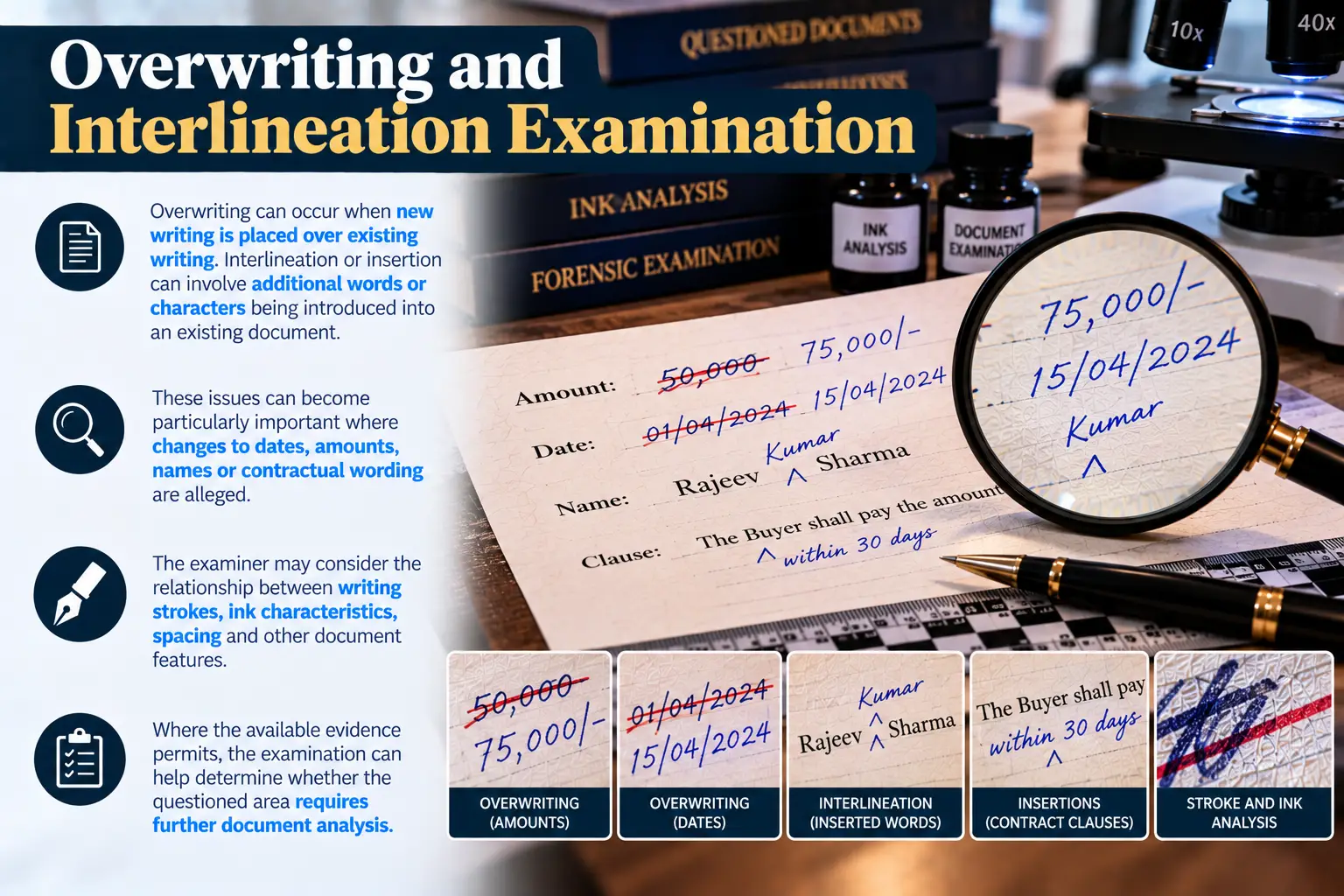
Overwriting can occur when new writing is placed over existing writing. Interlineation or insertion can involve additional words or characters being introduced into an existing document.
These issues can become particularly important where changes to dates, amounts, names or contractual wording are alleged.
The examiner may consider the relationship between writing strokes, ink characteristics, spacing and other document features.
Where the available evidence permits, the examination can help determine whether the questioned area requires further document analysis.
Sequence of Writing and Stroke Examination
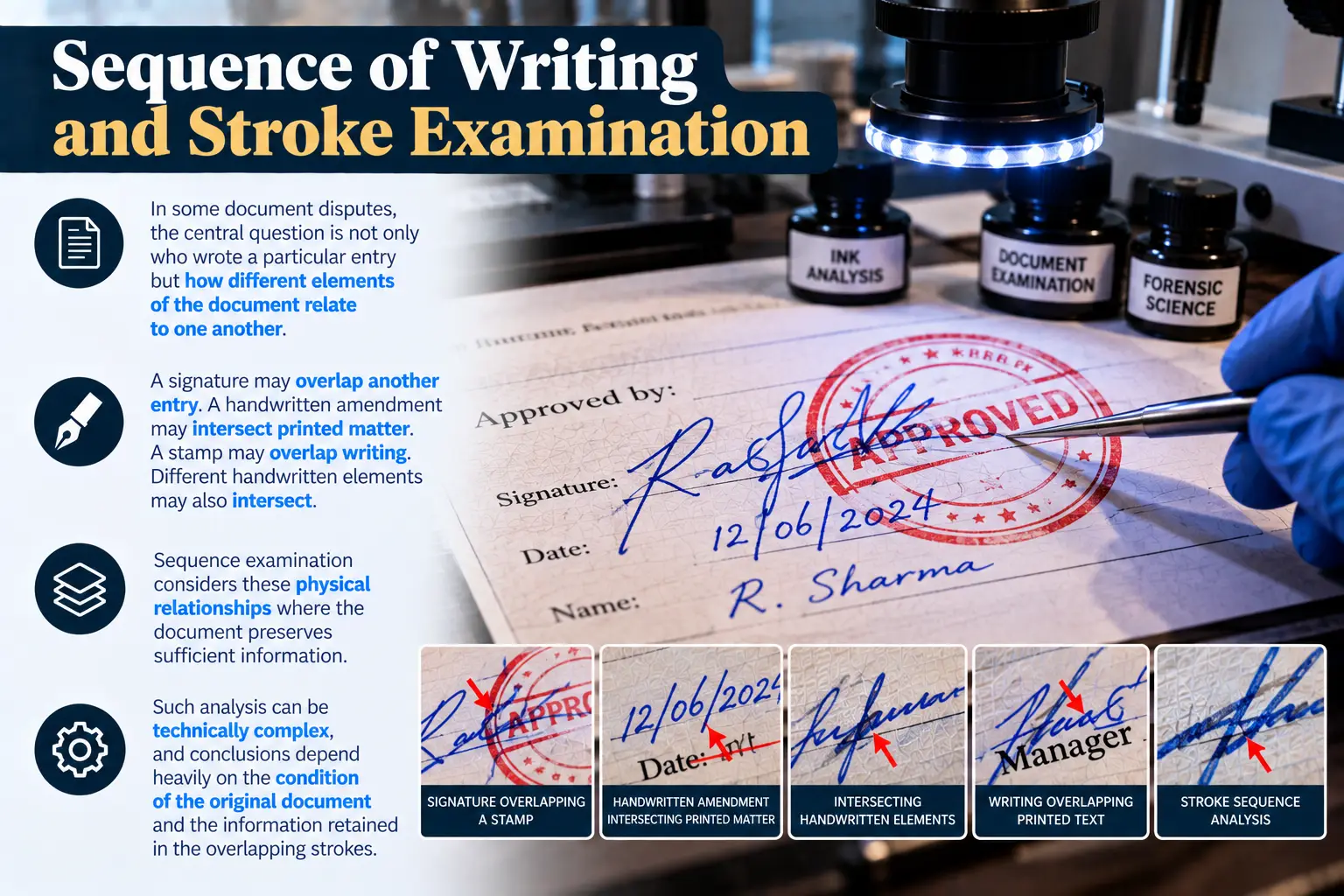
In some document disputes, the central question is not only who wrote a particular entry but how different elements of the document relate to one another.
A signature may overlap another entry. A handwritten amendment may intersect printed matter. A stamp may overlap writing. Different handwritten elements may also intersect.
Sequence examination considers these physical relationships where the document preserves sufficient information.
Such analysis can be technically complex, and conclusions depend heavily on the condition of the original document and the information retained in the overlapping strokes.
Ink and Handwriting Examination
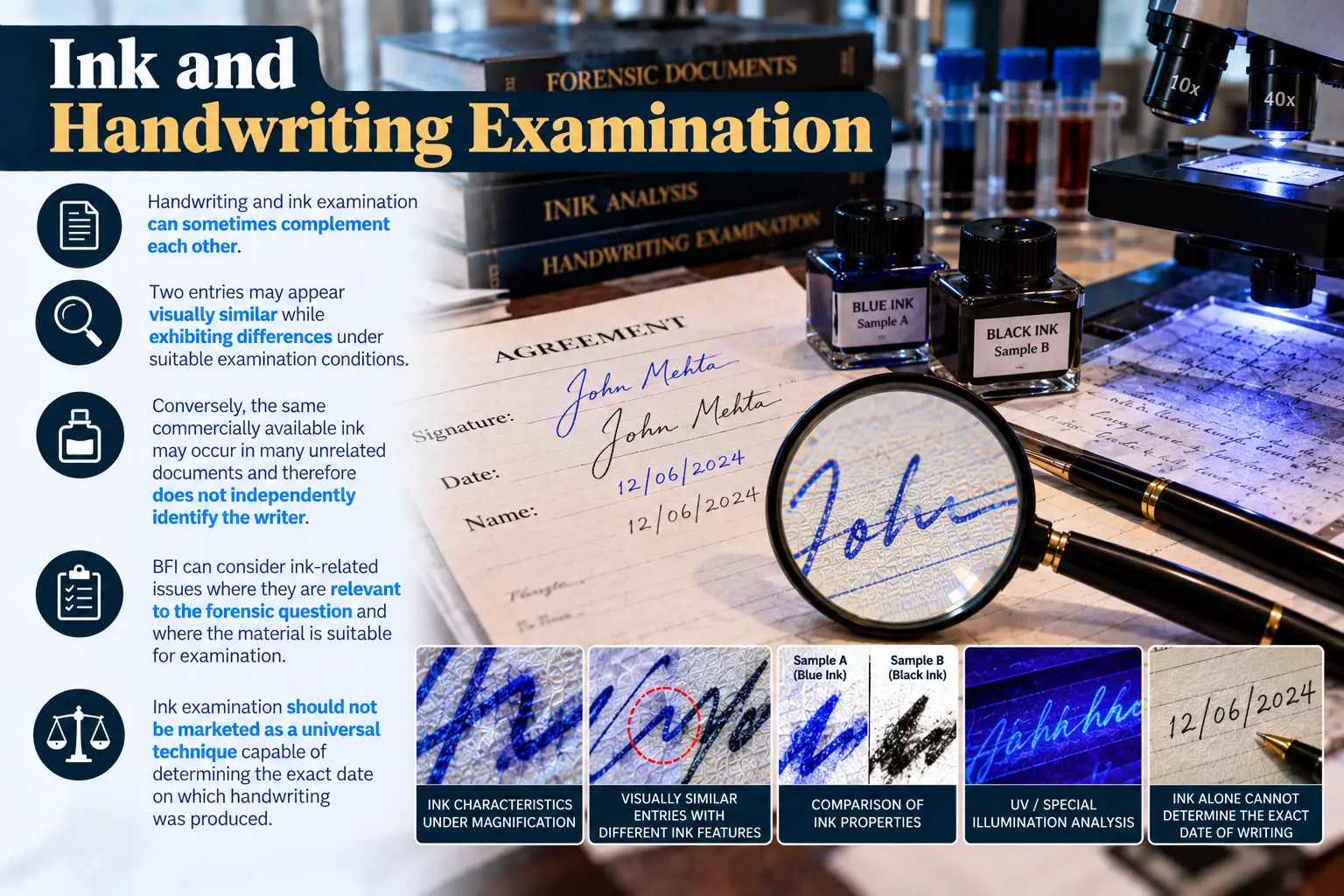
Handwriting and ink examination can sometimes complement each other.
Two entries may appear visually similar while exhibiting differences under suitable examination conditions. Conversely, the same commercially available ink may occur in many unrelated documents and therefore does not independently identify the writer.
BFI can consider ink-related issues where they are relevant to the forensic question and where the material is suitable for examination.
Ink examination should not be marketed as a universal technique capable of determining the exact date on which handwriting was produced.
Paper Examination in Handwriting Cases
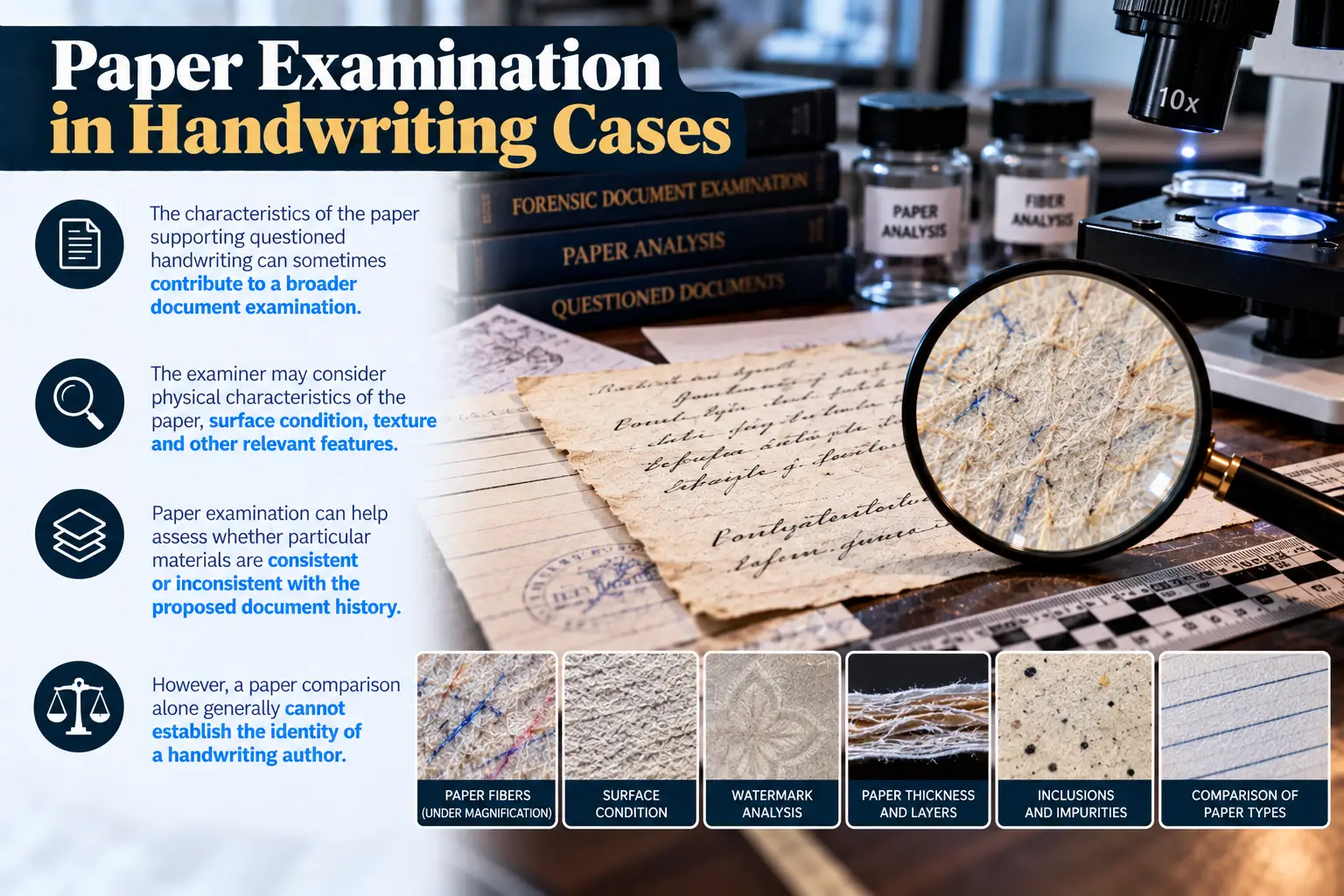
The characteristics of the paper supporting questioned handwriting can sometimes contribute to a broader document examination.
The examiner may consider physical characteristics of the paper, surface condition, texture and other relevant features.
Paper examination can help assess whether particular materials are consistent or inconsistent with the proposed document history, but a paper comparison alone generally cannot establish the identity of a handwriting author.
Indented Writing Examination
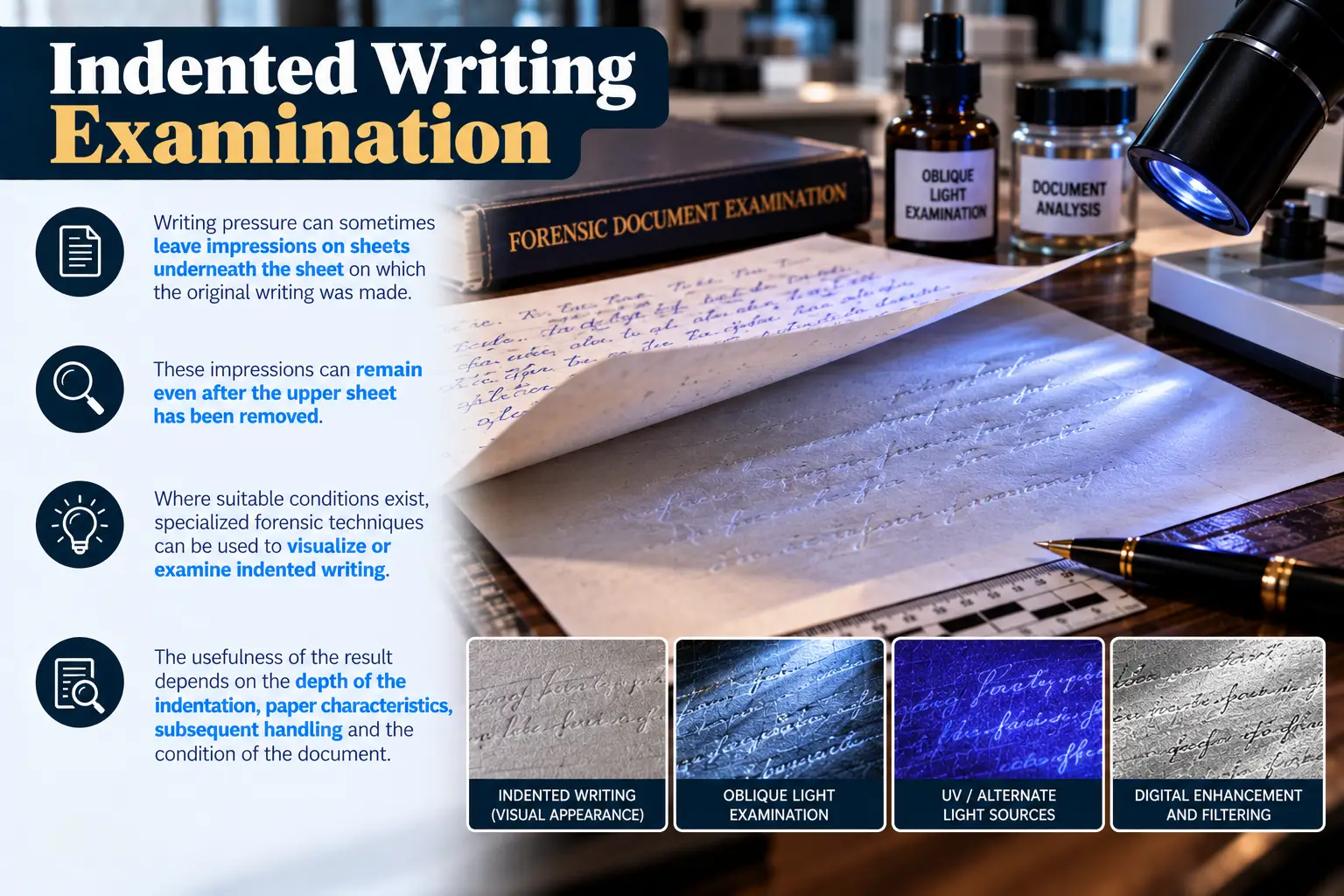
Writing pressure can sometimes leave impressions on sheets underneath the sheet on which the original writing was made.
These impressions can remain even after the upper sheet has been removed.
Where suitable conditions exist, specialized forensic techniques can be used to visualize or examine indented writing.
The usefulness of the result depends on the depth of the indentation, paper characteristics, subsequent handling and the condition of the document.
Handwriting Examination of Photocopies, Scans and Photographs
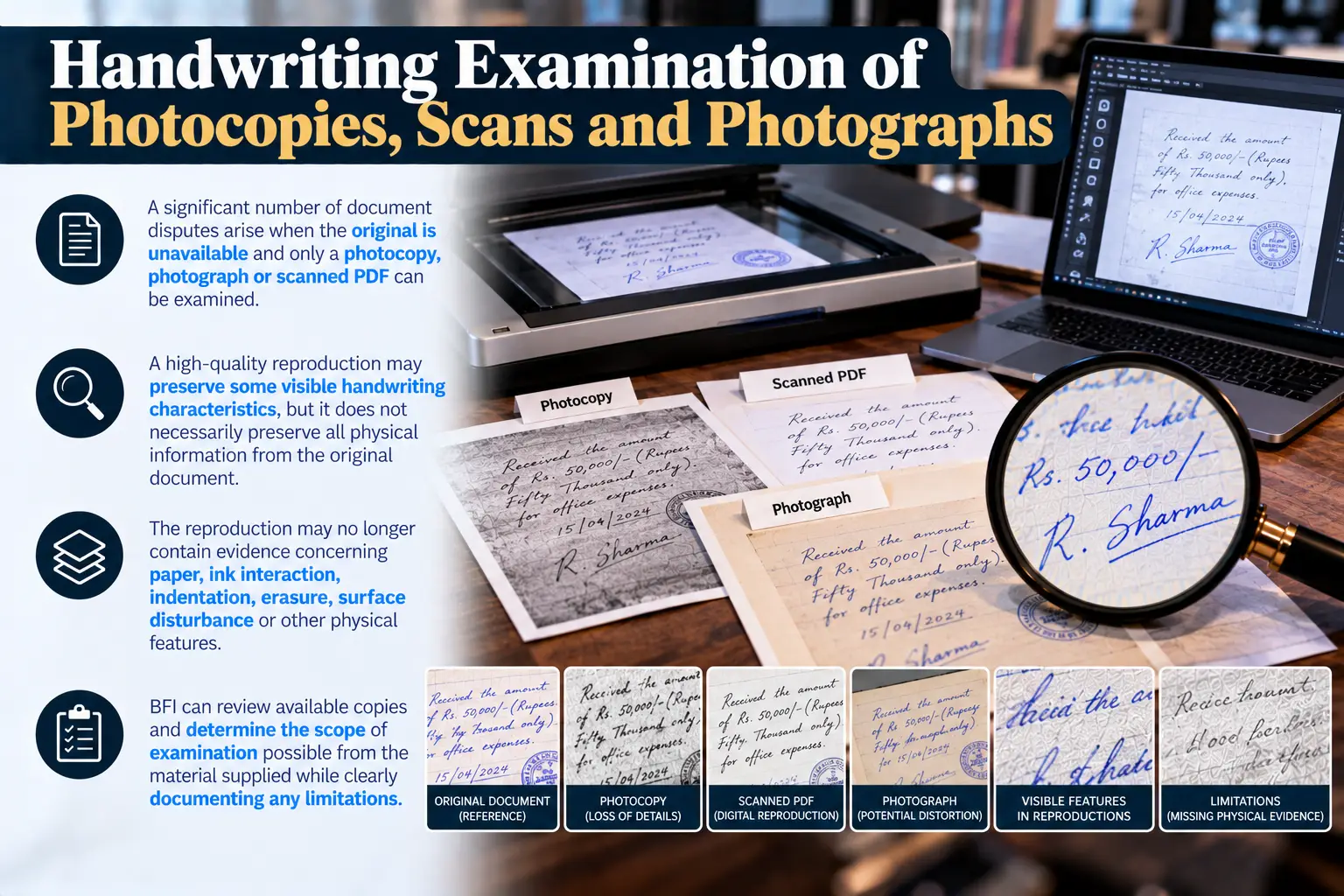
A significant number of document disputes arise when the original is unavailable and only a photocopy, photograph or scanned PDF can be examined.
A high-quality reproduction may preserve some visible handwriting characteristics, but it does not necessarily preserve all physical information from the original document.
The reproduction may no longer contain evidence concerning paper, ink interaction, indentation, erasure, surface disturbance or other physical features.
BFI can review available copies and determine the scope of examination possible from the material supplied while clearly documenting any limitations.
Digital Handwriting Examination
Digital devices increasingly capture handwritten material through styluses, tablets, digitizers and electronic signing platforms.
Digitally captured handwriting should not simply be treated as a scanned version of ordinary handwriting. The technology may preserve different types of information, and the forensic examination should account for the source system and the nature of the available data.
Where electronic handwriting is involved, BFI can determine whether the issue is primarily one of handwriting comparison, digital-document authentication or a combination of both.
Forensic Handwriting Examination Report
A professional forensic report should explain what was examined and the basis of the reported opinion.
Depending upon the engagement, BFI’s report may identify the questioned writing, known comparison material, examination procedures, relevant characteristics, comparative findings, conclusion and limitations.
The objective is to make the reasoning understandable without overstating the scientific strength of the result.
A report should distinguish between direct observations and interpretations derived from those observations.
Handwriting Evidence in Indian Legal Proceedings
The Bharatiya Sakshya Adhiniyam, 2023 is the current principal Indian evidence statute and provides a framework for expert opinion and comparison of handwriting, signatures and other document-related evidence.
Forensic handwriting evidence may therefore form part of a legal proceeding where relevant and properly presented.
However, a forensic opinion is expert evidence. It does not itself determine the ultimate legal issue.
The weight and significance of a handwriting opinion are matters for the competent legal authority or court after considering the expert’s reasoning, the underlying material and the other evidence in the case.
Why Choose Brilliant Forensic Investigation?
- Brilliant Forensic Investigation approaches handwriting as a forensic evidence discipline rather than a simple visual-comparison service.
- Where necessary, handwriting analysis can be connected with broader questioned-document examination involving signatures, alterations, ink, paper, printing, stamps, digital documents and other evidence.
- This broader perspective can be particularly useful when the handwriting issue forms part of a larger allegation concerning document manipulation or disputed transactions.
- BFI focuses on structured examination, evidence preservation, scientific comparison and transparent reporting of relevant limitations.
Contact Brilliant Forensic Investigation
When the authorship or authenticity of handwriting is disputed, the preservation of the original document and availability of suitable comparison material can be important. Brilliant Forensic Investigation provides professional Handwriting Expert Services in India for disputed handwriting, anonymous writings, questioned entries, wills, cheques, agreements, contracts, property records, financial documents, corporate records, official documents and other handwriting-related forensic matters.
BFI can review the nature of the dispute, the questioned material and the available comparison material and determine the appropriate forensic scope.
Call To Action

📞 Contact Us: 9990292279
🌐 Visit Our Website: https://forensicexpertinvestigation.com/
✉️ Email: ceo.bfi@gmail.com
Frequently Asked Questions (FAQs)
-
What is a handwriting expert?
A handwriting expert is a specialist trained to examine questioned handwriting and compare it with suitable known material for forensic questions involving authorship, authenticity, simulation, disguise or related document issues.
-
Can a handwriting expert identify the writer?
Where sufficient and suitable questioned and known material exists, a forensic examiner may provide an opinion concerning source or authorship. The strength of that opinion depends on the quality and comparability of the evidence.
-
Can genuine handwriting change over time?
Yes. Natural handwriting varies because of age, writing conditions, speed, health, physical position and other factors. An examination must account for this variation.
-
Does one difference prove forgery?
No. Genuine writing can contain natural differences. A meaningful examination evaluates the overall combination of similarities and differences.
-
Can disguised handwriting be examined?
Yes. Appropriate known samples can be compared with the questioned writing to assess whether apparent differences are consistent with disguise or another explanation.
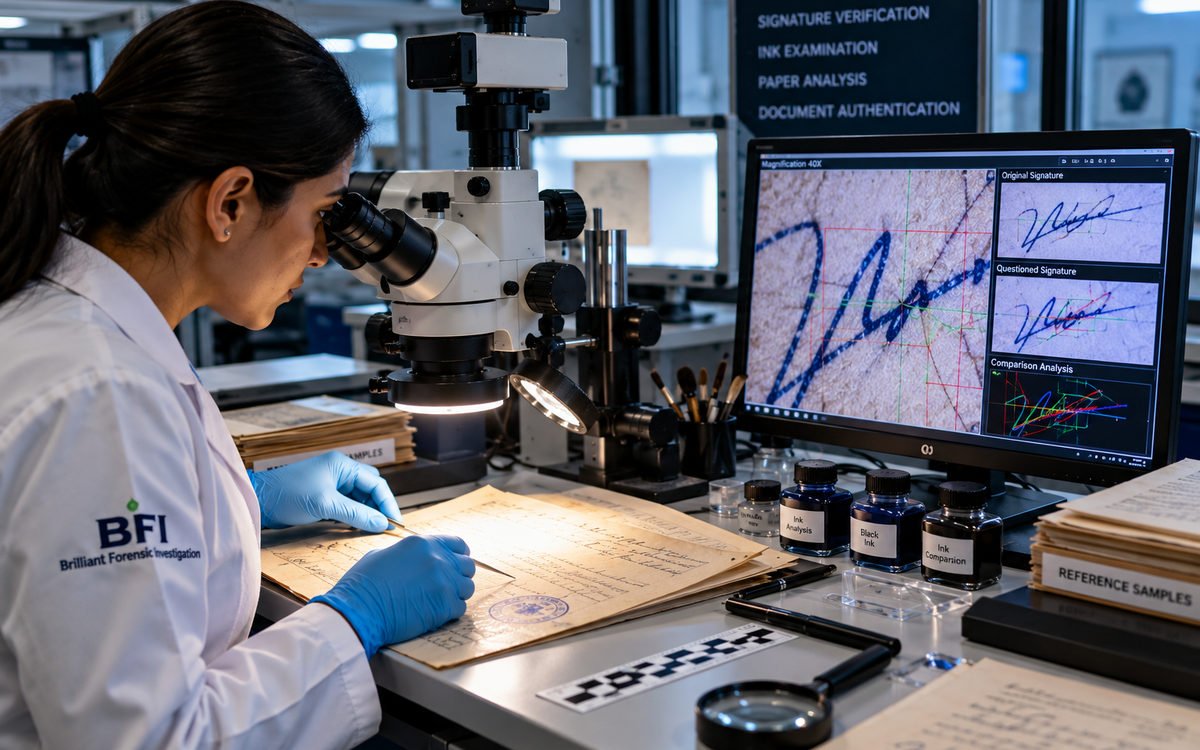
Top 15 Handwriting Expert Services keywords to reach us in India
- Handwriting Expert Services India
- Forensic Handwriting Examination India
- Handwriting Analysis Expert India
- Forensic Handwriting Expert
- Questioned Handwriting Examination
- Handwriting Verification Services
- Handwriting Identification Expert
- Handwriting Forgery Detection
- Signature Verification Expert India
- Disputed Handwriting Expert
- Anonymous Handwriting Examination
- Handwriting Expert for Court Cases
- Forensic Document Examination India
- Handwriting Comparison Services
- Handwriting Expert Witness India
Handwriting Expert Services India
union territory Forensic Handwriting Expert Services in Andaman and Nicobar Islands (union territory)-Port Blair | Forensic Handwriting Expert Services in Andhra Pradesh – Adoni, Amaravati, Anantapur, Chandragiri, Chittoor, Dowlaiswaram, Eluru, Guntur, Kadapa, Kakinada, Kurnool, Machilipatnam, Nagarjunakoṇḍa, Rajahmundry, Srikakulam, Tirupati, Vijayawada, Visakhapatnam, Vizianagaram, Yemmiganur | Forensic Handwriting Expert Services in Arunachal Pradesh – Itanagar | Forensic Handwriting Expert Services in Assam – Dhuburi, Dibrugarh, Dispur, Guwahati, Jorhat, Nagaon, Sivasagar, Silchar, Tezpur, Tinsukia | Forensic Handwriting Expert Services in Bihar – Ara, Barauni, Begusarai, Bettiah, Bhagalpur, Bihar Sharif, Bodh Gaya, Buxar, Chapra, Darbhanga, Dehri, Dinapur Nizamat, Gaya, Hajipur, Jamalpur, Katihar, Madhubani, Motihari, Munger, Muzaffarpur, Patna, Purnia, Pusa, Saharsa, Samastipur, Sasaram, Sitamarhi, Siwan | Forensic Handwriting Expert Services in Chandigarh (union territory) – Chandigarh | Forensic Handwriting Expert Services in Chhattisgarh – Ambikapur, Bhilai, Bilaspur, Dhamtari, Durg, Jagdalpur, Raipur, Rajnandgaon | Forensic Handwriting Expert Services in Dadra and Nagar Haveli and Daman and Diu (union territory) – Daman, Diu, Silvassa | Forensic Handwriting Expert Services in Delhi (national capital territory) – Delhi, New Delhi | Forensic Handwriting Expert Services in Goa – Madgaon, Panaji | Forensic Handwriting Expert Services in Gujarat – Ahmadabad, Amreli, Bharuch, Bhavnagar, Bhuj, Dwarka, Gandhinagar, Godhra, Jamnagar, Junagadh, Kandla, Khambhat, Kheda, Mahesana, Morbi, Nadiad, Navsari, Okha, Palanpur, Patan, Porbandar, Rajkot, Surat, Surendranagar, Valsad, Veraval | Forensic Handwriting Expert Services in Haryana – Ambala, Bhiwani, Chandigarh, Faridabad, Firozpur Jhirka, Gurugram, Hansi, Hisar, Jind, Kaithal, Karnal, Kurukshetra, Panipat, Pehowa, Rewari, Rohtak, Sirsa, Sonipat | Forensic Handwriting Expert Services in Himachal Pradesh – Bilaspur, Chamba, Dalhousie, Dharmshala, Hamirpur, Kangra, Kullu, Mandi, Nahan, Shimla, Una | Forensic Handwriting Expert Services in Jammu and Kashmir (union territory) – Anantnag, Baramula, Doda, Gulmarg, Jammu, Kathua, Punch, Rajouri, Srinagar, Udhampur | Forensic Handwriting Expert Services in Jharkhand – Bokaro, Chaibasa, Deoghar, Dhanbad, Dumka, Giridih, Hazaribag, Jamshedpur, Jharia, Rajmahal, Ranchi, Saraikela | Forensic Handwriting Expert Services in Karnataka – Badami, Ballari, Bengaluru, Belagavi, Bhadravati, Bidar, Chikkamagaluru, Chitradurga, Davangere, Halebid, Hassan, Hubballi-Dharwad, Kalaburagi, Kolar, Madikeri, Mandya, Mangaluru, Mysuru, Raichur, Shivamogga, Shravanabelagola, Shrirangapattana, Tumakuru, Vijayapura | Forensic Handwriting Expert Services in Kerala – Alappuzha, Vatakara, Idukki, Kannur, Kochi, Kollam, Kottayam, Kozhikode, Mattancheri, Palakkad, Thalassery, Thiruvananthapuram, Thrissur | Forensic Handwriting Expert Services in Ladakh (union territory) – Kargil, Leh | Forensic Handwriting Expert Services in Madhya Pradesh – Balaghat, Barwani, Betul, Bharhut, Bhind, Bhojpur, Bhopal, Burhanpur, Chhatarpur, Chhindwara, Damoh, Datia, Dewas, Dhar, Dr. Ambedkar Nagar (Mhow), Guna, Gwalior, Hoshangabad, Indore, Itarsi, Jabalpur, Jhabua, Khajuraho, Khandwa, Khargone, Maheshwar, Mandla, Mandsaur, Morena, Murwara, Narsimhapur, Narsinghgarh, Narwar, Neemuch, Nowgong, Orchha, Panna, Raisen, Rajgarh, Ratlam, Rewa, Sagar, Sarangpur, Satna, Sehore, Seoni, Shahdol, Shajapur, Sheopur, Shivpuri, Ujjain, Vidisha | Forensic Handwriting Expert Services in Maharashtra – Ahmadnagar, Akola, Amravati, Aurangabad, Bhandara, Bhusawal, Bid, Buldhana, Chandrapur, Daulatabad, Dhule, Jalgaon, Kalyan, Karli, Kolhapur, Mahabaleshwar, Malegaon, Matheran, Mumbai, Nagpur, Nanded, Nashik, Osmanabad, Pandharpur, Parbhani, Pune, Ratnagiri, Sangli, Satara, Sevagram, Solapur, Thane, Ulhasnagar, Vasai-Virar, Wardha, Yavatmal | Forensic Handwriting Expert Services in Manipur – Imphal | Forensic Handwriting Expert Services in Meghalaya – Cherrapunji, Shillong | Forensic Handwriting Expert Services in Mizoram – Aizawl, Lunglei | Forensic Handwriting Expert Services in Nagaland – Kohima, Mon, Phek, Wokha, Zunheboto | Forensic Handwriting Expert Services in Odisha – Balangir, Baleshwar, Baripada, Bhubaneshwar, Brahmapur, Cuttack, Dhenkanal, Kendujhar, Konark, Koraput, Paradip, Phulabani, Puri, Sambalpur, Udayagiri | Forensic Handwriting Expert Services in Puducherry (union territory) – Karaikal, Mahe, Puducherry, Yanam | Forensic Handwriting Expert Services in Punjab – Amritsar, Batala, Chandigarh, Faridkot, Firozpur, Gurdaspur, Hoshiarpur, Jalandhar, Kapurthala, Ludhiana, Nabha, Patiala, Rupnagar, Sangrur | Forensic Handwriting Expert Services in Rajasthan – Abu, Ajmer, Alwar, Amer, Barmer, Beawar, Bharatpur, Bhilwara, Bikaner, Bundi, Chittaurgarh, Churu, Dhaulpur, Dungarpur, Ganganagar, Hanumangarh, Jaipur, Jaisalmer, Jalor, Jhalawar, Jhunjhunu, Jodhpur, Kishangarh, Kota, Merta, Nagaur, Nathdwara, Pali, Phalodi, Pushkar, Sawai Madhopur, Shahpura, Sikar, Sirohi, Tonk, Udaipur | Forensic Handwriting Expert Services in Sikkim – Gangtok, Gyalshing, Lachung, Mangan | Forensic Handwriting Expert Services in Tamil Nadu – Arcot, Chengalpattu, Chennai, Chidambaram, Coimbatore, Cuddalore, Dharmapuri, Dindigul, Erode, Kanchipuram, Kanniyakumari, Kodaikanal, Kumbakonam, Madurai, Mamallapuram, Nagappattinam, Nagercoil, Palayamkottai, Pudukkottai, Rajapalayam, Ramanathapuram, Salem, Thanjavur, Tiruchchirappalli, Tirunelveli, Tiruppur, Thoothukudi, Udhagamandalam, Vellore | Forensic Handwriting Expert Services in Telangana – Hyderabad, Karimnagar, Khammam, Mahbubnagar, Nizamabad, Sangareddi, Warangal | Forensic Handwriting Expert Services in Tripura – Agartala | Forensic Handwriting Expert Services in Uttar Pradesh – Agra, Aligarh, Amroha, Ayodhya, Azamgarh, Bahraich, Ballia, Banda, Bara Banki, Bareilly, Basti, Bijnor, Bithur, Budaun, Bulandshahr, Deoria, Etah, Etawah, Faizabad, Farrukhabad-cum-Fatehgarh, Fatehpur, Fatehpur Sikri, Ghaziabad, Ghazipur, Gonda, Gorakhpur, Hamirpur, Hardoi, Hathras, Jalaun, Jaunpur, Jhansi, Kannauj, Kanpur, Lakhimpur, Lalitpur, Lucknow, Mainpuri, Mathura, Meerut, Mirzapur-Vindhyachal, Moradabad, Muzaffarnagar, Partapgarh, Pilibhit, Prayagraj, Rae Bareli, Rampur, Saharanpur, Sambhal, Shahjahanpur, Sitapur, Sultanpur, Tehri, Varanasi | Forensic Handwriting Expert Services in Uttarakhand – Almora, Dehra Dun, Haridwar, Mussoorie, Nainital, Pithoragarh | Forensic Handwriting Expert Services in West Bengal – Alipore, Alipur Duar, Asansol, Baharampur, Bally, Balurghat, Bankura, Baranagar, Barasat, Barrackpore, Basirhat, Bhatpara, Bishnupur, Budge Budge, Burdwan, Chandernagore, Darjeeling, Diamond Harbour, Dum Dum, Durgapur, Halisahar, Haora, Hugli, Ingraj Bazar, Jalpaiguri, Kalimpong, Kamarhati, Kanchrapara, Kharagpur, Cooch Behar, Kolkata, Krishnanagar, Malda, Midnapore, Murshidabad, Nabadwip, Palashi, Panihati, Purulia, Raiganj, Santipur, Shantiniketan, Shrirampur, Siliguri, Siuri, Tamluk, Titagarh.
Handwriting Expert Services in Various Major Cities of India
Brilliant Forensic Investigation (BFI) provides Handwriting Expert Services across major cities and regions in India, including Mumbai, New Delhi, Bangalore, Hyderabad, Ahmedabad, Chennai, Kolkata, Surat, Pune, Jaipur, Lucknow, Kanpur, Nagpur, Indore, Thane, Bhopal, Visakhapatnam, Pimpri-Chinchwad, Patna, Vadodara, Ghaziabad, Ludhiana, Agra, Nashik, Meerut, Kalyan-Dombivali, Vasai-Virar, Varanasi, Srinagar, Aurangabad, Dhanbad, Amritsar, Navi Mumbai, Allahabad, Howrah, Ranchi, Gwalior, Coimbatore, Vijayawada, Jodhpur, Madurai, Raipur, Kota, Chandigarh, Guwahati, Solapur, Hubballi-Dharwad, Nellore, Bhavnagar, Dehradun, Durgapur, Asansol, Rourkela, Nanded, Kolhapur, Ajmer, Akola, Gulbarga, Mangalore, Erode, Belgaum, Ambattur, Tirunelveli, Malegaon, Gaya, Jalgaon, Udaipur, Maheshtala, Davanagere, Kozhikode, Kurnool, Rajpur-Sonarpur, Bhatpara, Rajahmundry, Bokaro, South Dumdum, Bellary, Patiala, Gopalpur, Agartala, Bhagalpur, Muzaffarnagar, Ahmednagar, Mathura, Kollam, Avadi, Kadapa, Kamarhati, Sambalpur, Bilaspur, Shahjahanpur, Satara, Bijapur, Rampur, Shivamogga, Chandrapur, Junagadh, Thrissur, Alwar, Bardhaman, Kulti, Kakinada, Nizamabad, Parbhani, Tumkur, Khammam, Ozhukarai, Bihar Sharif, Panipat, Darbhanga, Bally, Aizawl, Dewas, Ichalkaranji, Karnal, Bathinda, Jalna, Eluru, Kirari Suleman Nagar, Mehsana, Durg, Barasat, Purnia, Satna, Mau, Sonipat, Farrukhabad, Sagar, Imphal, Ratlam, Hapur, Begusarai, Gandhidham, Baranagar, Tiruvottiyur, Puducherry, Sikar, Thoothukudi, Rewa, Mirzapur, Raichur, Pali, Ramagundam, Haridwar, Thanjavur, Bulandshahr, Uluberia, Murwara, Sambhal, Singrauli, Nadiad, Secunderabad, Naihati, Bidhannagar, Pallavaram, Bidar, Munger, Panchkula, Burhanpur, Raurkela Industrial Township, Chittoor, Jehanabad, Kharagpur, Dindigul, Gandhinagar, Hospet, Nangloi Jat, Malda, Ongole, Deoghar, Chapra, Haldia, Khandwa, Nandyal, Morena, Amroha, Anand, Bhind, Bhalswa Jahangir Pur, Rae Bareli, Madhyamgram, Bhiwani, Panvel, Baharampur, Ambala, Morbi, Fatehpur, Mahabubnagar, Bhusawal, Orai, Bahraich, Vellore, Raiganj, Sirsa, Danapur, Serampore, Sultan Pur Majra, Guna, Jaunpur, Shivpuri, Surendranagar-Dudhrej, Kumbakonam, Dehri, Madanapalle, Phagwara, Narasaraopet, Tadipatri, Kishanganj, Karaikudi, Faridabad, Rajkot, Jabalpur, Tiruchirappalli, Bareilly, Mysore, Tiruppur, Gurgaon, Aligarh, Jalandhar, Bhubaneswar, Salem, Mira-Bhayandar, Warangal, Guntur, Bhiwandi, Saharanpur, Gorakhpur, Bikaner, Amravati, Noida, Jamshedpur, Bhilai, Cuttack, Firozabad, Kochi, Jamnagar, Ujjain, Loni, Siliguri, Jhansi, Ulhasnagar, Jammu, Sangli-Miraj-Kupwad, Thiruvananthapuram, Panihati, Latur, Dhule, Tirupati, Rohtak, Korba, Bhilwara, Berhampur, Arrah, Anantapur, Karimnagar, Etawah, Ambarnath, North Dumdum, Bharatpur, Vijayanagaram, Katihar, Nagercoil, Sri Ganganagar, Karawal Nagar, Mango, Katni, Yamunanagar, Unnao, Chinsurah, Alappuzha, Kottayam, Machilipatnam, Shimla, Adoni, Udupi, Tenali, Proddatur, Saharsa, Hindupur, Sasaram, Hajipur, Bhimavaram, Siwan, Bettiah, Guntakal, Srikakulam, Motihari, Dharmavaram, Gudivada, Suryapet, Kavali, Tadepalligudem, Amaravati, Buxar, and Gangtok, as well as Kolkata and other locations throughout West Bengal. BFI aims to support individuals, advocates, law firms, corporate organizations, insurance companies, and institutions with professional forensic investigation, scientific evidence examination, and expert consultation services, subject to service availability and case requirements.