

Digital Evidence Services in India
Digital Evidence Services | Digital Forensic Investigation | Mobile Forensics | Computer Forensics | Cyber Evidence Analysis | Court-Ready Digital Evidence
Digital evidence is now a critical part of investigations involving cybercrime, online fraud, corporate misconduct, financial disputes, employee investigations, intellectual-property theft, cyber harassment, impersonation, ransomware, email fraud, mobile-phone evidence, social-media disputes, CCTV investigations and civil or criminal litigation.
Brilliant Forensic Investigation (BFI) provides Digital Evidence Services in India for individuals, corporates, law firms, investigators, financial organisations and other clients who need technically documented examination of electronic records. Depending on the matter, a digital evidence investigation may involve smartphones, laptops, desktops, hard drives, SSDs, USB devices, memory cards, servers, cloud platforms, email systems, messaging applications, websites, social-media accounts, network logs, CCTV/DVR systems, PDFs, photographs, audio/video files and other digital sources.
Digital evidence is not simply a screenshot, downloaded file or forwarded message. Its value can depend on where the information originated, how it was preserved, whether the source can be identified, whether the record has been altered, how it was acquired, what metadata or system artifacts remain, and whether the relevant legal requirements have been satisfied.
India’s current evidence framework is particularly important in this area. The Bharatiya Sakshya Adhiniyam, 2023 (BSA) recognizes electronic and digital records, and Sections 61–63 specifically address electronic/digital records and admissibility. The Schedule under Section 63 contains a certificate format that includes information relating to the device or digital source and hash values.
BFI approaches digital evidence investigation as a structured forensic process: identify the relevant source, preserve it appropriately, acquire data using a suitable method, examine the evidence, correlate artifacts, document findings and prepare a technically understandable report.
Need Digital Evidence Investigation in India? Contact BFI for a confidential assessment of your case, device or digital evidence.
What Are Digital Evidence Services in India?
Digital Evidence Services in India refer to professional forensic activities used to identify, collect, preserve, recover, examine, analyse and report information stored or generated by electronic devices and digital systems.
Digital evidence can exist in obvious forms, such as photographs, videos, emails, documents and messages, but it can also exist as less visible technical artifacts. These may include file-system records, application databases, browser history, device logs, authentication events, network records, cloud activity, metadata, deleted-file remnants and system-generated timestamps.
The purpose of a forensic digital investigation is not simply to find information. It is to establish what the available evidence can reliably show and to document how the evidence was obtained and analysed.
For example, in an employee data-theft matter, the investigation may need to determine whether confidential files were accessed, copied, archived, transferred to removable media, sent by email or synchronized to a personal cloud account. A single document may not answer that question. Correlation between endpoint artifacts, file-system activity, email records, cloud history and external-device traces may provide a much stronger evidentiary picture.
Similarly, in a cyber-fraud matter, investigators may need to connect an email address, phone number, payment reference, chat conversation, website, device and transaction chronology rather than relying on one screenshot or message.
BFI’s digital evidence services are therefore structured around evidence correlation, preservation, forensic examination and documented findings.
Why Digital Evidence Matters in India
India’s rapidly expanding digital environment has increased the importance of electronic records in both business and legal investigations.
NCRB data for 2023 recorded 86,420 registered cybercrime cases, while 59,526 cases, or 68.9%, were recorded with fraud as the motive. Registered cases do not represent the entire universe of cyber victimisation, but they demonstrate the growing scale of digitally enabled crime.
The financial impact of cyber incidents is also significant. IBM’s 2026 India findings reported an average data-breach cost of ₹25.5 crore, with an average of 39,500 records compromised in its India study. IBM also reported phishing, including voice and SMS phishing, as the most common initial attack vector in the India study.
DSCI’s India Cyber Threat Report 2025 analysed 369.01 million malware detections across 8.44 million endpoints, with the report examining ransomware, AI-powered malware, supply-chain attacks, application scams and other threats affecting India’s digital environment.
The country’s public cyber-forensic infrastructure has also expanded. A Ministry of Home Affairs document stated that the National Cyber Forensic Laboratory at Dwarka had provided forensic assistance in approximately 12,952 cyber cases for State law-enforcement agencies up to 31 October 2025, while cyber forensic-cum-training laboratories had been commissioned in 33 States/UTs under the cited government programme.
These figures should not be interpreted as proof that every company, device or individual is at high risk. They demonstrate why digital evidence preservation, forensic analysis and incident-response capability have become important components of modern investigations.
Digital Evidence vs. Digital Forensics
The terms digital evidence and digital forensics are closely related but are not exactly the same.
Digital evidence refers to the electronic information itself. Digital forensics refers to the disciplined process used to identify, preserve, acquire, examine and analyse that information.
A WhatsApp conversation, for example, is digital evidence. A forensic examination of the underlying device, application database, media files, timestamps, backups and related artifacts is digital forensic work.
Likewise, a CCTV recording is digital evidence, while examining the original recording source, metadata, export characteristics, timestamps, recording gaps and technical integrity is part of video or digital forensic analysis.
This distinction is important because a digital file may exist without providing enough information to establish its origin, chronology or authenticity. BFI’s role is to examine the available digital record and document the technical findings and limitations.
15 Core Digital Evidence Services Offered by BFI
BFI can structure the national page around the following specialist services. Each service should be scoped to the actual device, data source, legal authority and investigative question rather than marketed as a universal recovery or attribution solution.
Digital Evidence Identification and Collection
The first stage of a successful digital investigation is determining where the relevant evidence actually exists.
Depending on the case, potential sources may include mobile phones, computers, laptops, external hard drives, SSDs, USB devices, memory cards, servers, cloud storage, email accounts, application databases, CCTV systems, network logs, virtual machines and other electronic systems.
BFI can help establish an evidence-source map based on the investigation’s objective. For a corporate insider case, this might include the employee laptop, company email, cloud storage and authentication logs. For a cyber-fraud matter, the evidence map may include the victim’s mobile phone, bank communications, email, payment records, suspect URLs and chat messages.
The collection process should document the source, condition and identification details of the evidence and should be carried out through lawful authority appropriate to the matter.
Digital Forensic Imaging and Evidence Preservation
Forensic imaging is the controlled acquisition of digital information from a source so that examination can be conducted while reducing unnecessary interaction with the original evidence.
Depending on the device and case, the process may involve write protection, acquisition logs, forensic image verification and cryptographic hashing.
ISO/IEC 27037 provides guidance concerning the identification, collection, acquisition and preservation of potential digital evidence, while NIST SP 800-86 describes a forensic process involving identification, acquisition and protection, followed by examination, analysis and reporting.
The exact acquisition method depends on factors such as device type, operating system, storage technology, encryption, physical condition and the investigative question.
Computer and Laptop Forensic Investigation
Computers and laptops can contain extensive evidence about user activity, document handling, system changes and external-device interactions.
A computer forensic investigation in India may examine:
Windows, macOS or Linux artifacts; file systems; user profiles; browser data; downloads; application records; temporary files; system logs; installed programs; removable-media activity; file timestamps; deleted files; scheduled tasks; persistence mechanisms and other relevant artifacts.
In corporate investigations, computer forensics may assist in matters involving:
Employee data theft, confidential information leakage, intellectual-property theft, unauthorised access, workplace misconduct, fraudulent records, suspicious file transfers, malware, insider activity and policy violations.
The presence of a file on a computer does not automatically prove that a specific person intentionally created or transferred it. Attribution normally requires correlation with user accounts, login information, system context, timestamps, communications and other independent evidence.
Mobile Phone Digital Forensics
Mobile devices are among the most important sources of digital evidence because they can combine communications, photographs, videos, location-related information, application data, contacts, browser activity, account information and device-level artifacts.
BFI’s mobile forensic investigation services in India can be tailored to Android and iOS devices, subject to the device model, operating-system version, security configuration, physical condition and lawful acquisition options.
Mobile forensic examination may involve:
Call records and device artifacts, SMS, messaging applications, photographs, videos, contacts, browser history, application databases, documents, location-related artifacts, downloaded content, backup-related information and deleted or residual data where technically recoverable.
Government forensic organisations in India also recognise mobile forensics as a dedicated examination area.
Recovery results depend heavily on the device and its condition. Encryption, secure deletion, factory reset, storage management, operating-system updates and overwriting can affect recoverability.
Deleted Data Recovery and Digital Data Recovery
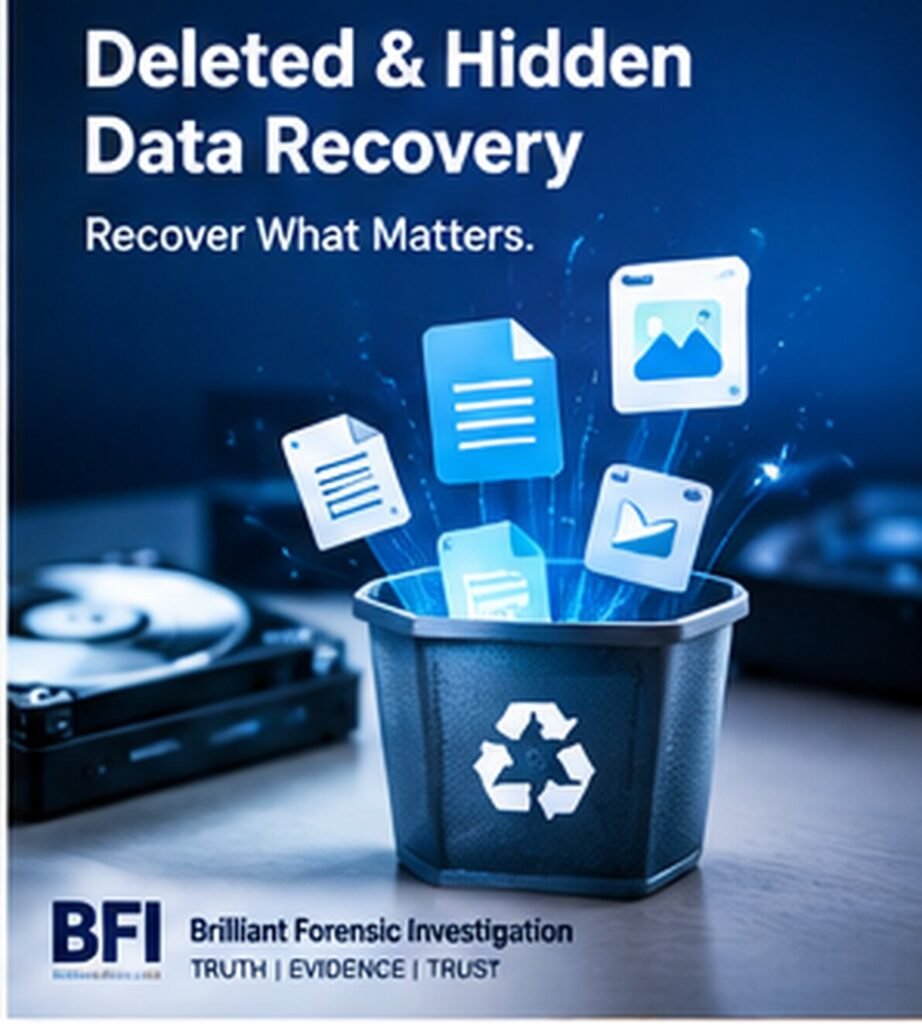
Deleted does not always mean destroyed.
Depending on the device and storage technology, remnants of deleted information may remain in file-system structures, unallocated storage, application databases, temporary files, thumbnails, caches, backups or other locations.
BFI can investigate whether recoverable traces exist and classify results according to what was actually obtained.
A forensic report should distinguish between:
Fully recovered data, partially recovered data, metadata-only evidence, database references, fragmented remnants and information that could not be recovered.
Modern SSDs, encrypted devices and secure-delete mechanisms can significantly reduce the possibility of recovery. For that reason, responsible forensic services should not promise guaranteed recovery of every deleted file, message or photograph.
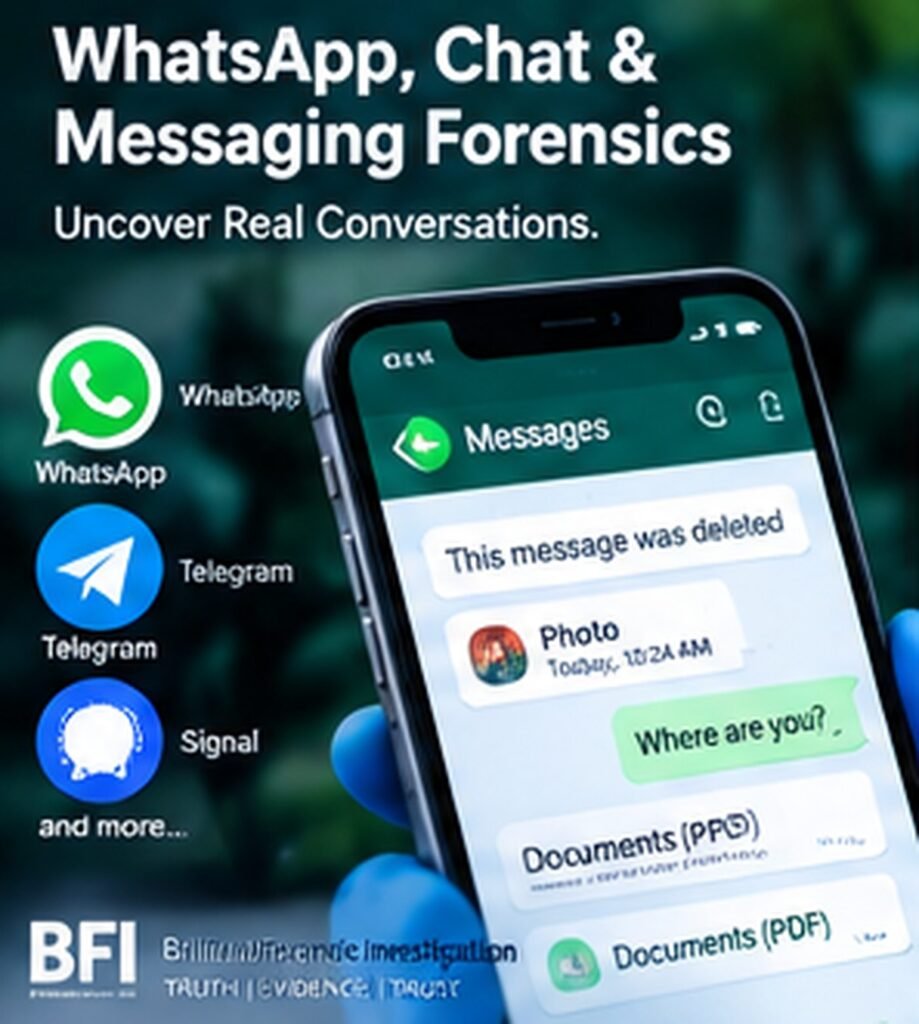
WhatsApp and Chat Forensics
WhatsApp and other messaging applications can contain communications, attachments, images, videos, timestamps, participant information and application databases relevant to an investigation.
BFI can conduct WhatsApp forensic investigation and chat evidence analysis where the necessary device, account or source data can lawfully be obtained.
A forensic examination may investigate:
The underlying application database, message records, media files, timestamps, participant information, deleted or residual records where available, related device artifacts and correlations with other digital sources.
A screenshot can be useful, but it may not preserve the entire source record. The original device or underlying digital record can potentially provide additional information about chronology, context, attachments and provenance.
The National Cyber Crime Reporting Portal itself identifies chat transcripts, screenshots, emails, URLs, videos, images, bank statements and online transfer receipts among the types of evidence that may be relevant when filing cybercrime complaints.
Email Forensics and Email Spoofing Investigation
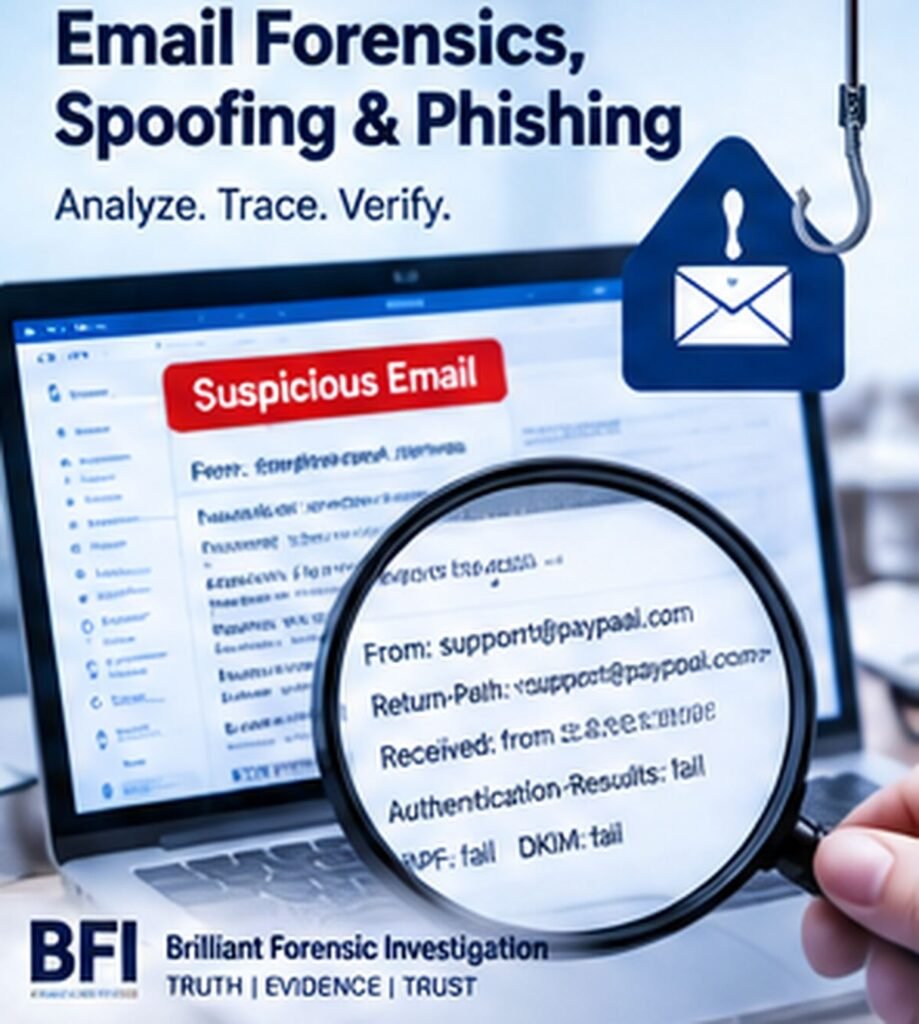
Email evidence can become important in phishing, business-email compromise, impersonation, workplace investigations, fraud and disputed communications.
A professional email forensic investigation may examine:
Sender and recipient fields, message headers, routing information, timestamps, authentication indicators, attachments, mailbox artifacts, account activity and related endpoint evidence.
The visible “From” address is not always sufficient to establish how a message was actually transmitted.
Email spoofing investigations can therefore involve examination of the original message and technical headers together with DNS information, mail-server records, endpoint artifacts and identity-provider logs where available.
BFI can also assist with phishing investigations involving suspicious links, fraudulent invoices, malicious attachments or impersonation of executives and vendors.
Cloud Forensics Services in India
Modern evidence often extends beyond the physical device.
Cloud platforms may preserve information relating to:
File access, sharing, version history, account logins, mailbox activity, administrative changes, synchronized folders, cloud storage, audit trails, identity-provider records and account activity.
A cloud-forensics investigation can be more complex than examining a local computer because information may be distributed between the cloud provider, endpoint devices, synchronization folders and enterprise logs.
BFI can structure cloud investigations around lawfully accessible cloud accounts, enterprise systems, endpoint synchronization artifacts and relevant provider records.
Because cloud providers may have different retention periods and access procedures, preservation should be considered as early as possible in a significant incident.

Network Forensics and Log Analysis
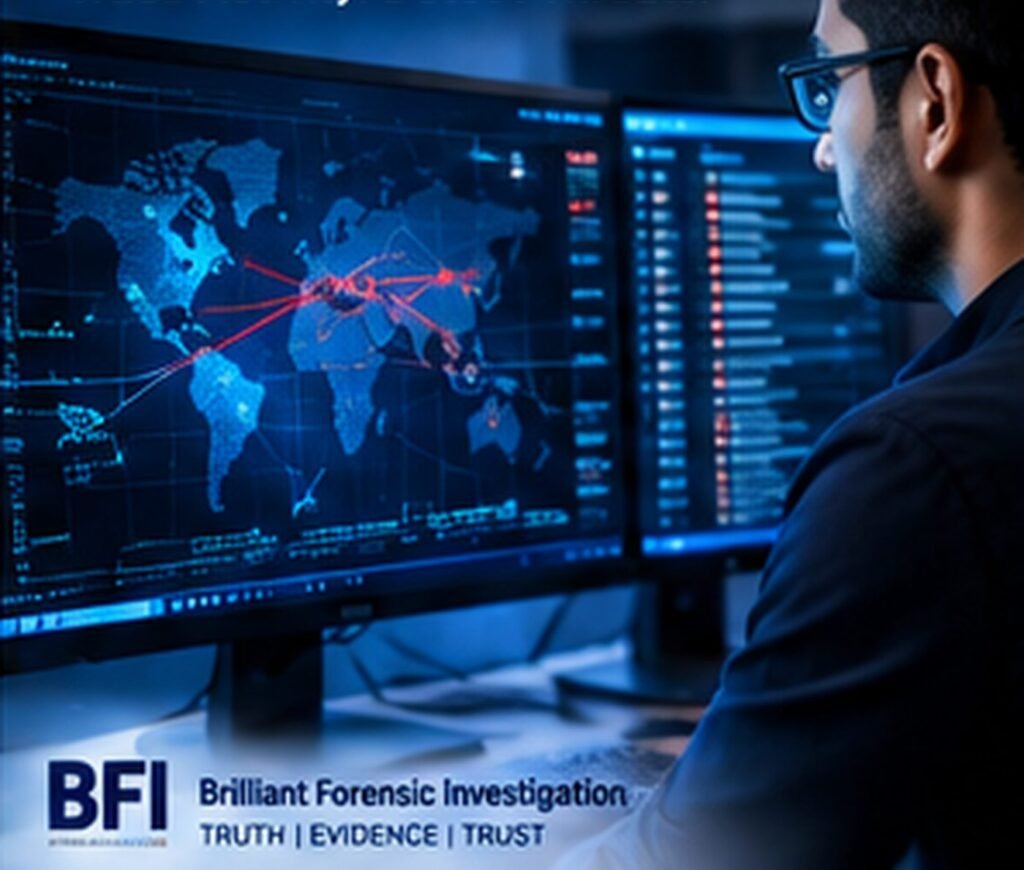
Network evidence can help reconstruct how systems communicated during an incident.
Depending on the organisation’s architecture, potentially relevant sources may include:
Firewall logs, VPN logs, SIEM records, intrusion-prevention systems, DNS records, proxy logs, web-server logs, database logs, mail-server logs, authentication records, endpoint telemetry and other security logs.
CERT-In’s official guidance identifies multiple categories of ICT logs that may be relevant to cyber-incident analysis and maintains the reporting framework under its Section 70B directions.
A network-forensics investigation can reconstruct a sequence such as:
Suspicious login → unusual endpoint activity → internal connection → file access → archive creation → outbound network connection → account containment.
Timeline reconstruction is often much more informative than reviewing one isolated log entry.
CCTV, DVR and NVR Digital Evidence Analysis
CCTV footage is frequently used in civil, criminal, corporate and insurance-related investigations.
BFI can examine supplied CCTV, DVR and NVR evidence and, where lawful and technically possible, examine the original recording system or relevant source data.
The examination may address:
Recording chronology, export characteristics, timestamp issues, recording gaps, relevant-event extraction, multiple-camera correlation, frame analysis, image enhancement and technical characteristics of the supplied recording.
This is especially important because a short exported video may not show what happened before or after the selected event.
The BSA’s Schedule specifically lists DVR among the digital record sources within its electronic-record certificate framework.
Video enhancement should also be described accurately. Enhancement may improve visibility or intelligibility, but it cannot reliably create detail that was never captured by the original recording system.
Audio Forensic Analysis

Audio evidence may originate from mobile phones, CCTV systems, call recordings, meetings, teleconferencing platforms, messaging applications or other recording devices.
BFI’s audio-forensic examination may include:
File-format analysis, metadata examination, waveform analysis, spectrogram review, noise reduction, channel separation, synchronization and other technically appropriate examination.
Where voice comparison is requested, the quality and suitability of the questioned and reference samples are important. A professional examination should clearly explain the methodology, limitations and degree of support provided by the available recordings.
Digital Document and PDF Forensics
Digital documents can contain important information that is not visible when the document is printed.
A forensic document examination of an electronic file may consider:
Creation and modification metadata, document properties, embedded objects, structural characteristics, revisions, application information, file relationships and correlations with email or cloud records.
This may be relevant to disputed invoices, contracts, certificates, reports, letters, financial documents, board records and other electronic material.
Where the issue also concerns handwriting, signatures, physical stamps or printed documents, BFI can coordinate digital and physical document examination as appropriate.
Malware and Ransomware Forensics
Malware incidents may require evidence of how malicious code entered an environment, what executed, which systems were affected and whether credentials or data were accessed.
A malware forensic investigation can examine:
Malicious files, execution traces, persistence mechanisms, suspicious processes, user activity, system logs, network connections, affected endpoints and indicators of possible data exfiltration.
CERT-In publishes India-specific ransomware intelligence, while DSCI’s India Cyber Threat Report 2025 identifies ransomware, AI-powered malware, supply-chain attacks and application scams among major themes in India’s threat landscape.
A forensic conclusion should distinguish between confirmed technical evidence and hypotheses regarding attacker identity or motive.
Browser, Internet and Application Forensics
Web browsers and applications can retain evidence about online activity even after visible history has been removed.
Depending on the system, relevant artifacts can include:
Browsing history, downloads, cache data, cookies, saved sessions, search activity, extensions, application databases and other technical traces.
Such artifacts can help reconstruct online activity, website access or file downloads, but the report should consider whether timestamps were automatically generated, synchronized across systems or potentially changed.
Digital Evidence for Cyber Fraud and Online Scam Investigations
Online scams frequently produce evidence across several unrelated systems.
A single cyber-fraud case may involve:
WhatsApp chats + phone numbers + emails + payment records + bank notifications + URLs + screenshots + QR codes + social-media profiles + mobile-device artifacts.
The challenge is connecting these records into one defensible chronology.
BFI can conduct digital evidence analysis to help identify relationships between communications, transactions, devices and online activity.
For victims of cyber-financial fraud, the Government of India’s National Cyber Crime Reporting Portal states that immediate reporting can be made through 1930, and the official portal provides mechanisms for cybercrime reporting and evidence submission.
A private forensic investigation does not replace official reporting. In financial cyber-fraud cases, rapid reporting to the appropriate authorities, bank or payment provider remains important.
Digital Evidence for Corporate Investigations
Businesses increasingly rely on digital evidence when investigating:
Employee data theft, intellectual-property leakage, unauthorised access, confidential-data transfer, procurement irregularities, fraudulent communications, insider activity, policy violations, cyber incidents and disputed business records.
A corporate digital investigation may examine authorised company devices, corporate email, cloud activity, file access, endpoint logs, removable-media traces and communications.
Because corporate investigations can involve highly sensitive business and personal information, the scope should be established by appropriate management, legal, HR or compliance stakeholders before examination begins.
Digital Evidence for Employee Misconduct Investigations
An employee investigation may arise from suspected:
Confidential-data copying, unauthorised access, manipulation of records, disclosure of client data, intellectual-property theft, fraudulent expense documentation or misuse of company systems.
BFI can examine relevant evidence sources where the organisation has appropriate authority.
The purpose should be clearly defined. The investigation should determine what happened, what evidence supports the conclusion and what remains uncertain rather than assuming that the presence of a particular file automatically proves misconduct.
Digital Evidence for Intellectual Property and Data Theft
Source code, product designs, customer lists, pricing information, research data and business strategies can be copied or transferred electronically.
Digital forensic analysis can examine indicators such as:
File-access history, removable-media usage, archive creation, cloud synchronization, email attachments, external storage, unusual login activity and endpoint artifacts.
Strong findings generally arise from multiple correlated sources rather than from the existence of a confidential document alone.
Digital Evidence for Banking, FinTech and Financial Investigations
Banking and fintech environments generate extensive digital records that can become important in fraud investigations and disputes.
Potential evidence sources may include:
Authentication records, transaction logs, device information, email, SMS, application logs, security alerts, system audit trails, call records and employee access logs.
RBI’s annual reporting on financial-sector fraud highlights the continuing importance of fraud-risk management, while its regulatory framework also places emphasis on controls, monitoring and auditability.
BFI’s role can be to examine the technical evidence and reconstruct activity while working within the institution’s legal, regulatory and internal-authority framework.
Digital Evidence for Cyber Harassment and Online Impersonation
Digital impersonation can involve fake social-media profiles, copied photographs, fraudulent websites, spoofed email accounts and messages sent while pretending to be another individual or organisation.
A forensic investigation may preserve:
Profile URLs, usernames, screenshots, website information, emails, messages, account-related artifacts, device evidence and other available information.
Public-source information should be captured carefully, including the date and time of observation. Attribution to a particular individual may require evidence beyond the public profile and, in some matters, lawful access to provider-held records.
Digital Evidence for Cryptocurrency and Blockchain Investigations
Blockchain records can provide transaction histories, but tracing a blockchain address to a real individual or organisation is a separate evidentiary issue.
A cryptocurrency investigation may correlate blockchain transactions with:
Exchange records, device evidence, email communications, chat evidence, account information and other lawfully obtained records.
BFI can position this work around transaction tracing and evidence correlation, rather than promising that every anonymous wallet can be attributed to a specific person.
Digital Evidence for Civil and Criminal Cases
Digital evidence can arise in both civil and criminal matters.
Civil cases can involve:
Contract disputes, electronic communications, intellectual-property matters, employment disputes, business fraud, financial records and digital document authenticity.
Criminal matters can involve:
Cybercrime, online fraud, unauthorised access, identity theft, extortion, harassment, stalking, ransomware and other offences in which electronic records form part of the evidence.
The technical significance of an artifact depends on the legal question.
For example, browser history may establish that a website was accessed from a device, but it does not automatically establish who physically operated the computer. Similarly, a message sent from an account does not automatically eliminate the possibility of account compromise.
Forensic analysis therefore focuses on corroboration, context and provenance.
Digital Evidence and eDiscovery
eDiscovery refers to the identification, preservation, collection, processing, review and production of electronically stored information relevant to litigation or investigation.
BFI can provide the technical forensic component of larger litigation-support matters.
This may include:
Targeted device imaging, evidence preservation, metadata review, relevant-file identification, communication analysis, chronology building and preparation of technical exhibits.
For large litigation matters, legal counsel should establish procedures for legal hold, privilege, discovery scope and production format.
Hash Values and Digital Evidence Integrity
A cryptographic hash is commonly used as an integrity check for a digital object or forensic image.
When a forensic image is acquired, the examiner can calculate a hash value and later verify the same object.
The BSA Schedule explicitly provides fields for hash values and identifies SHA1, SHA256, MD5 and other legally acceptable standards in the certificate format.
Hashing is an integrity mechanism. It should not be described as an automatic guarantee of admissibility. Legal admissibility can depend on the applicable statute, source, acquisition process, certification, testimony and other facts.
Digital Evidence Investigation Process at BFI
Step 1: Understand the Case
BFI begins by understanding what happened, what evidence exists and what question the investigation must answer.
Step 2: Define the Investigation Scope
The investigation is scoped around the specific device, account, time period, incident or legal issue.
Step 3: Identify Evidence Sources
Potential devices, accounts, servers, cloud sources, CCTV systems, network logs and applications are identified.
Step 4: Preserve Relevant Evidence
Priority evidence is preserved to reduce the risk of deletion, overwriting or alteration.
Step 5: Acquire the Evidence
An appropriate technical acquisition method is selected according to the device and investigative circumstances.
Step 6: Record Integrity Information
Relevant hash values, evidence identifiers and acquisition details are documented.
Step 7: Conduct Forensic Examination
The acquired data is examined using appropriate forensic techniques.
Step 8: Recover Relevant Artifacts
Deleted or hidden information may be examined where technically feasible.
Step 9: Correlate Digital Evidence
Evidence from different sources is compared to reconstruct chronology and relationships.
Step 10: Prepare the Forensic Report
The final report explains methodology, evidence, observations, analysis, limitations and conclusions.
Digital Evidence and the Bharatiya Sakshya Adhiniyam, 2023
India’s current evidentiary framework is particularly important for electronic records.
The Bharatiya Sakshya Adhiniyam, 2023 recognises electronic and digital records.
Section 61 provides that an electronic or digital record is not to be denied admissibility merely because it is electronic or digital and, subject to Section 63, gives such records the same legal effect, validity and enforceability as other documents.
Section 62 addresses proof of the contents of electronic records.
Section 63 sets out conditions relating to admissibility of specified computer outputs and provides for a certificate mechanism.
The Schedule includes detailed source information such as:
Computer/storage media
DVR
Mobile
Flash drive
CD/DVD
Server
Cloud
Make and model
Serial number
IMEI/UIN/UID/MAC/Cloud ID where applicable
Hash values
The certificate schedule also identifies fields for hash algorithms including SHA1 and SHA256.
For this reason, BFI’s website should describe forensic evidence collection in terms of source identification, integrity, acquisition documentation, examination methodology and reporting, rather than simply promising a “court-admissible report.”
Actual admissibility and evidentiary weight remain legal and judicial questions.
Bharatiya Nagarik Suraksha Sanhita and Electronic Investigation
The Bharatiya Nagarik Suraksha Sanhita, 2023 also incorporates audio-video electronic means into criminal procedure.
Its definition of “audio-video electronic” includes the use of communication devices for purposes including video conferencing, recording identification, search and seizure or evidence, and transmission of electronic communication.
The development of technology-enabled criminal procedure reinforces the importance of maintaining reliable digital records and properly documented evidence workflows.
CERT-In and Digital Evidence Preservation
CERT-In operates under Section 70B of the Information Technology Act, 2000 and its official page continues to publish the Directions dated 28 April 2022 and related FAQs.
For organisations subject to the applicable requirements, cyber-incident response may involve preserving technical logs and reporting specified incidents within the applicable time framework.
Digital investigation teams may therefore need to consider:
Firewall logs
VPN logs
SIEM records
Authentication logs
Mail-server logs
Web-server logs
Database logs
Proxy logs
Endpoint logs
DNS records
Security alerts
The availability of these records can become critical when reconstructing a cyber incident.
Why Choose Brilliant Forensic Investigation for Digital Evidence Services in India?
Brilliant Forensic Investigation can position its digital evidence services around structured forensic examination, evidence preservation, technical analysis and clear reporting.
BFI’s existing digital and forensic service portfolio includes digital evidence, digital forensics, cyber-forensic investigation and related forensic specialities.
Where one investigation involves multiple evidence types, BFI can coordinate appropriate forensic disciplines, such as:
Digital Forensics
Mobile Forensics
Computer Forensics
Forensic Document Examination
Handwriting and Signature Examination
Audio Forensics
Video Forensics
Corporate Investigation
Cyber Forensic Investigation
Forensic Consultation
This cross-disciplinary approach can be useful when a case contains both digital and physical evidence.
Frequently Asked Questions (FAQs)
-
What are Digital Evidence Services in India?
Digital Evidence Services involve the identification, preservation, acquisition, recovery, examination and analysis of electronic records from devices and digital systems. These services may support cybercrime investigations, corporate investigations, litigation, fraud matters and other legal or investigative assignments.
-
What is digital evidence?
Digital evidence is electronic information that may be relevant to an investigation. It can include messages, emails, files, photographs, videos, cloud records, application databases, logs, metadata and device artifacts.
-
Is digital evidence admissible in Indian courts?
Electronic and digital records are expressly recognized under the Bharatiya Sakshya Adhiniyam, 2023. Sections 61–63 address electronic records and admissibility, including the statutory certificate framework in specified circumstances. Actual admissibility and evidentiary weight depend on the applicable law and facts of the case.
-
What is Section 63 of the Bharatiya Sakshya Adhiniyam?
Section 63 sets out conditions concerning the admissibility of specified computer outputs and provides for a certificate mechanism. The Schedule contains a detailed certificate format relating to the electronic/digital source and its hash information.
-
Can BFI provide a court-ready digital forensic report?
BFI can prepare a technically documented forensic report for the defined assignment. However, no investigator should guarantee that a court will accept a particular item of evidence. Admissibility is ultimately determined under the applicable law and by the court.
Contact Brilliant Forensic Investigation
When an important legal, corporate or cyber matter depends on electronic information, preserving and examining the evidence properly can be critical.
Whether the case involves a mobile phone, laptop, WhatsApp chats, email, deleted files, CCTV footage, cloud records, online fraud, ransomware, employee misconduct, digital documents, social-media evidence or network logs, BFI can structure the investigation around the evidence sources and questions relevant to your matter.
Call To Action

Contact Brilliant Forensic Investigation for Digital Evidence Services in India.
📞 Contact Us: 9990292279
🌐 Visit Our Website: https://forensicexpertinvestigation.com/
✉️ Email: ceo.bfi@gmail.com
Digital Evidence Services In India
Digital Evidence Services in Andaman and Nicobar Islands (union territory)-Port Blair | Digital Evidence Services in Andhra Pradesh – Adoni, Amaravati, Anantapur, Chandragiri, Chittoor, Dowlaiswaram, Eluru, Guntur, Kadapa, Kakinada, Kurnool, Machilipatnam, Nagarjunakoṇḍa, Rajahmundry, Srikakulam, Tirupati, Vijayawada, Visakhapatnam, Vizianagaram, Yemmiganur | Digital Evidence Services in Arunachal Pradesh – Itanagar | Digital Evidence Services in Assam – Dhuburi, Dibrugarh, Dispur, Guwahati, Jorhat, Nagaon, Sivasagar, Silchar, Tezpur, Tinsukia | Digital Evidence Services in Bihar – Ara, Barauni, Begusarai, Bettiah, Bhagalpur, Bihar Sharif, Bodh Gaya, Buxar, Chapra, Darbhanga, Dehri, Dinapur Nizamat, Gaya, Hajipur, Jamalpur, Katihar, Madhubani, Motihari, Munger, Muzaffarpur, Patna, Purnia, Pusa, Saharsa, Samastipur, Sasaram, Sitamarhi, Siwan | Digital Evidence Services in Chandigarh (union territory) – Chandigarh | Digital Evidence Services in Chhattisgarh – Ambikapur, Bhilai, Bilaspur, Dhamtari, Durg, Jagdalpur, Raipur, Rajnandgaon | Digital Evidence Services in Dadra and Nagar Haveli and Daman and Diu (union territory) – Daman, Diu, Silvassa | Digital Evidence Services in Delhi (national capital territory) – Delhi, New Delhi |Digital Evidence Services in Goa – Madgaon, Panaji | Corporate Crime Scene Investigation – Services in Gujarat – Ahmadabad, Amreli, Bharuch, Bhavnagar, Bhuj, Dwarka, Gandhinagar, Godhra, Jamnagar, Junagadh, Kandla, Khambhat, Kheda, Mahesana, Morbi, Nadiad, Navsari, Okha, Palanpur, Patan, Porbandar, Rajkot, Surat, Surendranagar, Valsad, Veraval | Digital Evidence Services in Haryana – Ambala, Bhiwani, Chandigarh, Faridabad, Firozpur Jhirka, Gurugram, Hansi, Hisar, Jind, Kaithal, Karnal, Kurukshetra, Panipat, Pehowa, Rewari, Rohtak, Sirsa, Sonipat | Digital Evidence Services in Himachal Pradesh – Bilaspur, Chamba, Dalhousie, Dharmshala, Hamirpur, Kangra, Kullu, Mandi, Nahan, Shimla, Una | Digital Evidence Services in Jammu and Kashmir (union territory) – Anantnag, Baramula, Doda, Gulmarg, Jammu, Kathua, Punch, Rajouri, Srinagar, Udhampur | Digital Evidence Services in Jharkhand – Bokaro, Chaibasa, Deoghar, Dhanbad, Dumka, Giridih, Hazaribag, Jamshedpur, Jharia, Rajmahal, Ranchi, Saraikela | Digital Evidence Services in Karnataka – Badami, Ballari, Bengaluru, Belagavi, Bhadravati, Bidar, Chikkamagaluru, Chitradurga, Davangere, Halebid, Hassan, Hubballi-Dharwad, Kalaburagi, Kolar, Madikeri, Mandya, Mangaluru, Mysuru, Raichur, Shivamogga, Shravanabelagola, Shrirangapattana, Tumakuru, Vijayapura | Digital Evidence Services in Kerala – Alappuzha, Vatakara, Idukki, Kannur, Kochi, Kollam, Kottayam, Kozhikode, Mattancheri, Palakkad, Thalassery, Thiruvananthapuram, Thrissur | Digital Evidence Services in Ladakh (union territory) – Kargil, Leh | Digital Evidence Services in Madhya Pradesh – Balaghat, Barwani, Betul, Bharhut, Bhind, Bhojpur, Bhopal, Burhanpur, Chhatarpur, Chhindwara, Damoh, Datia, Dewas, Dhar, Dr. Ambedkar Nagar (Mhow), Guna, Gwalior, Hoshangabad, Indore, Itarsi, Jabalpur, Jhabua, Khajuraho, Khandwa, Khargone, Maheshwar, Mandla, Mandsaur, Morena, Murwara, Narsimhapur, Narsinghgarh, Narwar, Neemuch, Nowgong, Orchha, Panna, Raisen, Rajgarh, Ratlam, Rewa, Sagar, Sarangpur, Satna, Sehore, Seoni, Shahdol, Shajapur, Sheopur, Shivpuri, Ujjain, Vidisha | Digital Evidence Services in Maharashtra – Ahmadnagar, Akola, Amravati, Aurangabad, Bhandara, Bhusawal, Bid, Buldhana, Chandrapur, Daulatabad, Dhule, Jalgaon, Kalyan, Karli, Kolhapur, Mahabaleshwar, Malegaon, Matheran, Mumbai, Nagpur, Nanded, Nashik, Osmanabad, Pandharpur, Parbhani, Pune, Ratnagiri, Sangli, Satara, Sevagram, Solapur, Thane, Ulhasnagar, Vasai-Virar, Wardha, Yavatmal |Digital Evidence Services in Manipur – Imphal | Digital Evidence Services in Meghalaya – Cherrapunji, Shillong | Digital Evidence Services in Mizoram – Aizawl, Lunglei | Digital Evidence Services in Nagaland – Kohima, Mon, Phek, Wokha, Zunheboto | Digital Evidence Services in Odisha – Balangir, Baleshwar, Baripada, Bhubaneshwar, Brahmapur, Cuttack, Dhenkanal, Kendujhar, Konark, Koraput, Paradip, Phulabani, Puri, Sambalpur, Udayagiri | Digital Evidence Services in Puducherry (union territory) – Karaikal, Mahe, Puducherry, Yanam | Digital Evidence Services in Punjab – Amritsar, Batala, Chandigarh, Faridkot, Firozpur, Gurdaspur, Hoshiarpur, Jalandhar, Kapurthala, Ludhiana, Nabha, Patiala, Rupnagar, Sangrur | Digital Evidence Services in Rajasthan – Abu, Ajmer, Alwar, Amer, Barmer, Beawar, Bharatpur, Bhilwara, Bikaner, Bundi, Chittaurgarh, Churu, Dhaulpur, Dungarpur, Ganganagar, Hanumangarh, Jaipur, Jaisalmer, Jalor, Jhalawar, Jhunjhunu, Jodhpur, Kishangarh, Kota, Merta, Nagaur, Nathdwara, Pali, Phalodi, Pushkar, Sawai Madhopur, Shahpura, Sikar, Sirohi, Tonk, Udaipur | Digital Evidence Services in Sikkim – Gangtok, Gyalshing, Lachung, Mangan | Digital Evidence Services in Tamil Nadu – Arcot, Chengalpattu, Chennai, Chidambaram, Coimbatore, Cuddalore, Dharmapuri, Dindigul, Erode, Kanchipuram, Kanniyakumari, Kodaikanal, Kumbakonam, Madurai, Mamallapuram, Nagappattinam, Nagercoil, Palayamkottai, Pudukkottai, Rajapalayam, Ramanathapuram, Salem, Thanjavur, Tiruchchirappalli, Tirunelveli, Tiruppur, Thoothukudi, Udhagamandalam, Vellore | Digital Evidence Services in Telangana – Hyderabad, Karimnagar, Khammam, Mahbubnagar, Nizamabad, Sangareddi, Warangal | Digital Evidence Services in Tripura – Agartala | Digital Evidence Services in Uttar Pradesh – Agra, Aligarh, Amroha, Ayodhya, Azamgarh, Bahraich, Ballia, Banda, Bara Banki, Bareilly, Basti, Bijnor, Bithur, Budaun, Bulandshahr, Deoria, Etah, Etawah, Faizabad, Farrukhabad-cum-Fatehgarh, Fatehpur, Fatehpur Sikri, Ghaziabad, Ghazipur, Gonda, Gorakhpur, Hamirpur, Hardoi, Hathras, Jalaun, Jaunpur, Jhansi, Kannauj, Kanpur, Lakhimpur, Lalitpur, Lucknow, Mainpuri, Mathura, Meerut, Mirzapur-Vindhyachal, Moradabad, Muzaffarnagar, Partapgarh, Pilibhit, Prayagraj, Rae Bareli, Rampur, Saharanpur, Sambhal, Shahjahanpur, Sitapur, Sultanpur, Tehri, Varanasi | Digital Evidence Services in Uttarakhand – Almora, Dehra Dun, Haridwar, Mussoorie, Nainital, Pithoragarh | Digital Evidence Services in West Bengal – Alipore, Alipur Duar, Asansol, Baharampur, Bally, Balurghat, Bankura, Baranagar, Barasat, Barrackpore, Basirhat, Bhatpara, Bishnupur, Budge Budge, Burdwan, Chandernagore, Darjeeling, Diamond Harbour, Dum Dum, Durgapur, Halisahar, Haora, Hugli, Ingraj Bazar, Jalpaiguri, Kalimpong, Kamarhati, Kanchrapara, Kharagpur, Cooch Behar, Kolkata, Krishnanagar, Malda, Midnapore, Murshidabad, Nabadwip, Palashi, Panihati, Purulia, Raiganj, Santipur, Shantiniketan, Shrirampur, Siliguri, Siuri, Tamluk, Titagarh.
Digital Evidence Service Various Cities of India
Brilliant Forensic Investigation (BFI) provides Digital Evidence services across major cities and regions in India, including Mumbai, New Delhi, Bangalore, Hyderabad, Ahmedabad, Chennai, Kolkata, Surat, Pune, Jaipur, Lucknow, Kanpur, Nagpur, Indore, Thane, Bhopal, Visakhapatnam, Pimpri-Chinchwad, Patna, Vadodara, Ghaziabad, Ludhiana, Agra, Nashik, Meerut, Kalyan-Dombivali, Vasai-Virar, Varanasi, Srinagar, Aurangabad, Dhanbad, Amritsar, Navi Mumbai, Allahabad, Howrah, Ranchi, Gwalior, Coimbatore, Vijayawada, Jodhpur, Madurai, Raipur, Kota, Chandigarh, Guwahati, Solapur, Hubballi-Dharwad, Nellore, Bhavnagar, Dehradun, Durgapur, Asansol, Rourkela, Nanded, Kolhapur, Ajmer, Akola, Gulbarga, Mangalore, Erode, Belgaum, Ambattur, Tirunelveli, Malegaon, Gaya, Jalgaon, Udaipur, Maheshtala, Davanagere, Kozhikode, Kurnool, Rajpur-Sonarpur, Bhatpara, Rajahmundry, Bokaro, South Dumdum, Bellary, Patiala, Gopalpur, Agartala, Bhagalpur, Muzaffarnagar, Ahmednagar, Mathura, Kollam, Avadi, Kadapa, Kamarhati, Sambalpur, Bilaspur, Shahjahanpur, Satara, Bijapur, Rampur, Shivamogga, Chandrapur, Junagadh, Thrissur, Alwar, Bardhaman, Kulti, Kakinada, Nizamabad, Parbhani, Tumkur, Khammam, Ozhukarai, Bihar Sharif, Panipat, Darbhanga, Bally, Aizawl, Dewas, Ichalkaranji, Karnal, Bathinda, Jalna, Eluru, Kirari Suleman Nagar, Mehsana, Durg, Barasat, Purnia, Satna, Mau, Sonipat, Farrukhabad, Sagar, Imphal, Ratlam, Hapur, Begusarai, Gandhidham, Baranagar, Tiruvottiyur, Puducherry, Sikar, Thoothukudi, Rewa, Mirzapur, Raichur, Pali, Ramagundam, Haridwar, Thanjavur, Bulandshahr, Uluberia, Murwara, Sambhal, Singrauli, Nadiad, Secunderabad, Naihati, Bidhannagar, Pallavaram, Bidar, Munger, Panchkula, Burhanpur, Raurkela Industrial Township, Chittoor, Jehanabad, Kharagpur, Dindigul, Gandhinagar, Hospet, Nangloi Jat, Malda, Ongole, Deoghar, Chapra, Haldia, Khandwa, Nandyal, Morena, Amroha, Anand, Bhind, Bhalswa Jahangir Pur, Rae Bareli, Madhyamgram, Bhiwani, Panvel, Baharampur, Ambala, Morbi, Fatehpur, Mahabubnagar, Bhusawal, Orai, Bahraich, Vellore, Raiganj, Sirsa, Danapur, Serampore, Sultan Pur Majra, Guna, Jaunpur, Shivpuri, Surendranagar-Dudhrej, Kumbakonam, Dehri, Madanapalle, Phagwara, Narasaraopet, Tadipatri, Kishanganj, Karaikudi, Faridabad, Rajkot, Jabalpur, Tiruchirappalli, Bareilly, Mysore, Tiruppur, Gurgaon, Aligarh, Jalandhar, Bhubaneswar, Salem, Mira-Bhayandar, Warangal, Guntur, Bhiwandi, Saharanpur, Gorakhpur, Bikaner, Amravati, Noida, Jamshedpur, Bhilai, Cuttack, Firozabad, Kochi, Jamnagar, Ujjain, Loni, Siliguri, Jhansi, Ulhasnagar, Jammu, Sangli-Miraj-Kupwad, Thiruvananthapuram, Panihati, Latur, Dhule, Tirupati, Rohtak, Korba, Bhilwara, Berhampur, Arrah, Anantapur, Karimnagar, Etawah, Ambarnath, North Dumdum, Bharatpur, Vijayanagaram, Katihar, Nagercoil, Sri Ganganagar, Karawal Nagar, Mango, Katni, Yamunanagar, Unnao, Chinsurah, Alappuzha, Kottayam, Machilipatnam, Shimla, Adoni, Udupi, Tenali, Proddatur, Saharsa, Hindupur, Sasaram, Hajipur, Bhimavaram, Siwan, Bettiah, Guntakal, Srikakulam, Motihari, Dharmavaram, Gudivada, Suryapet, Kavali, Tadepalligudem, Amaravati, Buxar, and Gangtok, as well as Kolkata and other locations throughout West Bengal. BFI aims to support individuals, advocates, law firms, corporate organizations, insurance companies, and institutions with professional forensic investigation, scientific evidence examination, and expert consultation services, subject to service availability and case requirements.