
-
ceo.bfi@gmail.com
Send Email
-
2C, C-6/A Block, Janakpuri, Delhi India 110058
Visit Our Office
99902-92279
Confidentiality Guaranteed
99902-92279
Confidentiality Guaranteed
Forensic Graphology Services In India
-
BRILLIANT FORENSIC INVESTIGATION | Best Forensic Expert Delhi India | Handwriting Signature Verification Expert| Training Internship in forensic lab > Forensic Graphology Services In India
Forensic Graphology Services In India
Handwriting can become important evidence when the authenticity of a document, signature, note or handwritten statement is disputed. A questioned will, cheque, agreement, threatening letter, anonymous message, handwritten acknowledgement or signed document may require more than visual inspection to determine whether the writing is consistent with a known writer.
BFI provides professional Forensic Graphology Services, Forensic Handwriting Examination and Handwriting Analysis Services for legal, investigative, corporate and private matters.
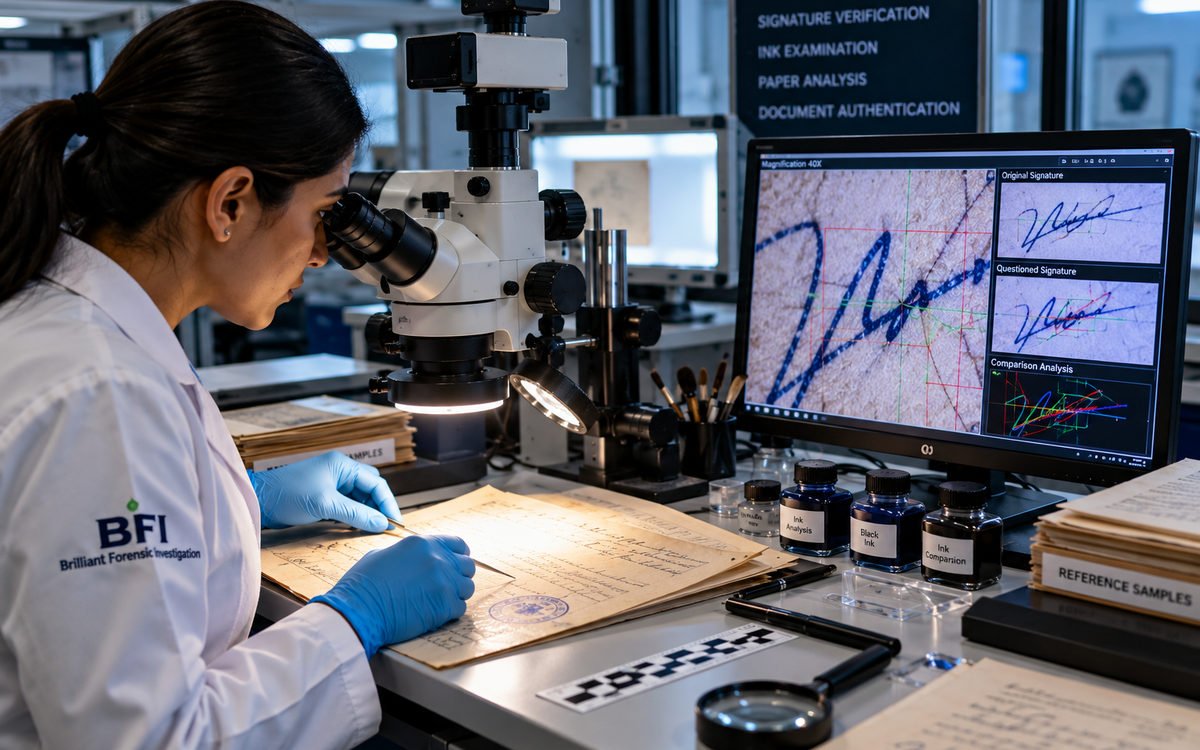
BFI examines handwriting and signatures through structured comparison of writing characteristics, natural variation, line quality, letter formation, spacing, proportions, connecting strokes, pen movement, rhythm and other relevant features. Where the evidence permits, questioned writing can be compared with suitable known or admitted writing samples to assess whether the writings demonstrate significant similarities or differences.
Forensic handwriting examination is not simply a matter of looking at whether two samples appear alike. It involves evaluating the questioned material, assessing whether the available samples are sufficient and suitable, examining the range of natural variation and comparing corresponding handwriting characteristics. Current forensic standards specifically address examinations and comparisons of questioned and known handwritten items and require consideration of whether the material available is sufficient for examination.
BFI approaches each case objectively. The purpose is to determine what the handwriting evidence can reasonably establish—not to begin with a predetermined conclusion.
What Is Forensic Graphology?
The term Forensic Graphology is commonly searched by people looking for professional handwriting analysis. In forensic practice, however, it is important to distinguish handwriting-based personality interpretation from forensic handwriting examination.
Forensic handwriting examination is concerned primarily with questions such as authorship, authenticity, comparison, simulation, disguise and the relationship between questioned and known writings. The examination may help determine whether questioned handwriting is consistent or inconsistent with writing attributed to a known person.
BFI uses the term Forensic Graphology to describe its handwriting-focused forensic services while applying a forensic-document examination approach to matters involving disputed documents, signatures and handwriting.
The examination is based on observable writing characteristics rather than assumptions about the writer.
A person’s handwriting naturally contains both common features and individual variations. The examiner therefore does not expect genuine writing from the same person to be identical every time. Instead, the examination considers whether similarities and differences fall within a plausible range of natural variation and whether the overall pattern of characteristics supports or contradicts a proposed common source.
Forensic Graphology vs. Personality Graphology
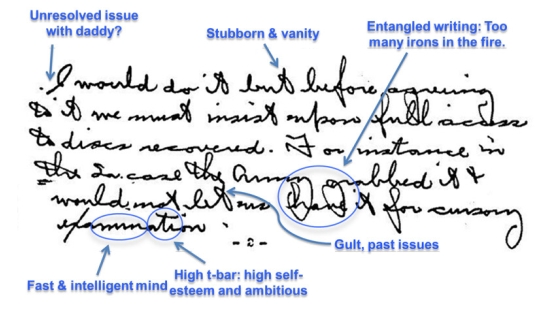
Handwriting is sometimes marketed as a way to determine personality, intelligence, mental health, criminal tendencies, honesty, future behaviour or emotional condition.
These claims should not be confused with forensic handwriting examination.
Published research has found little or no convincing evidence that traditional graphology can reliably measure personality traits from handwriting alone. Studies examining predicted personality characteristics have reported weak or unsuccessful validation, including low agreement between graphologists in some research.
For that reason, BFI does not present handwriting examination as a substitute for psychological assessment or clinical evaluation. BFI does not diagnose mental illness, determine criminal personality, establish guilt, or claim that a particular handwriting style automatically proves a psychological condition.
Where a client requires a forensic opinion, BFI concentrates on questions that can be addressed through the available handwriting and document evidence.
This distinction makes the examination more scientifically defensible and more useful for legal and investigative applications.
BFI Forensic Handwriting Examination Services
Handwriting Identification & Authorship Examination
When a document contains questioned handwriting, one of the central forensic questions is whether the writing may have been produced by a particular person.
BFI can compare questioned handwriting with appropriate known or admitted specimens and evaluate similarities, differences, natural variation and distinctive characteristics.
The examination may consider letter construction, connecting strokes, proportions, spacing, baseline behaviour, slant, writing movement, line quality, terminal strokes, beginning strokes, pen lifts, rhythm and other features that are appropriate to the material.
A conclusion depends on the quantity and quality of the writing available. Ideally, the questioned material should contain sufficient writing and the known material should be representative of the person’s natural writing range. Research on forensic handwriting comparison also emphasizes the importance of original, naturally produced and sufficiently comparable specimens.
BFI therefore evaluates the suitability of the evidence before treating it as sufficient for a meaningful comparison.
Disputed Handwriting Examination
A disputed handwriting case arises when the authorship of written material is challenged.
The dispute may concern a handwritten statement, agreement, property document, letter, diary entry, financial record, personal note or other written material.
BFI examines the questioned writing and available reference specimens to assess whether the characteristics are consistent with the proposed writer.
A professional comparison does not depend upon one letter or one visual feature. Individual handwriting habits can vary because of writing speed, writing position, writing surface, writing instrument, fatigue, physical condition and other circumstances. Forensic practice therefore considers multiple characteristics and the natural range of variation rather than relying upon a single distinctive-looking letter.
Signature Verification & Signature Examination
A signature may be one of the most important features on a legal or financial document.
BFI provides forensic signature examination for questioned signatures appearing on wills, agreements, cheques, contracts, property documents, financial papers, authorizations and other records.
The examination can consider features such as:
Stroke formation and direction
Line quality
Writing movement
Pen lifts
Connections between strokes
Proportion and spacing
Baseline characteristics
Speed and fluency
Natural variation
Unusual hesitation or tremor
Evidence consistent with tracing or simulation
Consistency with suitable genuine specimens
A genuine signature does not have to be visually identical every time it is written. Natural variation is expected. A forensic examination therefore seeks to distinguish natural variation from characteristics that may be inconsistent with the proposed writer.
BFI reports findings based on the material supplied and does not force a definitive conclusion where the evidence is insufficient.
Forged Handwriting Examination
Handwriting forgery can involve a variety of methods.
A person may attempt to imitate another person’s writing, trace an existing signature, copy a signature from another document, slowly simulate a writing style, reproduce selected characteristics, or combine different methods.
BFI can examine questioned handwriting and signatures for characteristics potentially associated with simulation, tracing, unnatural execution or other forms of questioned writing.
An important feature of forensic examination is understanding that a good forgery may reproduce visible characteristics while failing to reproduce the natural writing movement that produced them.
The examiner therefore looks beyond superficial appearance and considers the relationship between writing features, movement, line quality, structure and natural variation.
Traced Signature & Simulated Signature Analysis
A traced signature may contain characteristics that differ from naturally executed handwriting.
The writing may show unnatural hesitation, interrupted movement, unusual pen control, inappropriate stroke direction or other characteristics that require examination.
A simulated signature may be produced by studying another person’s genuine signature and attempting to reproduce its appearance without naturally reproducing the underlying writing movement.
BFI can examine questioned signatures for characteristics that may assist in distinguishing naturally produced writing from potentially simulated or traced writing.
The exact conclusion depends on the quality of the questioned signature and the quantity and quality of suitable genuine reference material.
Disguised Handwriting Examination
A person may intentionally change handwriting characteristics to conceal authorship.
Disguised writing can involve changes in slant, letter formation, size, spacing, writing speed, connections or other habitual features.
This creates a difficult forensic problem because handwriting naturally changes under different circumstances even when there is no intention to disguise it.
BFI can examine questioned writing for internal consistency, unusual variation and other features relevant to an examination of possible disguise.
Where sufficient material is available, a comparison with known writing can help determine whether apparently different writings may nevertheless demonstrate meaningful similarities.
Anonymous Handwriting Examination
Anonymous letters and handwritten messages may become important evidence in investigations involving threats, blackmail, harassment, extortion, fraud or disputed communications.
BFI provides forensic examination of anonymous handwriting to assess whether questioned writing can be meaningfully compared with known specimens.
The purpose of the examination is to address the source of the handwriting rather than to make unsupported assumptions about the author’s motives or personality.
An anonymous note may be examined for handwriting characteristics, writing style and other relevant features, while additional document examination may be required when questions concern paper, ink, alterations or the method by which the document was produced.
Threatening Letter & Blackmail Note Examination
Threatening letters and blackmail notes can contain significant forensic information.
BFI can examine the handwriting and signature characteristics appearing in questioned letters and compare them with suitable known writing when such material is available.
The examination may be relevant to cases involving anonymous communications, coercive messages, extortion-related documents or other disputed handwritten material.
The existence of unusual handwriting does not by itself establish the identity of the writer. The strength of a source opinion depends on the quality and comparability of the evidence available for examination.
Handwritten Suicide Note Examination
A questioned suicide note may raise several separate forensic questions.
One question may concern whether the handwriting is consistent with the deceased person’s known writing. Another may concern whether portions of the note appear to have been altered or added. Additional questions may concern the paper, ink, printing, sequence or circumstances in which the document was produced.
BFI can conduct handwriting and document examination directed toward the specific question presented.
BFI does not use handwriting alone to diagnose the writer’s mental state or to declare a psychological condition. Handwriting evidence can address handwriting and document questions; it should not be presented as a substitute for a complete psychological or medico-legal investigation.
Will & Testament Handwriting Examination
Disputed wills can have significant financial and legal consequences.
BFI can examine handwriting and signatures appearing on wills and related documents when questions arise concerning authorship, signature authenticity, additions, alterations or other disputed writing.
A will examination may compare questioned signatures or handwritten sections with suitable genuine reference material and assess the writing characteristics in context.
When a dispute concerns whether text was added after the document was originally prepared, handwriting comparison alone may not answer every question. Document alteration, ink, sequence and physical examination may need to be considered separately.
Cheque & Financial Document Handwriting Examination
Financial documents can be targeted in fraud and forgery cases.
BFI can examine handwriting and signatures appearing on cheques, payment instructions, receipts, financial records and related documents.
The examination may address questioned signatures, handwritten entries, alterations, additions, overwriting or other features relevant to authenticity.
Where the original physical document is available, examination can provide more information than analysis of a photocopy or scanned image.
For this reason, BFI recommends preserving the original document whenever possible.
Property Document Handwriting Examination
Property transactions can involve agreements, deeds, acknowledgements, declarations, powers of attorney and other documents containing handwritten entries or signatures.
When such writing is disputed, BFI can conduct forensic handwriting and signature examination to assess the questioned material against appropriate known specimens.
The examination can help address whether the questioned writing is consistent with the attributed writer and whether additional document examination may be required.
BFI can also assist with broader document examination when a dispute includes suspected alterations, additions, erasures or other physical changes.
Contract & Agreement Handwriting Examination
Contracts and agreements may become disputed when one party denies signing or writing a particular portion of the document.
BFI can examine signatures, handwritten clauses, initials, dates and other questioned writing contained within contracts and agreements.
Where multiple documents are available, comparisons can be made between questioned writing and suitable reference material.
The examination should always distinguish between what the handwriting evidence can establish and questions that require other forms of evidence.
Handwriting Alteration & Addition Examination
A document may be genuine in general appearance but contain a disputed addition, overwriting or replacement.
BFI can examine questioned portions of documents for physical and handwriting characteristics that may assist in determining whether an entry is consistent with the surrounding document.
The examination may include consideration of line quality, writing sequence, intersections, spacing, alignment, ink characteristics and other document features where appropriate.
When the question concerns alterations rather than authorship alone, a broader questioned-document examination may provide stronger evidence.
Erasure, Overwriting & Modification Examination
Physical and chemical alterations can change the appearance or meaning of a document.
BFI can examine questioned documents for indications of erasure, overwriting, additions, obliteration or other forms of modification.
The appropriate examination method depends on the material and the specific issue.
Some alterations can be assessed visually and microscopically, while others may require specialized examination of the document, ink or writing sequence.
The original document is generally preferable because copies can hide important physical characteristics.
Examination of Writing Characteristics
BFI can examine multiple characteristics of questioned handwriting, including:
Letter Formation
The way individual letters are formed can provide comparative information, particularly when the same unusual construction appears across suitable writings.
Slant
Writing may display consistent or variable directional tendencies. Slant is examined in context rather than treated as an identity marker on its own.
Size and Proportion
Relative letter height, width and proportions may provide useful comparative information when appropriate material is available.
Spacing
Spacing between letters, words and lines may contribute to the overall handwriting pattern.
Baseline Behaviour
The relationship of writing to the baseline can be examined as one of many comparative characteristics.
Connecting Strokes
The way letters and components connect can provide information about writing movement and habitual execution.
Pen Lifts
The locations and frequency of pen lifts can contribute to comparison, particularly where the writer demonstrates distinctive habits.
Line Quality
Fluency, smoothness, hesitation and other line characteristics can be examined in combination with the wider handwriting pattern.
Writing Rhythm & Movement
The dynamic aspects of writing can sometimes provide useful evidence when sufficient original material is available.
No single characteristic should normally be treated as sufficient on its own. The overall combination of features is what matters.
Handwriting Examination of Photocopied Documents
Photocopies can sometimes be examined, but they are not equivalent to original documents.
Copying may remove fine detail, introduce distortion, change contrast and eliminate information about ink, pressure or physical interaction with the paper.
BFI can examine a photocopy when no original is available, but the limitations created by reproduction are taken into account.
Where the available copy does not contain sufficient information, BFI may recommend obtaining a better-quality reproduction or the original document.
Does Handwriting Analysis Prove Who Wrote a Document?
A handwriting examination can provide an expert opinion concerning whether questioned and known writings demonstrate sufficient agreement or disagreement to support a source conclusion.
However, no responsible examination should guarantee certainty before the evidence is examined.
The reliability of the conclusion can be affected by the amount and quality of writing, similarity of writing conditions, distortion, availability of genuine standards and other case-specific factors. Research into handwriting comparison also identifies the importance of sufficient, original and representative comparison material.
BFI therefore assesses the evidence first and states the conclusion at an appropriate level of confidence.
Is Handwriting Unique to Every Person?
Handwriting contains individual habits, but it is not correct to assume that every writing sample is completely unique in every visible feature.
Many people can share common handwriting characteristics because of schooling, writing systems, language and other influences.
Forensic handwriting examination therefore relies upon the combination and pattern of characteristics, including meaningful similarities and differences, rather than claiming that one isolated feature is unique to one individual.
This is why professional comparison involves systematic examination rather than simply placing two signatures side by side and judging which one “looks similar.”
Can a Person Change Their Handwriting?
Yes. Handwriting naturally varies, and an individual can also intentionally alter writing habits.
A person may change writing speed, size, slant, spacing, letter construction or other characteristics.
The existence of variation therefore does not automatically demonstrate disguise or forgery.
Forensic examination considers whether the observed differences fall within the writer’s known range of variation or whether they are sufficiently inconsistent to require another explanation.
Can Disguised Handwriting Be Identified?
In some cases, yes.
The examination may identify internal inconsistencies, unusual combinations of characteristics, indications of unnatural execution or similarities to known writing that become apparent when the writing is examined as a whole.
However, disguised writing can be difficult, particularly when the available questioned writing is short or distorted.
The suitability of the evidence is therefore a fundamental part of the examination.
Forensic Graphology & Personality Assessment
Because the term “graphology” is commonly associated with personality analysis, BFI receives inquiries concerning whether handwriting can reveal personality or behavioural characteristics.
Scientific research has not established traditional graphology as a dependable standalone method for measuring personality traits. For example, empirical studies examining handwriting-based personality predictions have found weak or unsuccessful validation.
For this reason, BFI does not represent handwriting analysis as a diagnostic psychological instrument.
Where handwriting observations are discussed for educational, exploratory or general-interest purposes, they should be understood as non-diagnostic interpretations, not scientific proof of personality, mental health, intelligence or future conduct.
For legal and forensic matters, BFI gives priority to examination questions that can be addressed through forensic document and handwriting evidence.
Why Choose BFI for Forensic Graphology Services?
BFI combines the public-facing accessibility of handwriting analysis with the disciplined approach required for forensic document examination.
The service is designed around the evidence rather than a predetermined result.
BFI considers the suitability of the material, the quality of comparison specimens, natural handwriting variation and the specific forensic question before forming an opinion.
BFI also recognizes an important principle: a scientifically responsible examiner must be willing to say when the evidence is insufficient.
That approach helps protect clients from exaggerated claims and ensures that the forensic opinion remains connected to the actual evidence.
Get a Confidential Forensic Handwriting Consultation from BFI
When the authenticity of a signature or handwriting is disputed, visual opinion alone may not be enough.
BFI provides Forensic Graphology Services, Forensic Handwriting Examination, Signature Verification, Disguised Handwriting Examination, Anonymous Handwriting Analysis and Questioned Document Examination for legal, investigative, corporate and private matters.
BFI examines the evidence systematically, considers natural handwriting variation, evaluates the adequacy of comparison material and reports conclusions according to the strength of the available evidence.
Whether you are dealing with a disputed signature, suspected forged will, questioned agreement, anonymous letter, financial-document dispute, threatening note or another handwriting-related matter, BFI can assess the evidence and identify the appropriate forensic examination.
Do not rely on appearance alone when the authenticity of handwriting matters. Let BFI examine the evidence.

📞 Contact Us: 9990292279
🌐 Visit Our Website: https://forensicexpertinvestigation.com/
✉️ Email: ceo.bfi@gmail.com
Frequently Asked Questions About Forensic Graphology
-
What is forensic graphology?
Forensic graphology is a commonly used term for handwriting-focused forensic analysis. In legal and investigative practice, the more precise discipline is forensic handwriting examination or questioned document examination, which focuses on questions such as authorship, authenticity and comparison.
-
Is forensic graphology the same as handwriting analysis?
The terms are sometimes used interchangeably in public-facing services, but “forensic handwriting examination” is more precise for legal and evidentiary work.
-
Can BFI identify disguised handwriting?
BFI can examine questioned writing for features relevant to possible disguise and compare it with suitable known writing when adequate material is available.
-
How many handwriting samples are required?
There is no universal number that guarantees a valid conclusion. The important issue is whether the available samples are authentic, sufficient, representative and comparable to the questioned writing.
-
Can a forensic handwriting report be used in court?
A handwriting expert's opinion can be relevant to questions of handwriting identity under Section 39 of the Bharatiya Sakshya Adhiniyam, 2023, but the final evidentiary treatment depends on the applicable legal process and the court.
Forensic Graphology Services In India
Forensic Graphology Expert Services in Andaman and Nicobar Islands (union territory)-Port Blair | Forensic Graphology Expert Services in Andhra Pradesh – Adoni, Amaravati, Anantapur, Chandragiri, Chittoor, Dowlaiswaram, Eluru, Guntur, Kadapa, Kakinada, Kurnool, Machilipatnam, Nagarjunakoṇḍa, Rajahmundry, Srikakulam, Tirupati, Vijayawada, Visakhapatnam, Vizianagaram, Yemmiganur | Forensic Graphology Expert Services in Arunachal Pradesh – Itanagar | Forensic Graphology Expert Services in Assam – Dhuburi, Dibrugarh, Dispur, Guwahati, Jorhat, Nagaon, Sivasagar, Silchar, Tezpur, Tinsukia | Forensic Graphology Expert Services in Bihar – Ara, Barauni, Begusarai, Bettiah, Bhagalpur, Bihar Sharif, Bodh Gaya, Buxar, Chapra, Darbhanga, Dehri, Dinapur Nizamat, Gaya, Hajipur, Jamalpur, Katihar, Madhubani, Motihari, Munger, Muzaffarpur, Patna, Purnia, Pusa, Saharsa, Samastipur, Sasaram, Sitamarhi, Siwan | Forensic Graphology Expert Services in Chandigarh (union territory) – Chandigarh | Forensic Graphology Expert Services in Chhattisgarh – Ambikapur, Bhilai, Bilaspur, Dhamtari, Durg, Jagdalpur, Raipur, Rajnandgaon | Forensic Graphology Expert Services in Dadra and Nagar Haveli and Daman and Diu (union territory) – Daman, Diu, Silvassa | Forensic Graphology Expert Services in Delhi (national capital territory) – Delhi, New Delhi |Forensic Graphology Expert Services in Goa – Madgaon, Panaji | Corporate Crime Scene Investigation – Services in Gujarat – Ahmadabad, Amreli, Bharuch, Bhavnagar, Bhuj, Dwarka, Gandhinagar, Godhra, Jamnagar, Junagadh, Kandla, Khambhat, Kheda, Mahesana, Morbi, Nadiad, Navsari, Okha, Palanpur, Patan, Porbandar, Rajkot, Surat, Surendranagar, Valsad, Veraval | Forensic Graphology Expert Services in Haryana – Ambala, Bhiwani, Chandigarh, Faridabad, Firozpur Jhirka, Gurugram, Hansi, Hisar, Jind, Kaithal, Karnal, Kurukshetra, Panipat, Pehowa, Rewari, Rohtak, Sirsa, Sonipat | Forensic Graphology Expert Services in Himachal Pradesh – Bilaspur, Chamba, Dalhousie, Dharmshala, Hamirpur, Kangra, Kullu, Mandi, Nahan, Shimla, Una | Forensic Graphology Expert Services in Jammu and Kashmir (union territory) – Anantnag, Baramula, Doda, Gulmarg, Jammu, Kathua, Punch, Rajouri, Srinagar, Udhampur | Forensic Graphology Expert Services in Jharkhand – Bokaro, Chaibasa, Deoghar, Dhanbad, Dumka, Giridih, Hazaribag, Jamshedpur, Jharia, Rajmahal, Ranchi, Saraikela | Forensic Graphology Expert Services in Karnataka – Badami, Ballari, Bengaluru, Belagavi, Bhadravati, Bidar, Chikkamagaluru, Chitradurga, Davangere, Halebid, Hassan, Hubballi-Dharwad, Kalaburagi, Kolar, Madikeri, Mandya, Mangaluru, Mysuru, Raichur, Shivamogga, Shravanabelagola, Shrirangapattana, Tumakuru, Vijayapura | Forensic Graphology Expert Services in Kerala – Alappuzha, Vatakara, Idukki, Kannur, Kochi, Kollam, Kottayam, Kozhikode, Mattancheri, Palakkad, Thalassery, Thiruvananthapuram, Thrissur | Forensic Graphology Expert Services in Ladakh (union territory) – Kargil, Leh | Forensic Graphology Expert Services in Madhya Pradesh – Balaghat, Barwani, Betul, Bharhut, Bhind, Bhojpur, Bhopal, Burhanpur, Chhatarpur, Chhindwara, Damoh, Datia, Dewas, Dhar, Dr. Ambedkar Nagar (Mhow), Guna, Gwalior, Hoshangabad, Indore, Itarsi, Jabalpur, Jhabua, Khajuraho, Khandwa, Khargone, Maheshwar, Mandla, Mandsaur, Morena, Murwara, Narsimhapur, Narsinghgarh, Narwar, Neemuch, Nowgong, Orchha, Panna, Raisen, Rajgarh, Ratlam, Rewa, Sagar, Sarangpur, Satna, Sehore, Seoni, Shahdol, Shajapur, Sheopur, Shivpuri, Ujjain, Vidisha | Forensic Graphology Expert Services in Maharashtra – Ahmadnagar, Akola, Amravati, Aurangabad, Bhandara, Bhusawal, Bid, Buldhana, Chandrapur, Daulatabad, Dhule, Jalgaon, Kalyan, Karli, Kolhapur, Mahabaleshwar, Malegaon, Matheran, Mumbai, Nagpur, Nanded, Nashik, Osmanabad, Pandharpur, Parbhani, Pune, Ratnagiri, Sangli, Satara, Sevagram, Solapur, Thane, Ulhasnagar, Vasai-Virar, Wardha, Yavatmal |Forensic Graphology Expert Services in Manipur – Imphal | Forensic Graphology Expert Services in Meghalaya – Cherrapunji, Shillong | Forensic Graphology Expert Services in Mizoram – Aizawl, Lunglei | Forensic Graphology Expert Services in Nagaland – Kohima, Mon, Phek, Wokha, Zunheboto | Forensic Graphology Expert Services in Odisha – Balangir, Baleshwar, Baripada, Bhubaneshwar, Brahmapur, Cuttack, Dhenkanal, Kendujhar, Konark, Koraput, Paradip, Phulabani, Puri, Sambalpur, Udayagiri | Forensic Graphology Expert Services in Puducherry (union territory) – Karaikal, Mahe, Puducherry, Yanam | Forensic Graphology Expert Services in Punjab – Amritsar, Batala, Chandigarh, Faridkot, Firozpur, Gurdaspur, Hoshiarpur, Jalandhar, Kapurthala, Ludhiana, Nabha, Patiala, Rupnagar, Sangrur | Forensic Graphology Expert Services in Rajasthan – Abu, Ajmer, Alwar, Amer, Barmer, Beawar, Bharatpur, Bhilwara, Bikaner, Bundi, Chittaurgarh, Churu, Dhaulpur, Dungarpur, Ganganagar, Hanumangarh, Jaipur, Jaisalmer, Jalor, Jhalawar, Jhunjhunu, Jodhpur, Kishangarh, Kota, Merta, Nagaur, Nathdwara, Pali, Phalodi, Pushkar, Sawai Madhopur, Shahpura, Sikar, Sirohi, Tonk, Udaipur | Forensic Graphology Expert Services in Sikkim – Gangtok, Gyalshing, Lachung, Mangan | Forensic Graphology Expert Services in Tamil Nadu – Arcot, Chengalpattu, Chennai, Chidambaram, Coimbatore, Cuddalore, Dharmapuri, Dindigul, Erode, Kanchipuram, Kanniyakumari, Kodaikanal, Kumbakonam, Madurai, Mamallapuram, Nagappattinam, Nagercoil, Palayamkottai, Pudukkottai, Rajapalayam, Ramanathapuram, Salem, Thanjavur, Tiruchchirappalli, Tirunelveli, Tiruppur, Thoothukudi, Udhagamandalam, Vellore | Forensic Graphology Expert Services in Telangana – Hyderabad, Karimnagar, Khammam, Mahbubnagar, Nizamabad, Sangareddi, Warangal | Forensic Graphology Expert Services in Tripura – Agartala | Forensic Graphology Expert Services in Uttar Pradesh – Agra, Aligarh, Amroha, Ayodhya, Azamgarh, Bahraich, Ballia, Banda, Bara Banki, Bareilly, Basti, Bijnor, Bithur, Budaun, Bulandshahr, Deoria, Etah, Etawah, Faizabad, Farrukhabad-cum-Fatehgarh, Fatehpur, Fatehpur Sikri, Ghaziabad, Ghazipur, Gonda, Gorakhpur, Hamirpur, Hardoi, Hathras, Jalaun, Jaunpur, Jhansi, Kannauj, Kanpur, Lakhimpur, Lalitpur, Lucknow, Mainpuri, Mathura, Meerut, Mirzapur-Vindhyachal, Moradabad, Muzaffarnagar, Partapgarh, Pilibhit, Prayagraj, Rae Bareli, Rampur, Saharanpur, Sambhal, Shahjahanpur, Sitapur, Sultanpur, Tehri, Varanasi | Forensic Graphology Expert Services in Uttarakhand – Almora, Dehra Dun, Haridwar, Mussoorie, Nainital, Pithoragarh | Forensic Graphology Expert Services in West Bengal – Alipore, Alipur Duar, Asansol, Baharampur, Bally, Balurghat, Bankura, Baranagar, Barasat, Barrackpore, Basirhat, Bhatpara, Bishnupur, Budge Budge, Burdwan, Chandernagore, Darjeeling, Diamond Harbour, Dum Dum, Durgapur, Halisahar, Haora, Hugli, Ingraj Bazar, Jalpaiguri, Kalimpong, Kamarhati, Kanchrapara, Kharagpur, Cooch Behar, Kolkata, Krishnanagar, Malda, Midnapore, Murshidabad, Nabadwip, Palashi, Panihati, Purulia, Raiganj, Santipur, Shantiniketan, Shrirampur, Siliguri, Siuri, Tamluk, Titagarh.
Forensic Graphology In India Services in Various Major Cities of India
Brilliant Forensic Investigation (BFI) provides forensic investigation and expert services across major cities and regions in India, including Mumbai, New Delhi, Bangalore, Hyderabad, Ahmedabad, Chennai, Kolkata, Surat, Pune, Jaipur, Lucknow, Kanpur, Nagpur, Indore, Thane, Bhopal, Visakhapatnam, Pimpri-Chinchwad, Patna, Vadodara, Ghaziabad, Ludhiana, Agra, Nashik, Meerut, Kalyan-Dombivali, Vasai-Virar, Varanasi, Srinagar, Aurangabad, Dhanbad, Amritsar, Navi Mumbai, Allahabad, Howrah, Ranchi, Gwalior, Coimbatore, Vijayawada, Jodhpur, Madurai, Raipur, Kota, Chandigarh, Guwahati, Solapur, Hubballi-Dharwad, Nellore, Bhavnagar, Dehradun, Durgapur, Asansol, Rourkela, Nanded, Kolhapur, Ajmer, Akola, Gulbarga, Mangalore, Erode, Belgaum, Ambattur, Tirunelveli, Malegaon, Gaya, Jalgaon, Udaipur, Maheshtala, Davanagere, Kozhikode, Kurnool, Rajpur-Sonarpur, Bhatpara, Rajahmundry, Bokaro, South Dumdum, Bellary, Patiala, Gopalpur, Agartala, Bhagalpur, Muzaffarnagar, Ahmednagar, Mathura, Kollam, Avadi, Kadapa, Kamarhati, Sambalpur, Bilaspur, Shahjahanpur, Satara, Bijapur, Rampur, Shivamogga, Chandrapur, Junagadh, Thrissur, Alwar, Bardhaman, Kulti, Kakinada, Nizamabad, Parbhani, Tumkur, Khammam, Ozhukarai, Bihar Sharif, Panipat, Darbhanga, Bally, Aizawl, Dewas, Ichalkaranji, Karnal, Bathinda, Jalna, Eluru, Kirari Suleman Nagar, Mehsana, Durg, Barasat, Purnia, Satna, Mau, Sonipat, Farrukhabad, Sagar, Imphal, Ratlam, Hapur, Begusarai, Gandhidham, Baranagar, Tiruvottiyur, Puducherry, Sikar, Thoothukudi, Rewa, Mirzapur, Raichur, Pali, Ramagundam, Haridwar, Thanjavur, Bulandshahr, Uluberia, Murwara, Sambhal, Singrauli, Nadiad, Secunderabad, Naihati, Bidhannagar, Pallavaram, Bidar, Munger, Panchkula, Burhanpur, Raurkela Industrial Township, Chittoor, Jehanabad, Kharagpur, Dindigul, Gandhinagar, Hospet, Nangloi Jat, Malda, Ongole, Deoghar, Chapra, Haldia, Khandwa, Nandyal, Morena, Amroha, Anand, Bhind, Bhalswa Jahangir Pur, Rae Bareli, Madhyamgram, Bhiwani, Panvel, Baharampur, Ambala, Morbi, Fatehpur, Mahabubnagar, Bhusawal, Orai, Bahraich, Vellore, Raiganj, Sirsa, Danapur, Serampore, Sultan Pur Majra, Guna, Jaunpur, Shivpuri, Surendranagar-Dudhrej, Kumbakonam, Dehri, Madanapalle, Phagwara, Narasaraopet, Tadipatri, Kishanganj, Karaikudi, Faridabad, Rajkot, Jabalpur, Tiruchirappalli, Bareilly, Mysore, Tiruppur, Gurgaon, Aligarh, Jalandhar, Bhubaneswar, Salem, Mira-Bhayandar, Warangal, Guntur, Bhiwandi, Saharanpur, Gorakhpur, Bikaner, Amravati, Noida, Jamshedpur, Bhilai, Cuttack, Firozabad, Kochi, Jamnagar, Ujjain, Loni, Siliguri, Jhansi, Ulhasnagar, Jammu, Sangli-Miraj-Kupwad, Thiruvananthapuram, Panihati, Latur, Dhule, Tirupati, Rohtak, Korba, Bhilwara, Berhampur, Arrah, Anantapur, Karimnagar, Etawah, Ambarnath, North Dumdum, Bharatpur, Vijayanagaram, Katihar, Nagercoil, Sri Ganganagar, Karawal Nagar, Mango, Katni, Yamunanagar, Unnao, Chinsurah, Alappuzha, Kottayam, Machilipatnam, Shimla, Adoni, Udupi, Tenali, Proddatur, Saharsa, Hindupur, Sasaram, Hajipur, Bhimavaram, Siwan, Bettiah, Guntakal, Srikakulam, Motihari, Dharmavaram, Gudivada, Suryapet, Kavali, Tadepalligudem, Amaravati, Buxar, and Gangtok, as well as Kolkata and other locations throughout West Bengal. BFI aims to support individuals, advocates, law firms, corporate organizations, insurance companies, and institutions with professional forensic investigation, scientific evidence examination, and expert consultation services, subject to service availability and case requirements.